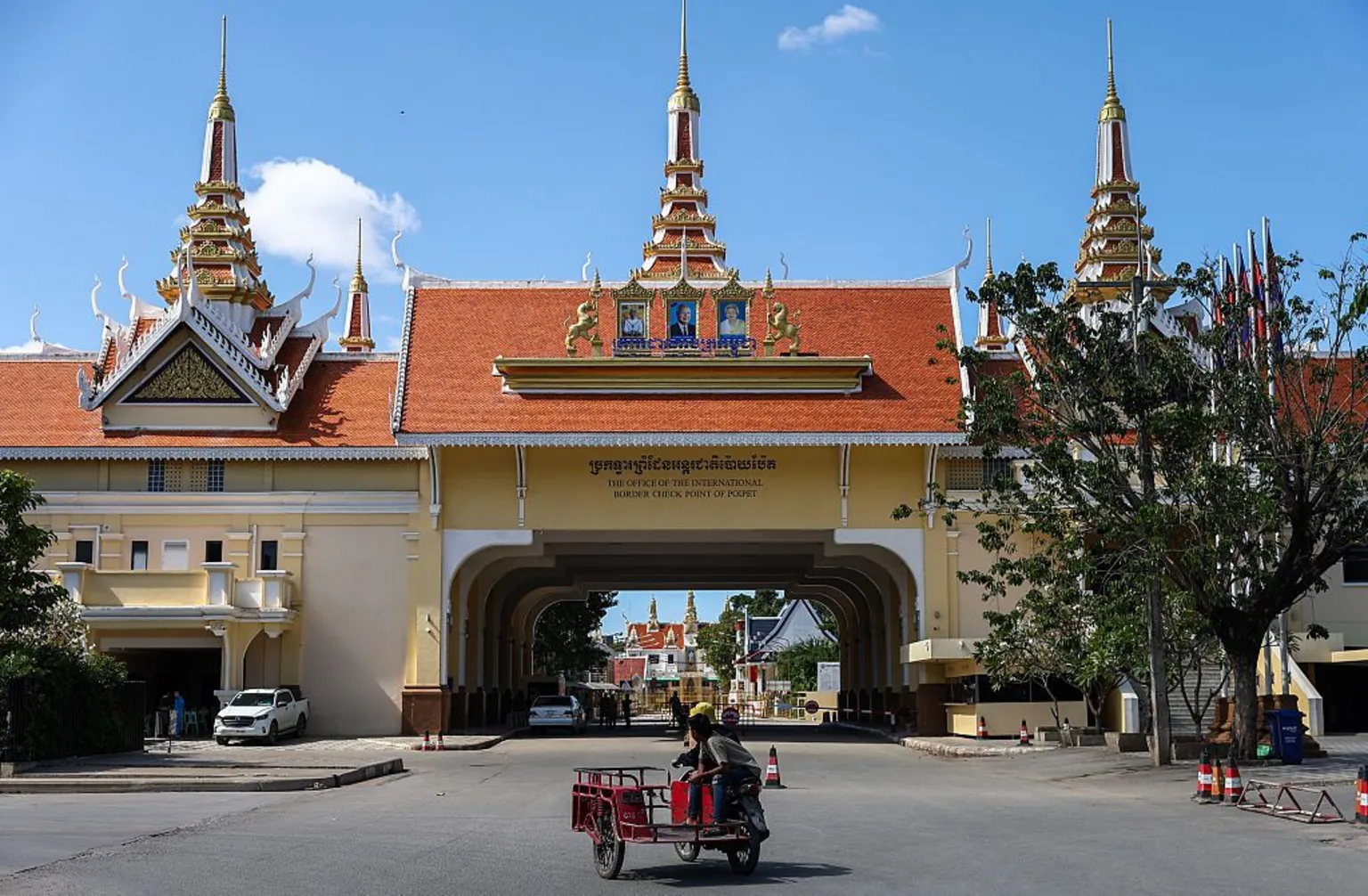
Thailand refused this month to convene the bilateral mechanism its foreign ministry has called the sole framework for resolving the border dispute with Cambodia.
Deputy Prime Minister and Foreign Minister Sihasak Phuangketkeow told reporters on April 11 that Bangkok was “not yet ready” for the Joint Boundary Commission meeting Cambodia had proposed for April 17 to 22 in Siem Reap. Thailand still needed to complete internal procedures, reconstitute its delegation, and identify a chair. The commission’s “work is highly technical,” Sihasak said, and “the chair should be someone with real expertise in international law and boundary issues.” Even if the meeting convened, he added, the delegations would first discuss procedures, not delimitation.
Cambodia had submitted five JBC-focused Note Verbales to Thailand since December 2025. The April 7 proposal Sihasak declined was the fifth. The State Secretariat of Border Affairs proposed a special JBC meeting in Siem Reap, a Joint Survey Team deployment April 20 to 24, and a 12th Operational Group meeting in the first week of May. The submission invoked the Franco-Siamese conventions and treaties and uti possidetis juris.
The JBC’s sixth session met in Phnom Penh on June 14 and 15, 2025, closing a thirteen-year gap from the fifth session in 2012. A Special JBC meeting followed in Chanthaburi on October 22. The seventh session, scheduled for January 2026, was postponed on January 8 and again on January 14 to 15. Cambodia proposed further meetings through diplomatic notes on January 5, January 13, and February 23. Thailand declined or postponed each one.
Thailand’s declaration accepting the International Court of Justice’s compulsory jurisdiction lapsed in 1960 and has not been renewed. Cambodia cannot compel adjudication of the four contested border zones at the Court. Thailand’s consent is required. None has been given. The ICJ’s prior rulings on Preah Vihear, in 1962 on the merits and in 2013 on interpretation, rested on jurisdictional bases that no longer apply. The 1962 case was filed under Thailand’s then-valid optional clause declaration. The 2013 case came under Article 60 of the Court’s Statute, which permits interpretation of prior judgments without new jurisdictional consent. The Court unanimously confirmed Cambodia’s sovereignty over the whole promontory and ordered Thailand to withdraw its military and police forces from that territory. Neither path is available for the four zones Cambodia raised in June 2025.
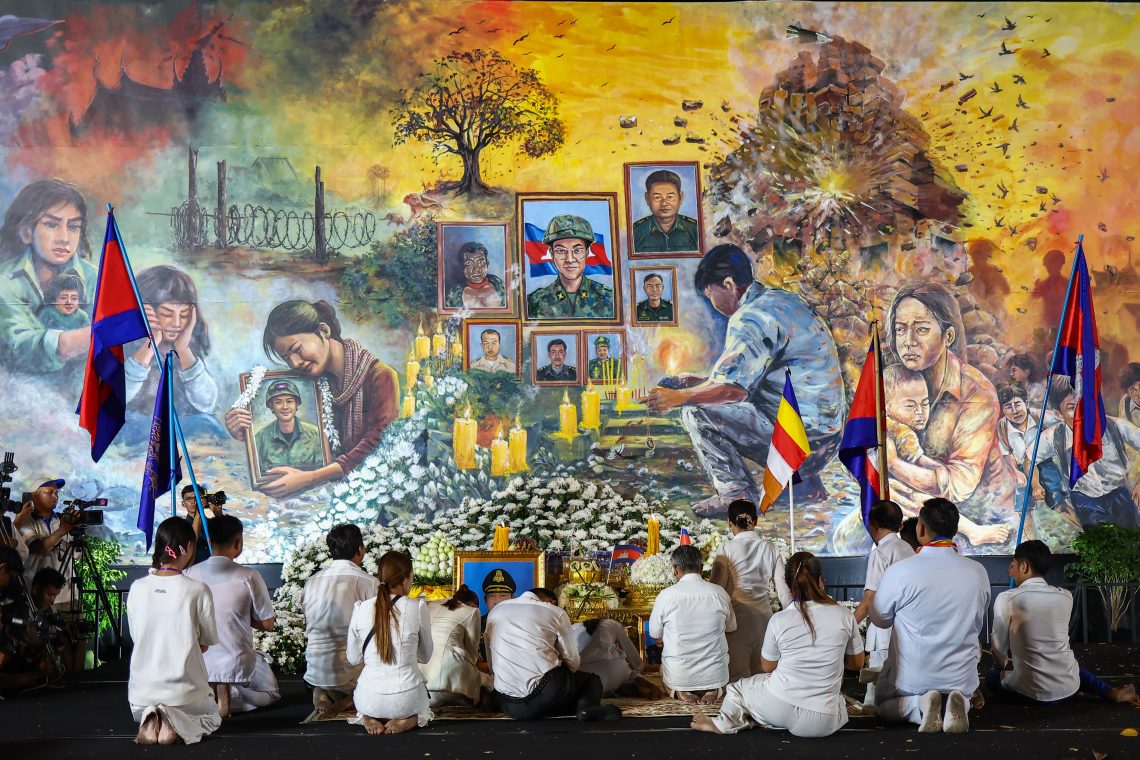
Cambodia submitted a letter to the ICJ on June 15, 2025 concerning four contested zones: the Emerald Triangle (Mom Bei), Ta Moan Thom, Ta Moan Tauch, and Ta Krabei temples. The submission followed unanimous approval from Cambodia’s Joint Congress of the National Assembly and Senate. It came eighteen days after a Cambodian soldier was killed by Thai forces at Chong Bok on May 28. Thailand declined to consent to the Court’s jurisdiction. On January 3, 2026, the Cambodian Permanent Representative to the United Nations filed identical letters to the Secretary-General and the President of the Security Council, circulated as UN document A/80/587–S/2026/7. The letter called the Council’s attention to what the Ministry of Foreign Affairs and International Cooperation described as “continued aggressive acts by Thai armed forces against Cambodia’s sovereignty and territorial integrity.” Thailand responded on January 19 with A/80/593–S/2026/37, a filing that invoked the 2000 MOU as the bilateral governing framework. In late February, Deputy Prime Minister and Foreign Minister Prak Sokhonn raised the dispute at the UN Human Rights Council in Geneva.
On February 6, 2026, Cambodia ratified the United Nations Convention on the Law of the Sea. The instrument of ratification contained an Article 298 declaration excluding maritime boundary delimitation disputes from compulsory settlement. The declaration was structured identically to the one Thailand filed in 2011. Cambodia’s ratification entered into force on March 8. Symmetrical exclusion blocks any third-party compulsory procedure over the overlapping claim area.
Prime Minister Hun Manet wrote Emmanuel Macron on February 4 requesting access to the Archives nationales d’outre-mer, specifically the Fonds de l’Indochine and the 1904 to 1907 Franco-Siamese Boundary Commission records. French Foreign Minister Jean-Noël Barrot told Sokhonn on February 25 that Paris would “facilitate access to, or the provision of” the requested documents. MOU 2000 Article I identifies the 1904 Convention, the 1907 Treaty, and the Mixed Commission’s 1:200,000 scale maps as the governing instruments for demarcation. The ICJ’s 1962 judgment referenced those same maps as Annex I. Cambodia is working inside the bilateral legal framework, using archives from the state that drew the original maps.
Thailand is moving to dismantle the framework Cambodia is working inside. Prime Minister Anutin Charnvirakul’s government policy statement, delivered to parliament on April 9 and 10, ordered the Foreign Ministry to “expedite studying how to terminate MOU 44,” the 2001 maritime overlapping claims agreement. The Thai Senate had voted unanimously on March 24 to recommend cancellation of MOU 43, the 2000 land boundary instrument. Both statements followed Thailand’s January 19 UN filing, which had relied on MOU 2000 as authoritative.
The Foreign Ministry warned against revocation in August 2025. The January 19 UN filing relied on MOU 2000 as authoritative. The same ministry called the instrument “the sole framework” on March 11, 2026. The Senate voted on March 24 to recommend cancellation of MOU 43, Thailand’s domestic name for MOU 2000. Prime Minister Anutin’s April 9 to 10 policy statement ordered termination of the 2001 maritime agreement MOU 44. Five documented institutional positions in eight months on the two bilateral MOU instruments, each pointing a different direction.
Neither MOU contains a termination clause. Any unilateral withdrawal must proceed under the Vienna Convention on the Law of Treaties Article 56, which requires twelve months’ notification and is conditioned on whether the parties intended to admit denunciation. The procedural pathway Sihasak described on April 11, Foreign Ministry proposal to the National Security Council and then to Cabinet, is a domestic process. No Article 65 notification has been filed.
“Cambodia’s decision to turn to the United Nations Security Council for assistance rather than ASEAN demonstrates a lack of trust and agency in the group.” That is the framing a Geopolitical Intelligence Services analysis published on April 17. The documents do not support it. Cambodia filed at the Council on January 3 after participating in the Special ASEAN Foreign Ministers’ Meeting of December 22 and the General Border Committee meeting of December 27, and while continuing to facilitate the ASEAN Observer Team deployment. The approach is not a binary choice between forums.
The frame that reads multi-forum engagement as ASEAN abandonment presumes ASEAN was the appropriate mechanism for a dispute over treaty interpretation, colonial-era boundary demarcation, and compulsory maritime jurisdiction. The ASEAN Charter contains no adjudicative function. The Observer Team’s mandate, set by the Kuala Lumpur Joint Declaration and operationalised through Philippine Armed Forces implementation, is ceasefire observation and verification. The AOT is not a tribunal the bloc is failing to run. It is the observation mechanism the bloc was designed to provide.
The ASEAN Observer Team deploys under dual command. A Philippine brigadier general leads AOT-Thailand. A Philippine commodore leads AOT-Cambodia. Both report to an overall two-star general. Philippine Armed Forces coordination succeeded the Malaysian-led initial deployment. Both governments have facilitated the mission. The open question is whether the team’s verification outputs are being converted into an internationally-publishable documentary record that can discipline conduct. That question is a Cambodian one, not an ASEAN one.
Thailand on April 11 was not ready to meet. Cambodia on April 20 planned a joint survey team deployment Thailand had not agreed to join. The MOU Cambodia is defending is the MOU Thailand is moving to cancel. The court that could adjudicate the boundary question is the court Thailand has not accepted for 66 years. A smaller state that files at the Security Council, ratifies the Law of the Sea with a declaration matching its neighbour’s, requests the colonial archives identified in the bilateral instrument, and continues to propose bilateral meetings its counterpart will not convene is not exhibiting absence of agency. It is doing what the architecture leaves it.