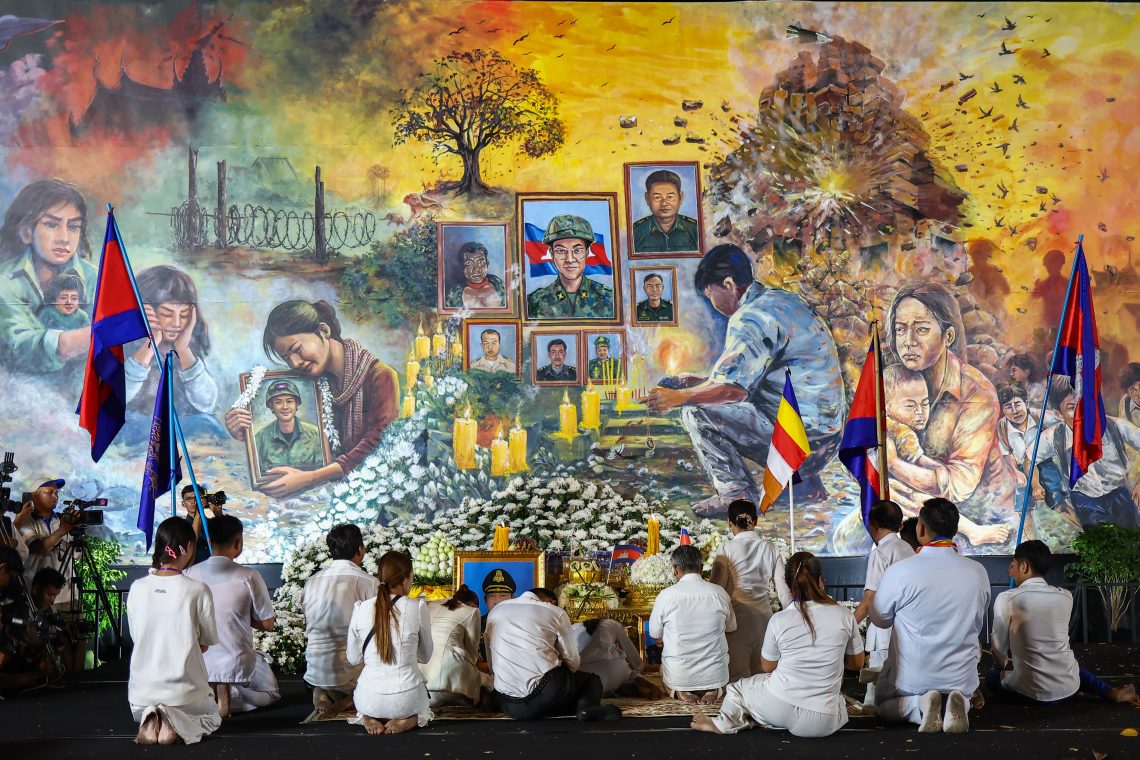
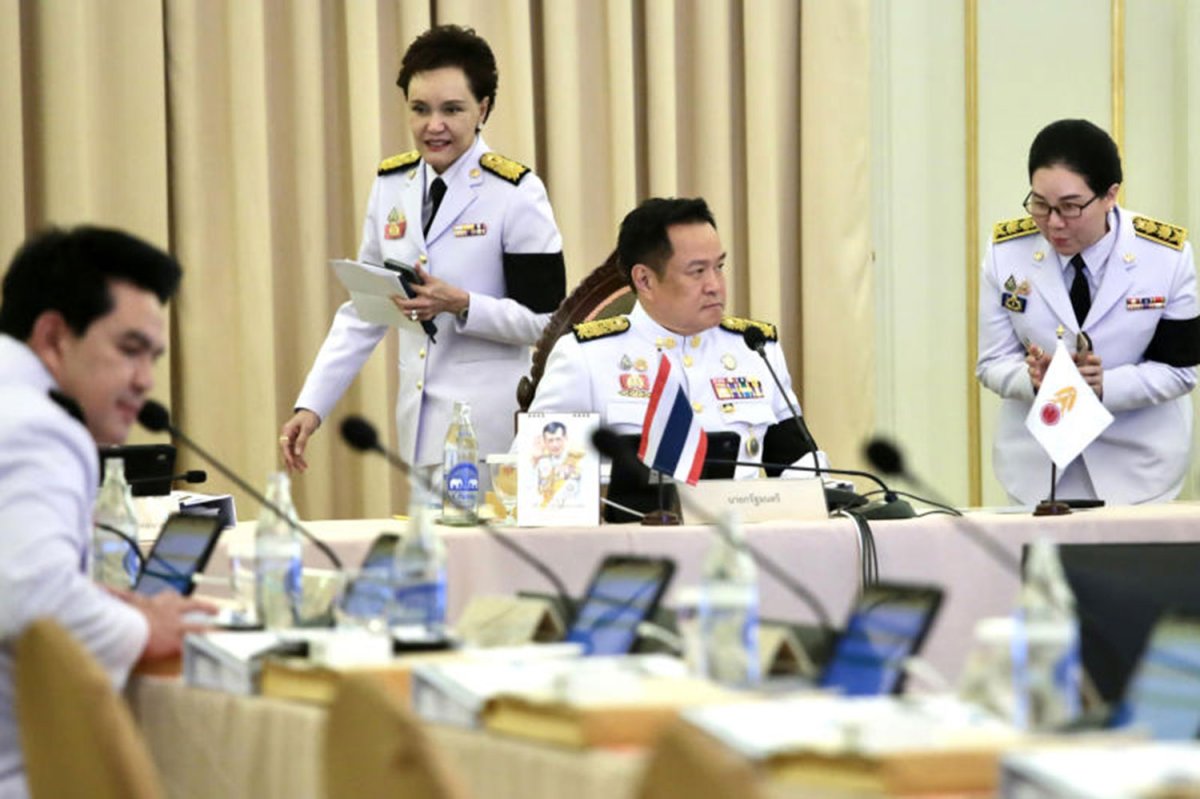
Cambodia’s National Assembly adopted the Law on Combating Online Scams on March 30, 2026. The Senate completed its constitutional review on April 3. King Norodom Sihamoni promulgated the law on April 6, the same day Thailand’s second Anutin cabinet took oath at Government House in Bangkok. The Cambodian statute prescribes 15 to 30 years of imprisonment, and life imprisonment where organising or leading a technology-enabled scam centre results in death. Article 21 commits the Kingdom to mutual legal assistance and extradition cooperation with foreign states. The law entered force immediately.
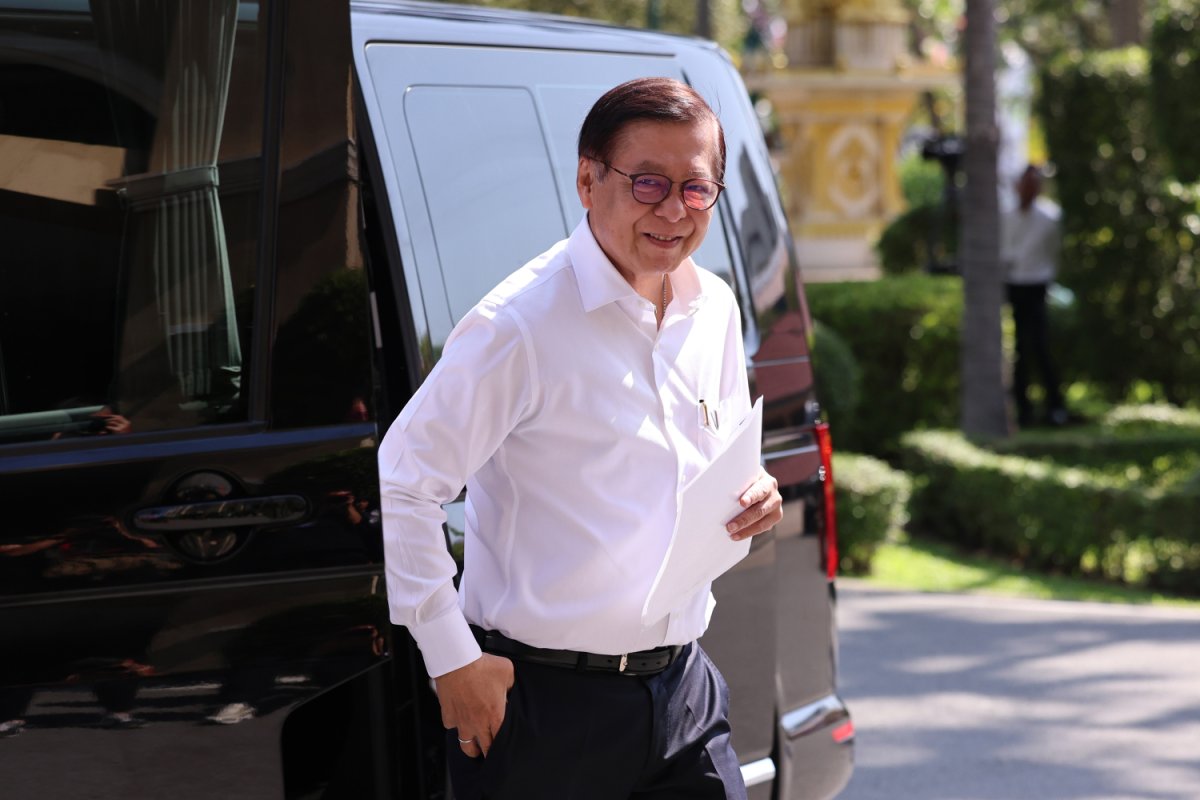
Two days later, Anutin signed Prime Minister’s Office Order distributing Thai cabinet work across eight mission groups. Thai media reporting of the order confirmed that Anutin personally took Mission Group 1, covering corruption, narcotics, human trafficking, online crime, and scam networks. Foreign Minister Sihasak Phuangketkeow received Mission Group 6, described in Thai coverage as including the memoranda of understanding the government wants reviewed or moved forward. Commerce Minister Suphajee Suthumpun leads Mission Group 5 covering commerce, agriculture, and tourism.
The following day, Anutin delivered his government’s policy statement to parliament. The 21-page document’s foreign-affairs section committed the government to “expedite studying how to terminate” the 2001 memorandum of understanding framing Cambodia-Thailand maritime boundary negotiation. The same paragraph pledged to “resolve the Thailand-Cambodia situation through peaceful bilateral mechanisms.” Anutin declined to include the 2000 land boundary MoU in the cancellation plan. 9DashLine analysis authored by William J. Jones and Thanachate Wisaijorn reported that Anutin “backed off after recognising that withdrawal would be detrimental for Thai interests,” a caution Sihasak reportedly shared.
On April 11, Cambodian Prime Minister Hun Manet spoke at the groundbreaking ceremony of Section II of the Funan Techo Integrated Water Resources Management Project in Takeo province. In what the Phnom Penh Post characterised as a shift toward “strategic patience and diplomatic pragmatism,” Hun Manet stated that while the International Court of Justice “remains a potential avenue,” the speed and efficiency of bilateral mechanisms make them the primary approach. He cited 43 of 74 border posts agreed under the MOU 2000 framework across the 874-kilometre frontier, with over 50 percent of demarcation work effectively settled. He explicitly called on Thailand to prepare its JBC team to resume work. “If the door for negotiation is still open, we must use it to avoid conflict,” he said. “Bilateral measures are the fastest way.”
The same day, Sihasak told reporters Thailand was “not yet ready” to convene the 7th JBC meeting Cambodia had proposed for April 17-22. He declined to chair the Thai JBC side himself, and said that even if the meeting were convened it “would not mean demarcation begins” but would begin with procedural discussion. The 7th JBC session had been postponed twice in January 2026. The commission had gone thirteen years between its 5th and 6th sessions.
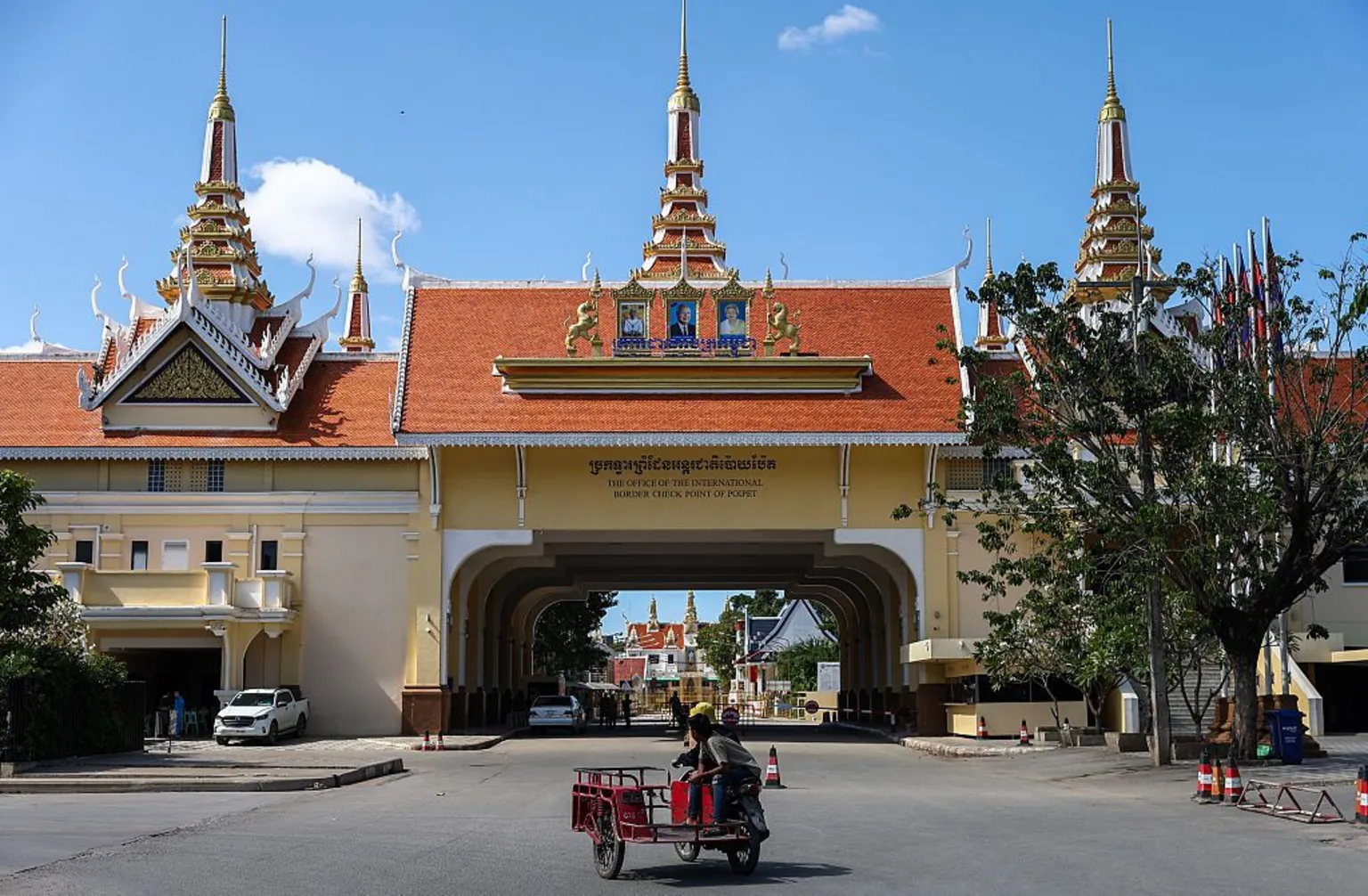
On April 16, Anutin personally confirmed that Thai border crossings with Cambodia in Chanthaburi and Trat remain shut. Royal Thai Navy Commander-in-Chief Admiral Pairot Fuangchan reinforced the position publicly, telling reporters the Navy had received no formal Cambodian request to reopen. Hun Sen, the Cambodian Senate President, had sent a close aide to Trat to negotiate reopening. The envoy was rejected.
The following day, Thailand’s King Prajadhipok’s Institute released a nationwide survey finding 50.8 percent of Thai respondents saw no ministerial group in Anutin’s cabinet offering hope for the country’s future. On personal performance, Anutin ranked fifth among cabinet ministers at 8.0 percent, behind Commerce Minister Suphajee at 14.4 percent, Higher Education Minister Yodchanan Wongsawat at 11.5 percent, and Sihasak at 9.5 percent. Twelve days earlier, the NIDA Poll of April 5 had found 46.87 percent of respondents not sympathetic at all to the government’s handling of the energy and economic crisis, with confidence readings on the three technocratic deputy prime ministers running net-negative across the board.
The bilateral architecture for the cooperation Mission Group 1 now carries within Thai government structure predates the Anutin II cabinet by seven months. At the Special General Border Committee meeting in Koh Kong on September 10, 2025, Thai Defence Minister Nattaphon Narkphanit and his Cambodian counterpart agreed five measures including the establishment within one week of a joint working group by both countries’ Interior Ministries and national police to develop an operational plan on online scam suppression. Thailand, in that same meeting, handed over coordinates of more than sixty alleged scam-centre locations in Cambodia for Cambodian suppression. Thai MFA spokesperson Nikorndej Balankura named three preconditions for border reopening: heavy weapons withdrawal, joint demining, and scam crackdown.
The 3rd Special General Border Committee Meeting of December 27, 2025 at Ban Phakkad checkpoint produced a 16-point Joint Statement signed between Nattaphon and Cambodian Defence Minister Tea Seiha. Paragraph 10 committed both parties to adhere to “the Action Plan for Cooperation on the Prevention and Suppression of Transnational Crimes, including Cyber Scams and Human Trafficking, between the Cambodian National Police and the Royal Thai Police.” The document was filed at the UN Security Council as A/80/593 S/2026/37. The ASEAN Observer Team participated as observer.
Cambodia’s April 6 statute constructed a domestic prosecution framework with universal-jurisdiction provisions covering offences committed extraterritorially by or against Cambodian nationals, and any offences routed through Cambodian banking or financial systems. The bilateral cooperation mechanism Anutin’s own defence minister signed in December 2025 remains the instrument that would operationally connect that statute to Thai enforcement. The two mechanisms have not been convened jointly at ministerial level since the second Anutin cabinet took office.
Cambodia’s April 9 Ministry of Foreign Affairs and International Cooperation statement characterised MoU 2001 as reflecting “the genuine political will and common intent of Cambodia and Thailand to pursue, in good faith, a mutually acceptable framework” and stated that Cambodia “remains firmly and consistently committed to both the letter and the spirit of MoU-2001.” Unilateral withdrawal, the ministry said, “would be deeply regrettable, as such a step would depart from the cooperative spirit underpinning the agreement.” Earlier, on March 27, the State Secretariat of Border Affairs issued a legal rebuttal to the Thai Senate vote characterising the Senate recommendations as “unfounded, contrary to international law, and driven by political motives aimed at undermining the achievements made” under MoU 2000, citing Vienna Convention Article 62(2) and the principle of uti possidetis juris. Cambodia filed Note Verbale A/80/587 S/2026/7 at the UN Security Council on January 5, 2026. Cambodia ratified UNCLOS on February 6, 2026, filing depositary notification CN.85.2026 without reservation under Article 298.
Thailand’s own foreign ministry had made a documented prior case against treaty cancellation. In November 2024, Thai MFA spokesperson Russ Jalichandra characterised MoU 44 as the “most effective tool” available for managing the overlapping maritime claims area, observed that “cancelling the MOU would not eliminate Cambodia’s territorial claims,” and confirmed that the agreement “does not require parliamentary approval under the current constitution.” That MFA position has been overtaken at cabinet level. It has not been formally retracted. On March 11, 2026, Thai MFA characterised MoU 2000 as the “sole framework” for boundary management. On March 24, the Senate Special Committee voted unanimously to recommend cancellation, invoking Vienna Convention Article 60 material breach. Thailand’s UN filing of January 19, 2026 relied on MoU 2000 as the governing framework. The institutions that speak for Thailand do not agree with each other on the instrument’s status.
Thai academics acknowledge the asymmetry in primary Thai press. Panitan Wattanayagorn told the Bangkok Post that Cambodia “has already ratified maritime legal instruments, which strengthens their position” and that Cambodia has moved first “in shaping international perceptions” through engagements with South Korea, Geneva, and Vienna. Wanwichit Boonprong of Rangsit University warned Thailand against becoming “a victim of narratives,” noting that MoU 44 formal discussions had occurred only once in two decades.
Thai domestic polling weakness does not produce a general rule of Cambodia-facing action. The record from 2008 through 2026 shows the pattern holding only conditionally. Yingluck Shinawatra, with approval in the low double digits during the amnesty crisis of late 2013 and early 2014, did not pivot toward Cambodia. Srettha Thavisin, whose June 2024 NIDA poll registered dissatisfaction exceeding satisfaction, oversaw the elevation of Thailand-Cambodia relations to a Strategic Partnership. Prayut Chan-o-cha’s approval troughs across 2014-2023 produced no documented Cambodia-directed consolidation moves.
Four conditions have converged in every case where the pattern has held. The civilian prime minister’s legitimacy has been eroding measurably at the time of the episode. A border or sovereignty trigger has been already active. A nationalist frame has been already installed in political discourse. And the military establishment has held operational latitude to harden policy faster than civilian leadership could cool it. The Paetongtarn Shinawatra government met all four in June and July 2025. NIDA’s Q2 2025 poll placed her preferred-PM support at 9.20 percent. Reuters reported the Thai military signalling readiness for a “high-level operation” on June 6. Lieutenant General Boonsin Padklang, then commander of the Second Army Region, later admitted he had defied a civilian ceasefire order during the July clashes.
Under the second Anutin cabinet, the same four conditions are documented. The KPI and NIDA polls confirm legitimacy erosion. The MoU 44 cancellation process and the Senate’s March 24 recommendation to cancel MoU 43 constitute an active sovereignty trigger. Reuters reported that Anutin’s February 2026 election victory was itself fuelled by nationalist sentiment built from the 2025 border conflict. Boonsin has moved from Second Army Region command to the position of Advisor to the Army Chief.
Thailand’s own record already documents the operational cost of the nationalist frame. Anutin’s National Security Council approved a one-year extension of work permits for 100,000 Cambodian workers whose authorisations expired on March 31, 2026, after the Thai Ministry of Labour cited the private sector’s request, communicated by the Thai Chamber of Commerce, the Federation of Thai Industries, and the Thai Bankers’ Association, for “urgent solutions to shortages of Cambodian workers in industrial, construction, and agricultural sectors.” Chanthaburi’s provincial chamber of commerce chairman had warned in June 2025 that one week of checkpoint closure could push regional losses above one billion baht. Cambodian workers in the Chanthaburi, Trat, and Surin border provinces constitute 70 to 80 percent of the agricultural, construction, and services workforce. The “no retreat, no dismantling, no opening of borders” position Anutin articulated in February 2026 coexists with a permit extension his government authorised because Thai businesses said they could not operate without Cambodian labour.
Cambodia’s agency through April 2026 is documented. A domestic anti-scam statute with life-imprisonment provisions entered force on April 6. A UNCLOS instrument was deposited on February 6 without reservation under Article 298. A UNSC Note Verbale on January 5 documented Thai military activity on Cambodian territory. An SSBA legal rebuttal on March 27 cited Vienna Convention Article 62(2) and uti possidetis juris. An MFAIC statement on April 9 characterised MoU 2001 as reflecting “genuine political will and common intent.” A prime-ministerial speech on April 11, at the groundbreaking of a trade-diversification canal financed under Chinese public-private partnership, explicitly offered bilateral engagement: 43 of 74 border posts already agreed, the JBC mechanism ready to resume, the door to negotiation open.
The instrument that Thailand’s own defence minister signed on December 27, 2025 remains the framework under which that offer would operate. That instrument has not been reconvened at ministerial level since the second Anutin cabinet took office. Two polls measured Thai legitimacy erosion over a twelve-day window. One prime-ministerial order distributed Thai consolidation instruments across eight mission groups. One prime-ministerial confirmation on April 16 kept the Trat and Chanthaburi crossings shut. Between April 6 and April 17, Cambodia presented its framework. Thailand presented its architecture. The documents are now on the record.