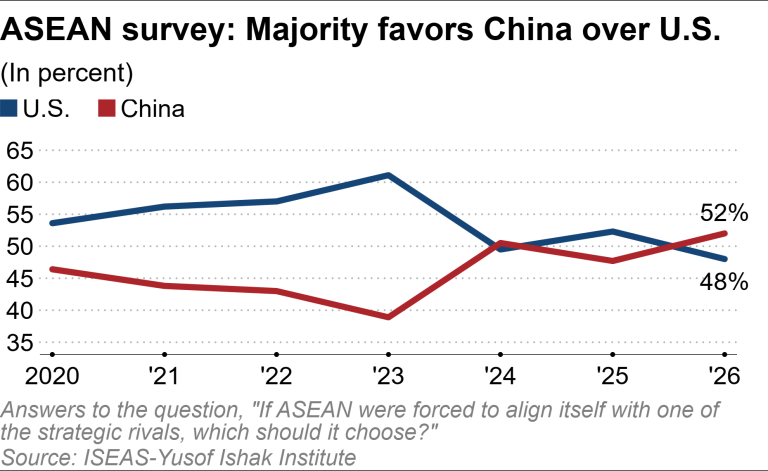
For the first time since 2024, a majority of Southeast Asian professionals surveyed by the ISEAS-Yusof Ishak Institute said they would choose China over the United States if forced to align with one superpower. The margin was 52% to 48%, reversing a narrow US lead in 2025, according to the State of Southeast Asia 2026 Survey published April 7. Cambodia moved in the opposite direction, choosing the US at 61%, the highest rate the survey has recorded for any mainland Southeast Asian state in the current polling cycle.
The survey collected responses from 2,008 professionals across all eleven ASEAN member states between Jan. 5 and Feb. 20, before the outbreak of the Iran war. Respondents included government officials, academics, private-sector professionals and civil society representatives. Cambodia accounted for 10% of the sample, roughly 201 respondents. The survey offered a Khmer-language option and screened for professional engagement with regional affairs. One methodological change affects the regional headline: Timor-Leste entered the aggregate calculation for the first time in 2026 after its October 2025 ASEAN accession. Timor-Leste’s respondents chose China at 58.2%, up from 40.9% in the 2025 survey when the country was surveyed but excluded from regional averages. The addition of a new China-leaning member mechanically shifts the aggregate denominator, meaning the regional swing toward Beijing is partly compositional.
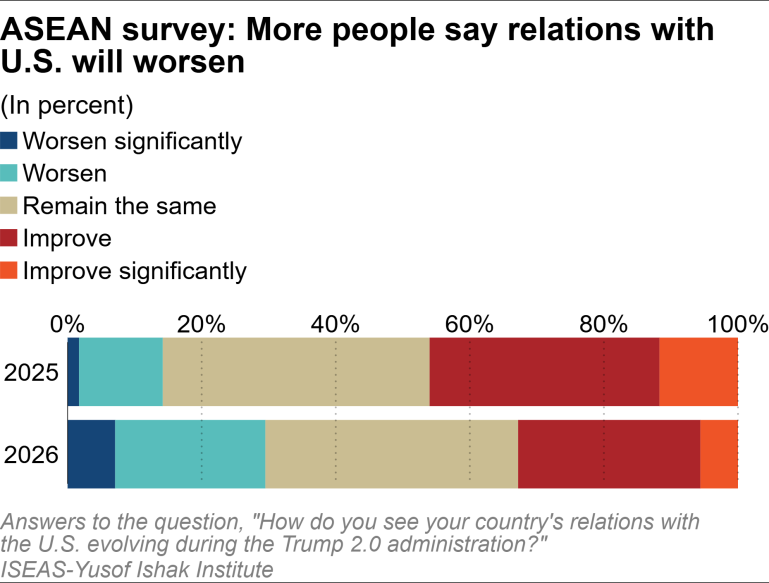
Cambodia’s 56% confidence rate in the US as a strategic partner and security provider was up from 52.3% in 2025, against a regional average of 42.7%, the ISEAS country-level data showed. Only 16.5% of Cambodian respondents expected relations with Washington to worsen under the second Trump term. The regional figure was 29.5%. A combined 55.5% expected relations to improve, though the composition of that optimism shifted: respondents expecting relations to “improve significantly” fell from 15.1% to 11.0%, while those expecting simple improvement rose from 41.9% to 44.5%. Enthusiasm downgraded to caution. The direction held.
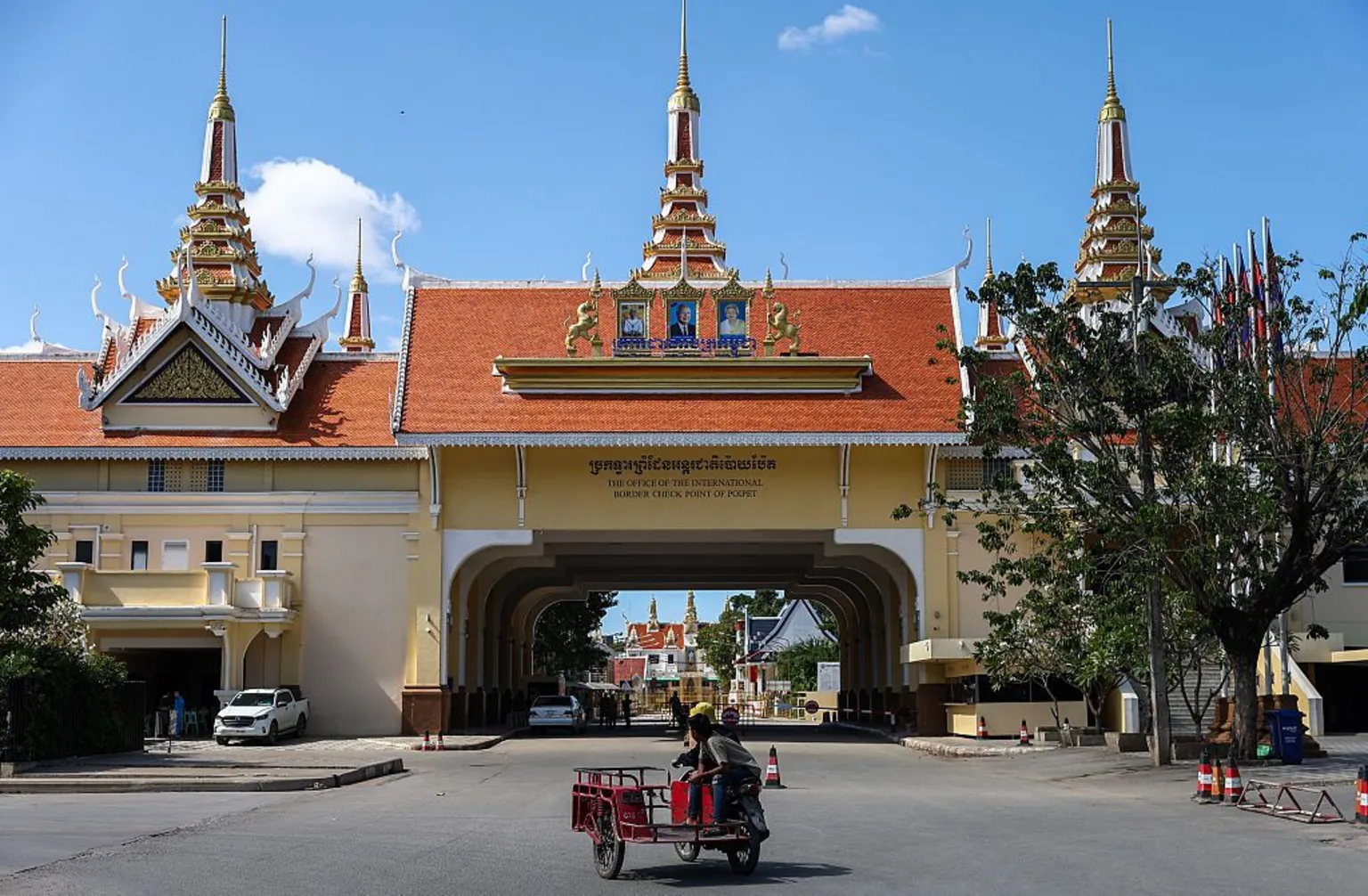
Asked to name their government’s most pressing geopolitical concern, 66% of Cambodian respondents chose the Cambodia-Thailand border conflict.
The regional average for that concern was 40.5%, and the ISEAS report explicitly identified it as Cambodia’s most pressing geopolitical preoccupation. No other country-level response in the survey exceeded its regional benchmark by 25 percentage points on any question. South China Sea aggression, the traditional anchor of US security relevance in the region, ranked second for Cambodia at 52.5%, close to the regional norm. Global scam operations tied at 52.5%, also near the regional figure of 51.4%, according to the ISEAS data. The external narrative frames Cambodia as a scam epicenter, but Cambodia’s own professional class rated scam operations as a concern at the same level as their counterparts across Southeast Asia. US leadership under President Trump ranked fourth for Cambodia at 43.5%, ten points below the regional figure of 51.9% that made it the survey’s top concern overall. The border was the outlier. Everything else tracked the region.
The 61% US preference and the 66% border anxiety are not two findings. They are one finding read in two registers. Cambodia’s professional class chose the US because an active territorial dispute made the security calculation specific. The preference is a function of the threat, not an expression of affinity.
The seven-year trend confirms this. Cambodia’s US preference has run: 42.3% in 2020, 53.8% in 2021, 18.5% in 2022, 73.1% in 2023, 55.0% in 2024, 57.0% in 2025, 61.0% in 2026, according to the ISEAS historical series. The 54.6-point swing between 2022 and 2023 is the largest single-year movement for any country in the survey’s history. No other ASEAN state’s trajectory resembles this. The Philippines has held between 76.8% and 86.6% US preference across the same period. Thailand’s split has stayed within a 10-point band favoring China since 2024.
A methodological note complicates the 2025-to-2026 comparison. Cambodia’s respondent composition changed substantially between survey years. In 2025, 35.5% of Cambodian respondents came from academia and think tanks, with 12.2% from government, according to the 2025 ISEAS survey methodology. In 2026, academia dropped to 20.0% and government rose to 20.5%. Government professionals and academics answer superpower-preference questions from different institutional positions. The four-point US preference increase from 57% to 61% may partly reflect who answered, not only what they thought.
The preference carries a condition. Among the 16.5% of Cambodian respondents who expected relations with the US to worsen, the survey asked what Washington could do to improve ties. The largest single response, at 42.4%, was “respect my country’s sovereignty and not constrain my country’s foreign policy choices,” the ISEAS report showed. Even the minority pessimistic about the relationship defined the problem as autonomy, not alignment.
The economic structure underneath the preference makes the calculation concrete. Cambodian exports to the US reached $1.28 billion in January 2026, a 47.6% increase year-on-year, under a 19% reciprocal tariff negotiated in August 2025 after an initial 49% rate announced that April. The US Supreme Court struck down the reciprocal tariff framework on Feb. 20, 2026, the survey’s final day of data collection, and a 10-15% global tariff under Section 122 replaced it four days later. The garment, footwear and travel-goods sector employed 1.11 million workers in 2025 and generated 51.8% of Cambodia’s export revenue, with the US taking more than 38% of the sector’s revenue in 2024, according to Better Work. Four tariff policy reversals in under a year did not break the trade relationship. The January export surge suggests shippers moved volume ahead of the February reset, but the structural dependency predates and will outlast any single tariff regime.
Singapore’s 19.2-point swing toward China, from 52.9% US in 2025 to 66.3% China in 2026, was the sharpest single-year movement in this cycle outside Cambodia’s historical volatility, the ISEAS data showed. Indonesia continued a trajectory that began in 2024, falling to 19.9% US preference, while Vietnam dropped from 73.5% to 59.2%, its largest annual decline toward China on record. Each movement tracks a national trade and security recalculation. The aggregate flattens these into a regional mood that does not exist as a collective phenomenon.
The survey registered one structural shift beneath the superpower question. For the first time, respondents across Southeast Asia trusted ASEAN (23.4%) more than the United States (22.3%) to uphold the rules-based international order, the ISEAS report found. The margin is thin. But for Cambodia, where the border dispute is an international law question rooted in the 1962 ICJ ruling on the Temple of Preah Vihear, the direction carries specific weight.
Mark Manantan, a research fellow at La Trobe University’s Centre for Global Security, told Nikkei Asia that Trump’s engagement with Southeast Asia, including brokering a border arrangement between Thailand and Cambodia in March 2026, was “self-serving.” On April 5, Cambodia’s foreign ministry issued a statement protesting Thai activities in occupied border areas, confirming that the March arrangement had not resolved the underlying territorial dispute. The survey had already closed by then. The 66% had already answered.
Data from the ISEAS-Yusof Ishak Institute State of Southeast Asia 2026 Survey and 2025 Survey. Trade data from Better Work and the White House. The survey was conducted between Jan. 5 and Feb. 20, 2026, before the outbreak of the Iran war.