On December 10, 2025, three days after fighting resumed along the Cambodia-Thailand border, UNESCO issued a statement expressing “strong concern” over threats to the Preah Vihear Temple and reminding parties of their obligations under the 1954 Hague Convention and the 1972 World Heritage Convention. The organization offered no funding, deployed no experts, and named no operational partner.
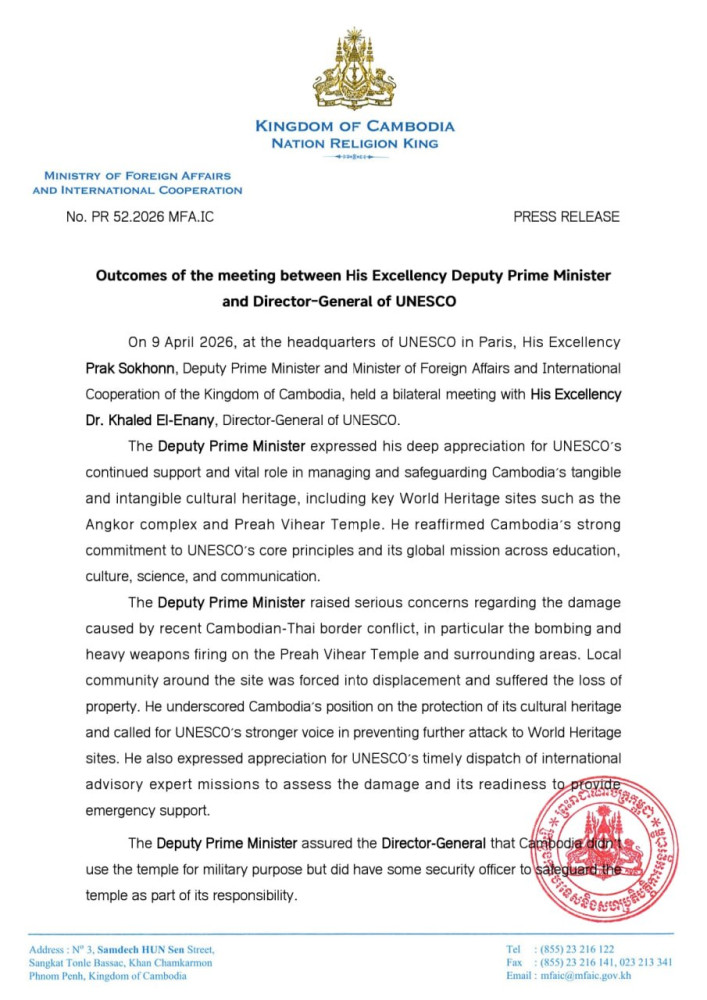
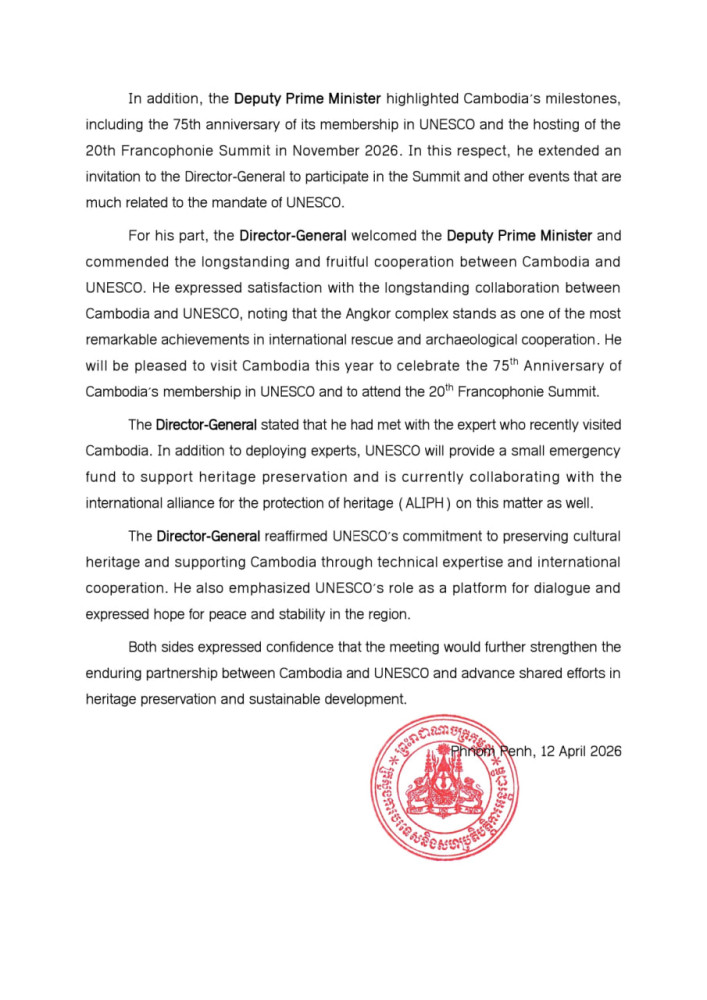
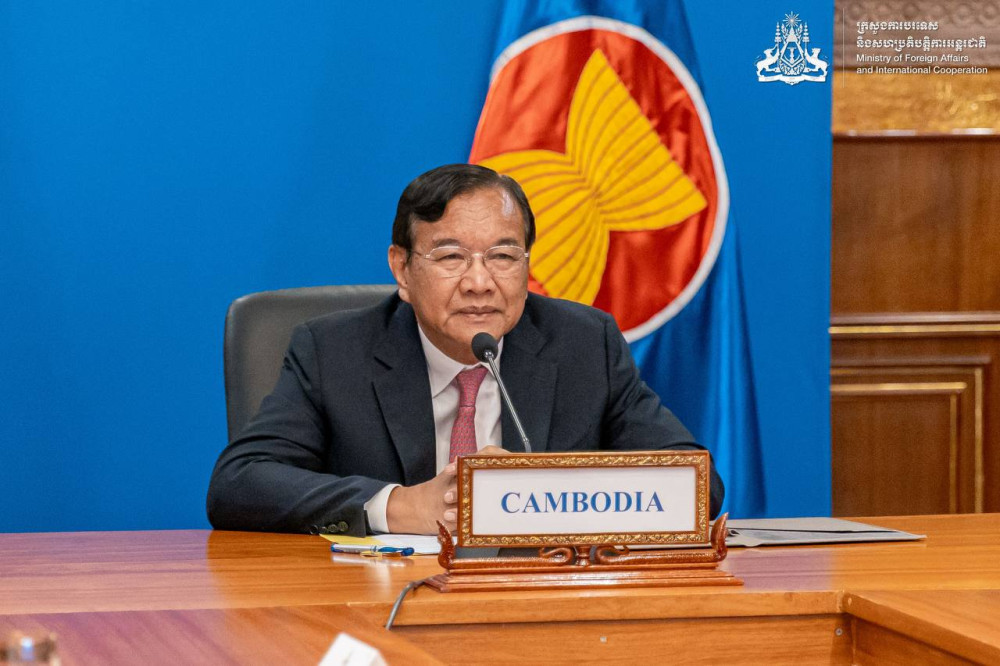
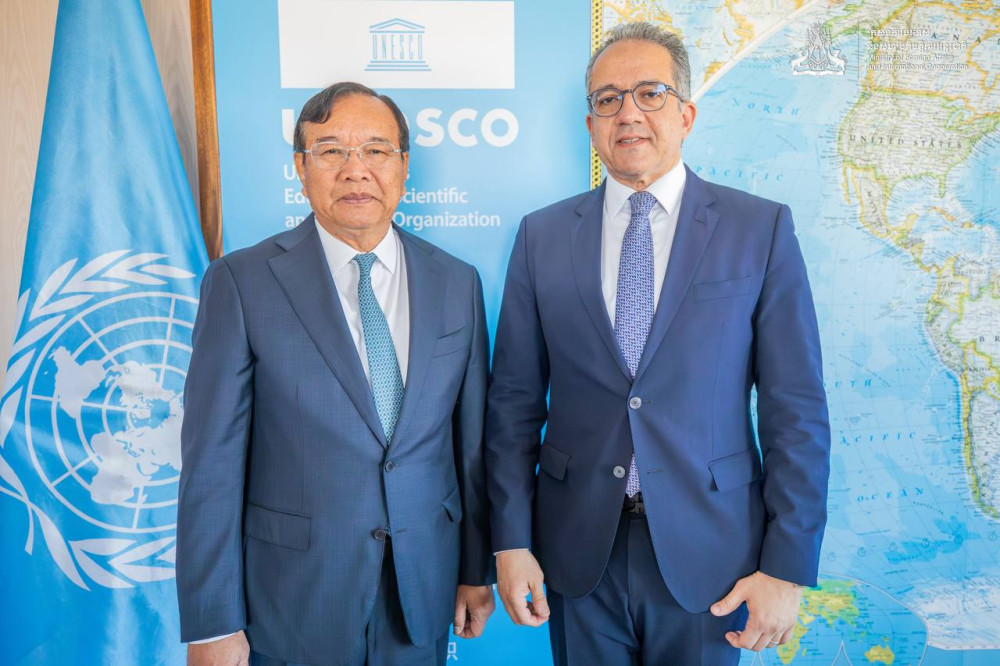
On April 9, Cambodia’s Deputy Prime Minister and Minister of Foreign Affairs Prak Sokhonn held a bilateral meeting with UNESCO’s Director-General, Dr. Khaled El-Enany, at the organization’s Paris headquarters. The meeting produced three operational commitments: an emergency fund for heritage preservation, confirmation that a UNESCO expert had already visited Cambodia to assess damage, and a new collaboration between UNESCO and the International Alliance for the Protection of Heritage in Conflict Areas (ALIPH), the Geneva-based foundation created in 2017 as a Franco-Emirati initiative to protect cultural property in conflict zones.
The outcomes, documented in MFAIC Press Release No. PR 52.2026 on April 12, represent the first time since the December 2025 escalation that UNESCO moved from institutional posture to operational commitment on Preah Vihear. The press release describes the emergency fund only as “small” and provides no figure. The ALIPH collaboration lacks operational specifics. The expert visit, announced in December, had never been publicly confirmed as completed until El-Enany told Sokhonn he had met with the expert who recently visited.
The shift from December’s posture, in which UNESCO stood “ready to provide” assistance, to April’s commitments follows a sequence of Cambodian diplomatic engagement across multiple multilateral institutions. In February, Sokhonn met French Foreign Minister Jean-Noël Barrot in Paris and secured France’s stated readiness to facilitate access to colonial-era border archives. In early March, OIF Secretary-General Louise Mushikiwabo visited Phnom Penh and displaced communities along the border ahead of the 20th Francophonie Summit, confirmed for November 15-16 in Phnom Penh. Mushikiwabo’s trip included personal observation of displacement caused by the conflict, a different institutional position than reading reports. Sokhonn’s April 9 meeting added the UNESCO Director-General to a list of institutional leaders, alongside French President Emmanuel Macron and the OIF Secretary-General, who have personally committed to visiting Cambodia later this year.
Sokhonn “assured the Director-General that Cambodia didn’t use the temple for military purpose but did have some security officer to safeguard the temple as part of its responsibility.”
The assurance operates on two levels. During the December 2025 fighting, the Thai Army accused Cambodia of using the Preah Vihear temple as a “military base of operations” and cited the Hague Convention’s provision permitting waiver of cultural property protections where military necessity requires it. Article 4(2) of the Convention allows such a waiver only “in cases where military necessity imperatively requires” it. Sokhonn’s statement denies military use entirely. That is the first layer.
The second sits in the treaty itself. Article 8(4) states that armed custodians guarding cultural property “shall not be deemed to be used for military purposes.” Even if personnel presence at the temple were disputed, the Convention’s own text explicitly exempts armed guards protecting cultural sites. Sokhonn’s formulation, security officers present to “safeguard the temple,” tracks this distinction. He delivered it to the head of the institution responsible for Hague Convention monitoring.
In any future proceeding examining whether strikes on the temple complex violated the Convention, Thailand would need to address a formal assurance from Cambodia’s senior diplomat, delivered to the UNESCO Director-General and entered into the institutional record, that the site was not militarily employed.
El-Enany described the Angkor complex as one of the “most remarkable achievements in international rescue and archaeological cooperation.” He reaffirmed UNESCO’s commitment to preserving Cambodia’s cultural heritage and described the organization as a “platform for dialogue” in the region.
ALIPH’s entry into the Preah Vihear file builds on existing infrastructure. The foundation funds two active projects at the Koh Ker World Heritage Site: the restoration of the Dancing Shiva statue through the French School of the Far East, completed in 2026, and the ongoing three-year Krahom Temple conservation launched in 2025. Both operate through the National Authority for Preah Vihear (NAPV), the Cambodian government body that also manages the temple at the center of the border dispute. The institutional pipeline between ALIPH and the authority responsible for Preah Vihear already exists. France co-created ALIPH, and is separately Cambodia’s channel to the colonial-era archives that Prime Minister Hun Manet formally requested from Macron in a February 4 letter targeting the 1904 and 1907 Franco-Siamese Border Commission records.
The 48th session of the World Heritage Committee meets in Busan, South Korea from July 19-29. The committee will examine the state of conservation of existing World Heritage sites, a category that includes Preah Vihear. Cambodia’s documented engagement with the UNESCO Director-General, the confirmed expert visit, and the ALIPH collaboration all pre-position Cambodia for that proceeding. El-Enany, as Director-General, attends the session.
The committee meeting falls during a period of institutional transition at UNESCO. The United States announced its withdrawal from the organization in July 2025, effective December 31, 2026. For El-Enany, who took office weeks before the announcement, heritage protection in active conflict zones demonstrates UNESCO’s operational relevance at the moment that relevance is most contested.
UNESCO has not published an independent damage assessment of the Preah Vihear site. Cambodia has documented 562 heritage sites affected by the conflict through its own agencies. No international verification exists in the public record.
Sokhonn highlighted Cambodia’s 75th anniversary of UNESCO membership, which falls in July 2026. Cambodia joined UNESCO on July 3, 1951, four years before it became a UN member state.
El-Enany, elected in November 2025 as the first Arab Director-General of UNESCO, accepted the invitation to visit Cambodia for both the anniversary and the Francophonie Summit. He holds a PhD in Egyptology from Paul-Valéry Montpellier 3 University in France, served as Egypt’s Minister of Tourism and Antiquities from 2016 to 2022, and received the French Legion of Honour in 2025. France supported his candidacy for the Director-General position.