The ceasefire agreement governing the Cambodia-Thailand border requires both sides to “refrain from constructing or enhancing any military infrastructure or fortifications beyond their own side.” On April 4, 2026, Thai armed forces cleared land, laid approximately 100 metres of barbed wire, and deployed armoured personnel vehicles in the Preah Vihear Temple area, according to a formal Cambodian protest issued the following day.
The activities took place in Sra Em Commune, Choam Ksan District, Preah Vihear Province, north of Keo Sikha Kiri Svara Pagoda and in the Bosbov-Choam Tae area. The International Court of Justice ruled unanimously in 2013 that Cambodia has sovereignty over the whole territory of the promontory of Preah Vihear. In the same proceedings, the Court noted that Thailand had accepted “a general and continuing legal obligation to respect the integrity of Cambodian territory, which applies to any disputed territory found by the Court to be under Cambodian sovereignty.”
Cambodia’s Ministry of Foreign Affairs designated the protest PR 48/2026 and stated that the April 4 activities are “neither defensive in nature nor consistent with” the Joint Statement of the 3rd Special General Border Committee, signed December 27, 2025.
The armoured vehicle deployment introduces a new element into a pattern Cambodia has documented since January. Previous protests cited construction: containers, roads, trenches, barbed wire, flags, and a Buddha statue begun on March 7 at the same Bosbov-Choam Tae location where the April 4 activities occurred. Armoured vehicles represent military posture, a category distinct from infrastructure.
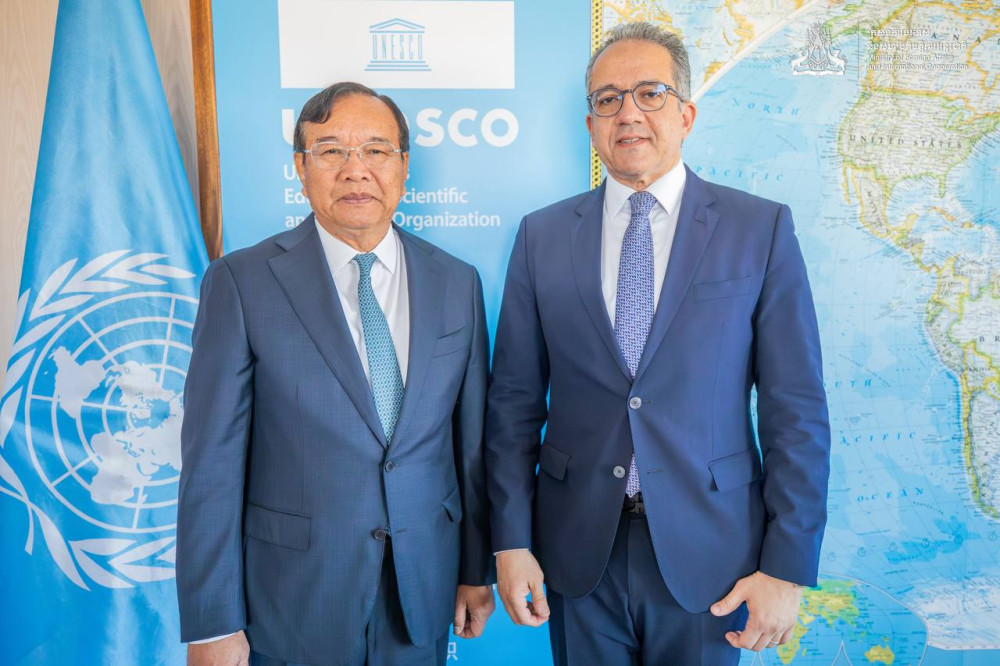
The governing instrument is the GBC Joint Statement, signed by Cambodia’s Deputy Prime Minister Tea Seiha and Thailand’s Defence Minister Nattaphon Narkphanit and subsequently annexed to Thailand’s own filing with the United Nations Security Council on January 19, 2026. Paragraph 6 requires both sides to refrain from constructing or enhancing military infrastructure “beyond their own side.” Paragraph 1 prohibits “advancement or movement of troops towards the other side’s positions.” Paragraph 5 prohibits increasing forces “along the entire Cambodia-Thailand border.” Paragraph 3 states that “all arrangements under this Joint Statement are without prejudice to the border demarcation and international boundary between the two countries.”
Thailand’s position, stated in its January 19 Security Council filing, maintains that “all measures undertaken by Thai authorities are conducted within Thai territory at the time of the ceasefire in accordance with the Joint Statement, serving solely the purposes of de-escalation, the maintenance of peace and security and the restoration of trust.” In a March 11 statement, the Thai Ministry of Foreign Affairs described border activities as “strictly defensive in nature” and characterized them as “provisional stabilization measures.”
That territorial characterization operates within a framework both parties agreed to. The same Paragraph 3 that governs the ceasefire states its arrangements do not prejudice the international boundary. The ceasefire line, by both sides’ own agreement, does not establish territorial claims. Thailand’s description of its activities as occurring “within Thai territory” relies on a boundary determination that the GBC Joint Statement explicitly reserves for the Joint Boundary Commission, which has not convened since the ceasefire.
The sequence of post-ceasefire activities Cambodia has protested follows a documented escalation. On January 3, Cambodia’s first post-ceasefire protest cited containers, barbed wire, and destroyed civilian property across Preah Vihear and Oddar Meanchey provinces. On February 5, additional containers blocked access to the An Ses international border checkpoint. On February 23, the State Secretariat of Border Affairs documented drone flights, road construction, and restrictions on civilian return. By mid-March, Cambodia was protesting concrete roads, stairways, and permanent religious and tourist structures near Preah Vihear and Ta Krabei Temple. None of the documented construction has been reversed.
Cambodia’s protest invokes the 1904 Franco-Siamese Convention and the 1907 Treaty. The ICJ’s 2013 operative clause, adopted unanimously, declared that “Cambodia had sovereignty over the whole territory of the promontory of Preah Vihear” and that “Thailand was under an obligation to withdraw from that territory.” The Court also noted that under Article 6 of the World Heritage Convention, to which both states are parties, each is obligated not to “take any deliberate measures which might damage directly or indirectly” the heritage site. Thailand has stated it does not recognize the ICJ’s jurisdiction over Cambodia’s proposed new referral of the current dispute to the Court. The binding force of the 2013 judgment itself, in which Thailand participated, is a separate legal question.
Thailand has separately accused Cambodia of ceasefire violations, citing projectiles fired into Thai territory on January 6 and February 24, 2026. In its March 11 statement, Thailand also accused Cambodia of violating Article V of the 2000 Memorandum of Understanding on boundary demarcation, which prohibits either side from carrying out “any work resulting in changes of environment of the frontier zone.” Thailand cited Cambodian construction of the Ta Om Equestrian Monument, a market at An Mah-An Ses, and an administrative building in Ta Phraya as Article V violations. The same Article V prohibition applies to construction by either party in the frontier zone.
No official Thai response to the April 5 protest has been published. The ASEAN Observer Team, mandated under the GBC Joint Statement to verify implementation of all de-escalation measures, has not released a public report on the April 4 activities. Prime Minister Anutin Charnvirakul’s cabinet was formed on March 30, six days before the reported deployment.
The GBC Joint Statement remains the only operative bilateral instrument governing the ceasefire. Its construction prohibition, the ICJ’s determination of Cambodian sovereignty over the promontory, and Thailand’s own accepted obligation to respect Cambodian territorial integrity form three concurrent legal constraints on military activity in the Preah Vihear area. The April 4 activities, as described in Cambodia’s protest, engage all three.