Thailand’s new government has placed the cancellation of its 2001 maritime agreement with Cambodia into the official policy statement being delivered to parliament on April 9. The publicly surfaced draft of that statement, reported by Thai PBS, instructs the bureaucracy to expedite study of ways to cancel the agreement. It does not instruct cancellation.
That distinction is the entire story.
The Memorandum of Understanding signed on June 18, 2001 created a framework for two simultaneous negotiations: maritime boundary delimitation in the Gulf of Thailand and joint development of hydrocarbon resources in the Overlapping Claims Area. Article 2 binds these as what the treaty calls “an indivisible package.” Article 5 provides that neither the agreement nor actions taken under it prejudice either country’s maritime claims until a delimitation agreement enters into force. No provision for unilateral termination. No notice period.
In 2009, the Thai cabinet voted in principle to cancel the agreement. A review of its advantages led to a decision to retain it in 2014. No diplomatic note was issued. No formal termination notification was filed. Thailand’s Vice Foreign Minister Russ Jalichandra confirmed this publicly in November 2024: the agreement “has not been officially cancelled since then.”
On March 31, 2026, Prime Minister Anutin Charnvirakul confirmed that cancellation of the maritime agreement would appear in his government’s policy statement to parliament. He reiterated it on April 1. On April 6, the newly sworn-in cabinet approved the draft. Nation Thailand reported the cancellation as a core Bhumjaithai pledge being embedded into state doctrine. The draft language surfaced by Thai PBS commits to “expediting study of ways to cancel” MOU 2544 (the Thai designation for the 2001 agreement). The government’s own April 7 summary of the policy statement’s foreign and security provisions described the Cambodia situation in generic terms without naming MOU 2544 at all. Between the rhetoric and the approved text, the verb changed.
Under the Vienna Convention on the Law of Treaties, a treaty containing no termination provision is governed by Article 56, which requires twelve months’ notice and an implicit right of denunciation established by the parties’ intent or the treaty’s nature. Thailand is not a party to the Vienna Convention, though it has cited its provisions in related filings. Cambodia’s State Secretariat of Border Affairs invoked the Convention’s Article 62 in its March 26 response to the Thai Senate’s earlier recommendation to cancel both the 2000 land boundary and 2001 maritime agreements. Thailand’s Senate has cited material breach under the Convention’s Article 60 as grounds for withdrawal. Whether that claim has merit is a separate question from whether any formal procedure has begun. No government on either side has initiated a formal termination notification.
Thailand’s Council of State Secretary-General Pakorn Nilprapunt acknowledged in November 2024 that the MOU could in principle be cancelled unilaterally but called such a move unwise. “We started the MOU together,” he said. “When it is time to cancel it, the principle is that we have to talk to each other first.” In February 2026, responding to renewed cancellation pressure, he said any termination would need to follow the required procedure and referred the international law dimension back to the Ministry of Foreign Affairs. The procedure has not materialized.
A cabinet resolution expressing intent to cancel is a domestic political act. It does not terminate an international agreement. The 2009 resolution produced no diplomatic note, no formal notification, and no legal termination. Seventeen years later, Thai officials confirmed the MOU remained in force. The 2026 policy statement, in its publicly surfaced text, has not advanced beyond the same point.
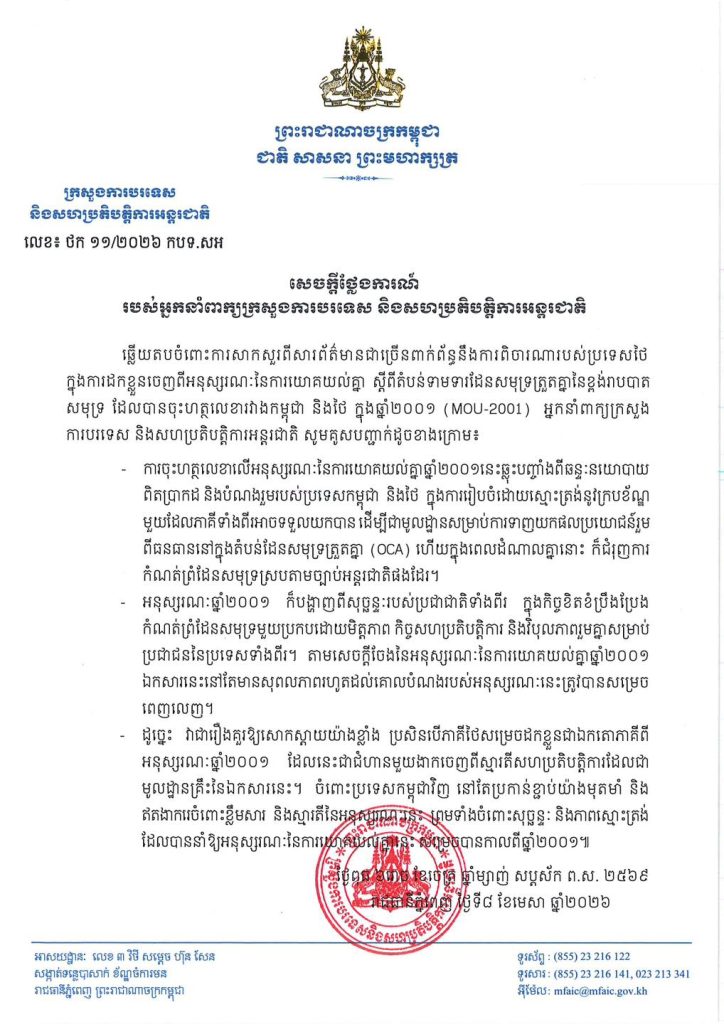
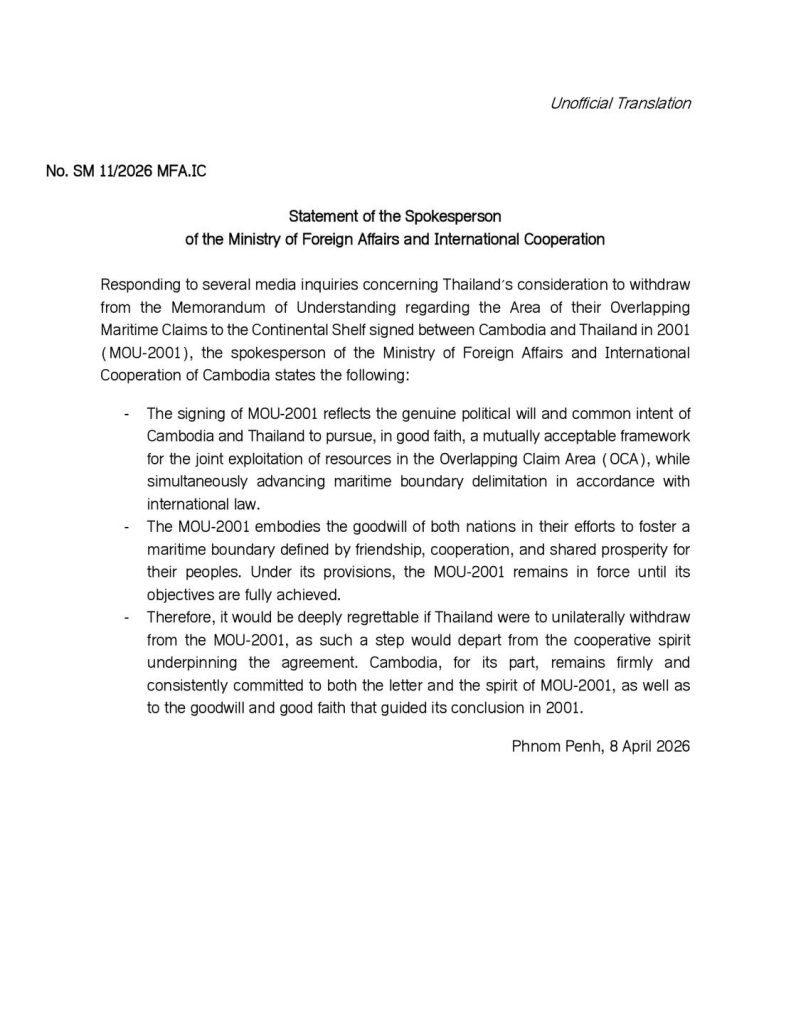
Cambodia’s April 8 spokesperson statement asserted that MOU-2001 “remains in force until its objectives are fully achieved.” That formulation does not appear in the treaty text. The MOU states the parties’ intent to treat joint development and delimitation as an indivisible package but does not specify its own duration or validity conditions. Cambodia’s position is a legal interpretation drawn from the absence of a termination clause and the agreement’s stated objectives. Defensible under treaty law. Not a quotation from the instrument.
The day before that statement, Cambodia’s State Secretariat of Border Affairs sent a Note Verbale proposing a special Joint Boundary Commission meeting in Siem Reap from April 17 to 22. The proposal included joint survey team deployment from April 20 to 24 at four contested sites: Boeung Trakuon, O’Smach, An Seh, and Thmar Da. This was the sixth formal diplomatic instrument Cambodia has sent Thailand since the December 2025 ceasefire, following notes on December 28 and January 5 pressing for a JBC meeting, a February proposal to deploy joint survey teams along agreed boundary segments, and a March 19 statement reaffirming the JBC as the authoritative bilateral mechanism. Thailand has not accepted any of them. Its most recent public response, from March 11, was that it “takes note” and would respond after the new government’s formation. That government took office on April 6. It delivered its policy statement on April 9. The word cancel does not appear in the approved text.
Thai critics and naval leadership contend that MOU-2001 implicitly legitimizes Cambodia’s 1972 continental shelf claim, designated Line 266, which extends across the southern portion of Koh Kood. Thailand’s Public Relations Department stated in November 2024 that the MOU does not concede territorial claims and that no negotiations involved Koh Kood. The formal state position and the escalatory political-military position are not identical. Cancelling the “indivisible package” would decouple resource-sharing from boundary delimitation, allowing Thailand to pursue unilateral boundary definitions without the framework both countries agreed to in 2001. That is precisely what the MOU was designed to prevent.
The text says indivisible package, says no prejudice, and says nothing about how to end.