Thailand’s Joint Information Centre on the Cambodia-Thailand Situation on Friday issued a six-point statement rejecting Cambodian allegations of territorial encroachment near the Chong Chom border crossing in Surin Province. The JIC reaffirmed what it called strict adherence to the December 27 General Border Committee Joint Statement and commitment to resolving the dispute through bilateral mechanisms.
One day earlier, Prime Minister Anutin Charnvirakul delivered his government’s 21-page policy statement to Parliament. The document commits to resolving the Cambodia-Thailand situation “through peaceful bilateral mechanisms” while ordering an expedited study to terminate the 2001 Memorandum of Understanding on overlapping continental shelf claims, known as MOU 44.
Anutin was more direct on March 31. After summoning his Defence Minister and chief of naval staff to Bhumjaithai Party headquarters, he told reporters: “I’ve made my decision. For me, that means cancellation,” according to the Nation Thailand.
The JIC statement claims compliance with a ceasefire agreement whose text it selectively cites, generates international wire coverage that contradicts its territorial framing, and commits to bilateral mechanisms whose foundational instruments are under legislative dismantlement.
What the Joint Statement says
The JIC cites paragraph 2 of the December 27 Joint Statement, under which both sides agreed to maintain current troop deployments without further movement. The JIC claims “no encroachment, no reinforcement and no change in position.”
The Joint Statement, filed with the United Nations as document A/80/593-S/2026/37, contains provisions the JIC does not address.
Paragraph 3 states that all arrangements “are without prejudice to the border demarcation and international boundary.” Military position is not territorial sovereignty. The Joint Statement separates the two, deferring the sovereignty question to the Joint Boundary Commission.
Paragraph 6 prohibits military activities “to enter the other side’s air space and territory or positions as of ceasefire” and bars “constructing or enhancing any military infrastructure or fortifications beyond their own side.”
Thailand’s own UN filing describes Thai positions as being “within Thai territory at the time of the ceasefire in accordance with the Joint Statement.” The Joint Statement assigns no territory. It freezes positions.
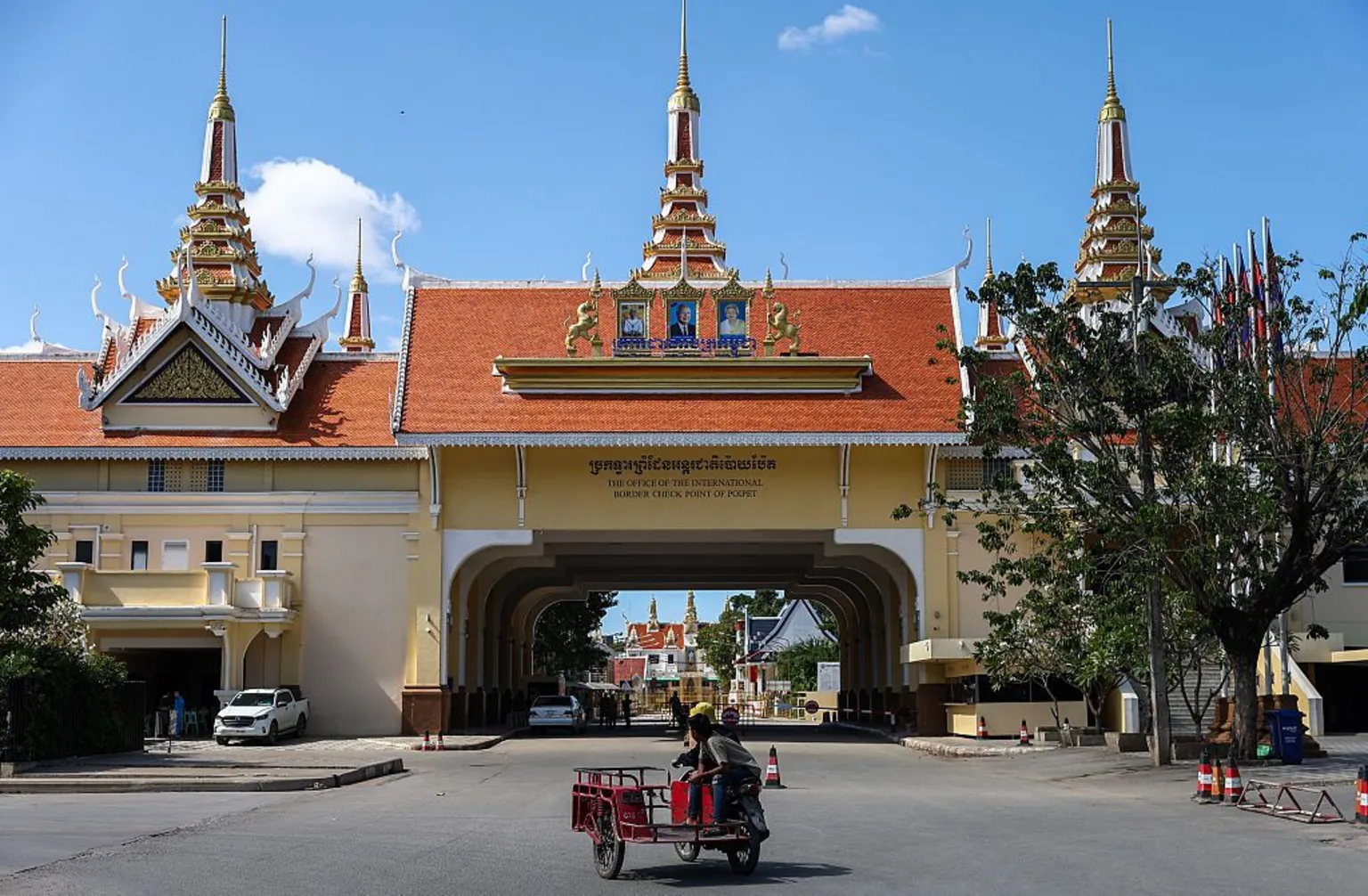
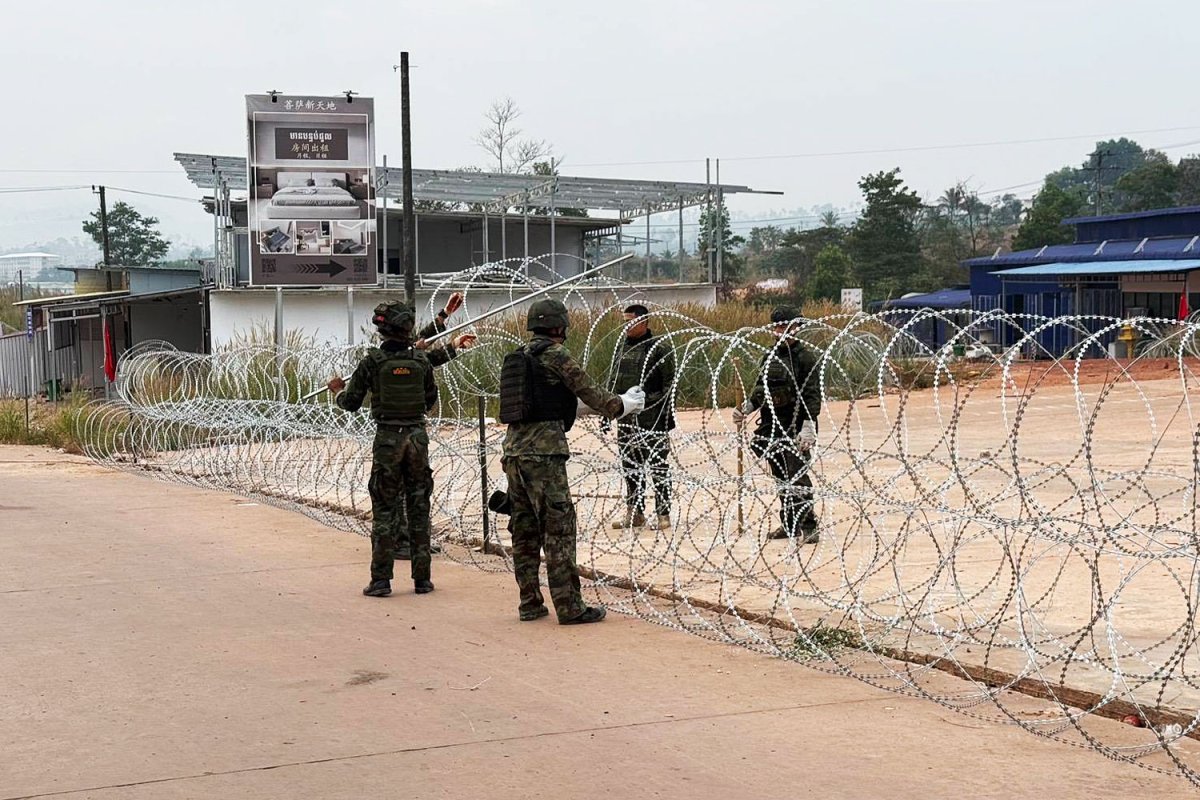
On April 2, the Thai military deployed M113 armoured personnel carriers to the Chong Chom-O’Smach crossing. Air Chief Marshal Prapas Sornchaidee, director of the JIC, described it as a defensive adjustment. Lt Gen Maly Socheata, spokesperson for Cambodia’s Ministry of National Defence, stated that the deployment took place at the O’Smach International Border Checkpoint in Oddar Meanchey province and that Thai forces reinforced barbed wire in areas Cambodia describes as illegally occupied, according to Khmer Times.
Neither side’s territorial claims at O’Smach have been independently verified. The ASEAN Observer Team inspected the site on March 29 but has not published findings. Cambodia, which has hosted AOT missions since January, has not released any AOT documentation to support its own territorial claims at the site.
The dateline
Thailand’s second and third claims frame the O’Smach compound as a site of defensive security operations. The JIC states that Cambodian forces used the area “as a military base to attack Thailand.” Both sides acknowledge armed conflict occurred in July and December 2025. Who attacked from where remains disputed.
On April 7, the Thai military conducted its third media tour of the compound, leading more than 60 journalists through a site containing 157 buildings across 197 acres, according to the Associated Press.
AP, which Thailand invited, datelined its dispatch from “O’SMACH, Cambodia.” Photographer Sakchai Lalit captioned every compound photograph “O’Smach, Cambodia” while captioning the scripts briefing separately as “Surin, Thailand.” The wire service Thailand selected to document its operations identified the compound as Cambodian territory and distinguished it from Thai territory within the same photo set.
AP identified the compound as the O’Smach Resort, owned by Cambodian politician Ly Yong Phat, who faces US Treasury OFAC sanctions for human rights abuses at the same complex. An OFAC-sanctioned Cambodian national operating a scam compound inside Cambodian territory is its own accountability question, separate from the border dispute. Cambodia’s National Assembly unanimously passed the Law on Combating Online Scams on March 30, with all 112 members present voting in favour, according to the Associated Press. The Senate approved it 58-0 on April 3. The legislation, Cambodia’s first dedicated anti-scam legal framework, arrived four days before Thailand’s third media tour of O’Smach and eleven days before the JIC statement framing the compound as evidence of Cambodian failure on transnational crime.
The scam evidence at the site, including SIM cards, multilingual scripts and detention rooms, is consistent with what Reuters documented at O’Smach in February. But criminal infrastructure at a location does not resolve who holds sovereignty over it. Paragraph 3 of the Joint Statement contains no law enforcement exception.
In February, Maj Gen Winthai Suvaree, Royal Thai Army spokesperson, stated that foreign defence attachés visited Chong Chom in Surin province but “did not enter Thai-controlled areas across the border, nor O’Smach, as alleged,” according to Pattaya Mail and the Nation Thailand. By April, the JIC described Thai forces as having maintained control over the compound for more than three months, a timeline beginning in late December, before Winthai’s denial.
Bilateral mechanisms
The JIC commits Thailand to resolving the dispute through the JBC, the GBC and the Regional Border Committee. The JBC operates under the 2000 Memorandum of Understanding on the Survey and Demarcation of Land Boundary, known as MOU 43.
On March 24, a Thai Senate committee unanimously recommended scrapping MOU 43 after more than 20 meetings and field visits to seven border provinces, according to the Bangkok Post. The recommendation is expected before the full Senate in April.
MOU 44 termination is in the policy statement delivered to Parliament on April 9. Anutin told the Bangkok Post in February that the cabinet could revoke MOU 44 without parliamentary approval “because it is only an MoU, not a legally binding treaty.” Cambodia’s State Secretariat of Border Affairs has argued the memorandum creates international law obligations through its registration with the United Nations.
Cambodia’s JBC has submitted at least six Note Verbales to the Thai side since December 28, proposing meetings and survey team deployments with specific dates, according to AKP, the Phnom Penh Post and Cambodianess. The most recent, dated April 7, proposed a special JBC meeting in Siem Reap between April 17 and 22 and joint survey team deployments between April 20 and 24 at boundary segments between Pillars 42-47 and 52-59.
Thailand has not accepted any proposed date. Its stated reasons include the need to complete internal procedures after forming a new government and a precondition that all demining along the border must be completed first, according to the Nation Thailand. Cambodia’s SSBA rejected the demining precondition, citing the 2000 MOU’s own provisions for demining by Booby Trap Clearance Officers under the JBC mechanism, according to the Phnom Penh Post.
The JIC’s April 10 statement commits to bilateral mechanisms. The government’s April 9 policy statement orders termination of one foundational instrument. The Senate is moving to cancel the other. Cambodia’s proposals to activate those mechanisms remain unanswered.
Paragraph 10 of the Joint Statement, which the JIC invokes, commits both sides to cooperation on transnational crime. It does not authorize unilateral site seizure, unilateral media operations at contested locations, or unilateral inspections with foreign law enforcement.