On 7 April 2026, three things happened along the Cambodia-Thailand border.
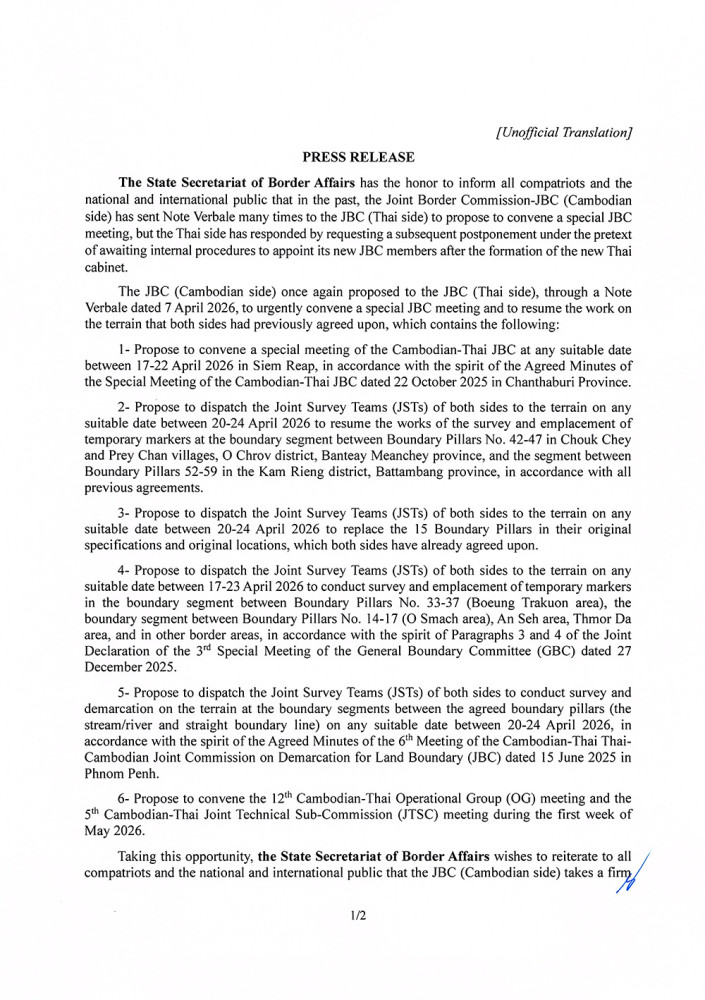
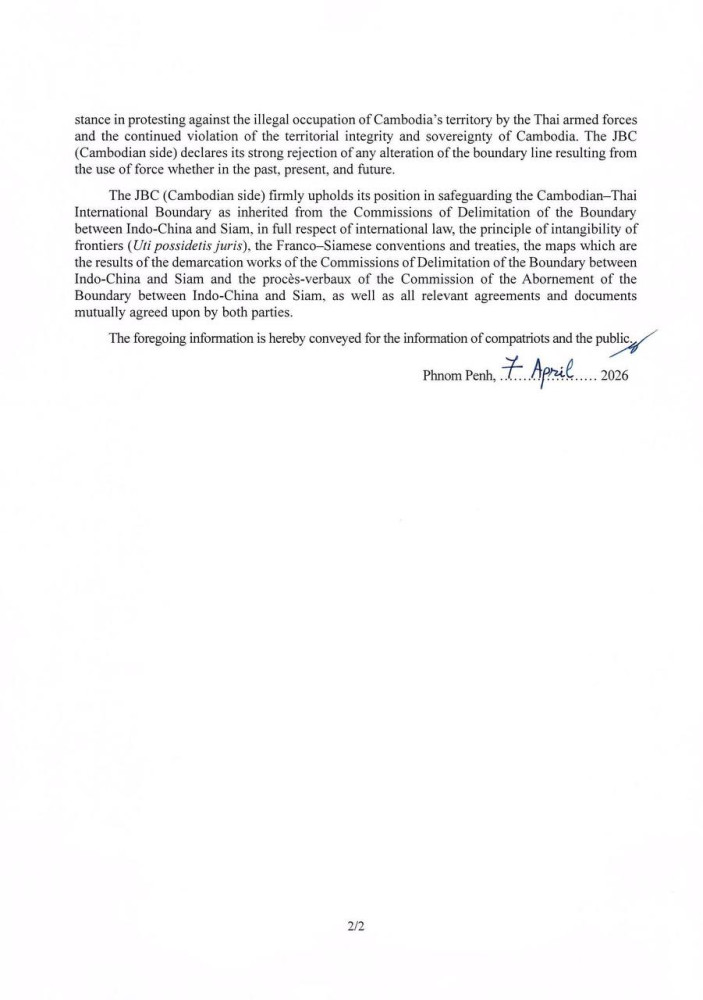
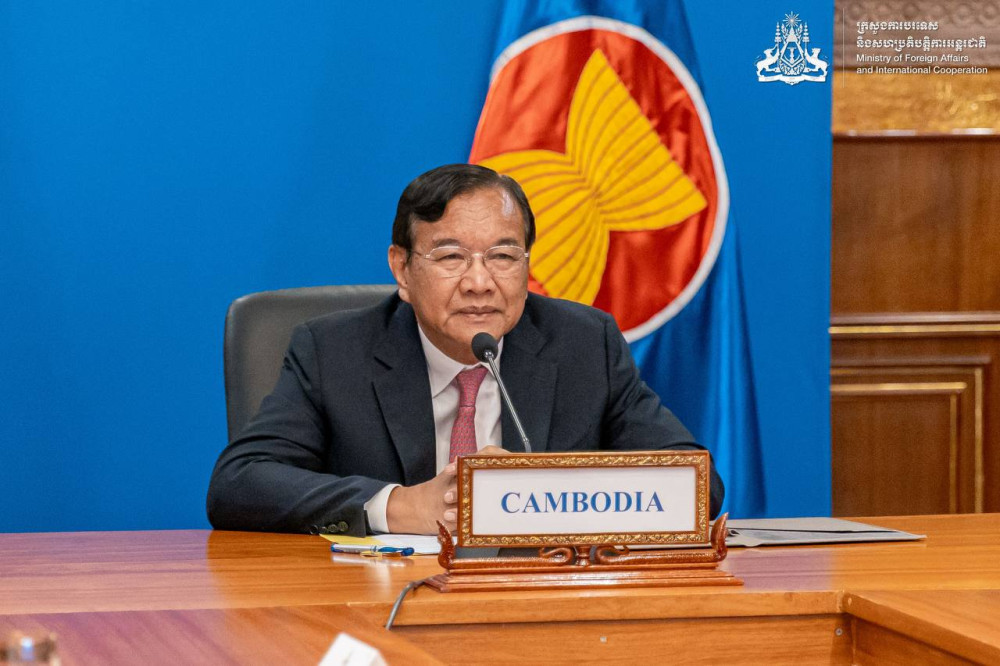
Cambodia’s State Secretariat of Border Affairs sent Thailand a Note Verbale proposing a special Joint Boundary Commission meeting in Siem Reap between 17 and 22 April, deployment of Joint Survey Teams to four boundary segments between 20 and 24 April, and convening of the 12th bilateral Operational Group and 5th Joint Technical Sub-Commission in the first week of May. One of the segments named was O’Smach, at Boundary Pillars 14-17.
On the same day, Thailand’s Joint Information Centre took Associated Press and international media to the O’Smach area to tour a 197-acre scam compound that AP described as resembling a self-contained town, owned by Cambodian politician Ly Yong Phat, who faces United States sanctions. Thai soldiers guarded the premises. AP ran the story with the dateline “O’SMACH, Cambodia.”
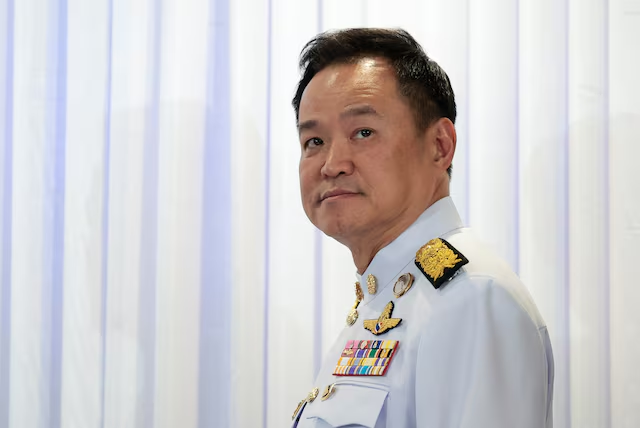
Also on 7 April, Thailand’s cabinet approved its policy statement for delivery to Parliament, with the session expected from 7 to 10 April. That statement includes the formal cancellation of the 2001 Memorandum of Understanding on maritime boundaries. The 2000 MOU on land boundaries, which created the JBC mechanism Cambodia is seeking to activate, remains “under consideration,” according to Prime Minister Anutin Charnvirakul.
Cambodia’s proposal was at least the sixth documented engagement attempt since January to resume the demarcation work both governments committed to in the Joint Statement of 27 December 2025. Thailand has not publicly responded to any of them with agreed dates.
What both sides committed to
The Joint Statement, signed at the 3rd Special General Border Committee meeting, established an immediate ceasefire from noon local time and directed both sides to refer boundary matters back to the JBC to resume survey and demarcation work “at the earliest.”
Two months before that, a special JBC session in Chanthaburi on 21-22 October 2025 produced a four-point framework: replacement of 15 French-era boundary pillars, finalization of a Technical Instruction for temporary markers between Boundary Pillars 42 and 47, replacement of three submerged pillars, and acceleration of orthophoto-map revision using LiDAR. Cambodia’s Minister in charge of Border Affairs Lam Chea and Thailand’s Advisor to the Ministry of Foreign Affairs Prasas Prasasvinitchai co-signed the joint press statement. Both sides agreed the next JBC meeting would take place in Siem Reap in the first week of January 2026.
Two days after the December ceasefire, Chinese Foreign Minister Wang Yi hosted a trilateral meeting in Yuxi, Yunnan Province, where Thai Foreign Minister Sihasak Phuangketkeow and Cambodian Foreign Minister Prak Sokhonn agreed to consolidate the ceasefire, resume normal exchanges, and rebuild political mutual trust.
The border dispute is not administrative. Two displacement waves in 2025, documented by the United Nations in Cambodia, uprooted more than 172,000 people beginning in July and peaked at 644,589 displaced in late December. By early March 2026, World Vision International reported approximately 600,000 returns, with 47,714 people still displaced.
Cambodia’s documented proposals
The sequence begins on 5 January 2026, when Cambodia sent a Note Verbale proposing a JBC meeting for the first week of January in Siem Reap, as both sides had agreed in Chanthaburi.
On 6 January, Cambodia reported Thailand had postponed the meeting, citing the need to complete internal procedures following its new cabinet formation.
On 15 January, Cambodia reported a second Thai postponement while Thailand finalized the composition of its new JBC delegation.
On 1 February, Cambodia disclosed it had sent a further note on 29 January proposing Joint Survey Team fieldwork for 9 to 13 February and Operational Group and JTSC meetings in the second week of February. The same statement protested Thai actions Cambodia said violated Article 5 of the 2000 MOU and the 27 December Joint Statement.
On 1 March, Cambodia submitted another note proposing JST deployment between 1 and 7 March for Pillars 42-47 and 52-59, followed by surveys between 8 and 15 March covering Boeung Trakuon, Thmar Da, and other contested locations. Cambodia also proposed operational and technical meetings in early March, followed by a special JBC meeting.
By 13 March, Cambodia’s Ministry of Foreign Affairs said it had sent five consecutive invitations to resume technical work. Cambodia’s foreign affairs spokesperson said the Thai allegation of a 24 February grenade incident “did not occur” and had been jointly verified by regional military liaison teams of both sides.
The 7 April Note Verbale proposed boundary work on four segments: Pillars 42-47 in Banteay Meanchey, Pillars 52-59 in Battambang, Pillars 33-37 at Boeung Trakuon, and Pillars 14-17 at O’Smach. O’Smach is the location where Thai Army officials have claimed sovereign control under the December Joint Statement while Cambodia has documented what it describes as a 420-metre encroachment.
Thailand’s shifting conditions
Thailand publicly tied JBC resumption to cabinet formation on 12 January 2026, stating it intended to resume activities “at the earliest practical opportunity” after the general election.
In the second week of March, Thailand introduced additional conditions. Foreign Minister Sihasak Phuangketkeow told reporters on 10 March that Cambodia would need to clear landmines before demarcation could proceed, and that scam network suppression, while not part of the JBC forum, was something Cambodia was obligated to address. He said discussions under the JBC must cover “all relevant issues under the JBC’s mandate and international law, not only the topics Cambodia is keen to address.” He said that if Cambodia wanted a JBC meeting and wanted to move boundary demarcation forward, “it would have to clear landmines so the area was safe, rather than opening the meeting simply to discuss the issues Cambodia wished to raise.”
On 11 March, Thailand’s Ministry of Foreign Affairs stated that technical survey and demarcation work could not proceed while the border situation had not stabilized and Joint Survey Team safety was not ensured. The statement referenced a 25 February Thai allegation that a 40-mm grenade round had been fired from the Cambodian side on 24 February. Thailand has not publicly retracted the allegation. Cambodia denied the incident. No public report from the ASEAN Observer Team or the bilateral liaison mechanism on the incident has been located.
The election took place on 8 February. Anutin Charnvirakul was elected prime minister on 19 March with 293 parliamentary votes. The cabinet was appointed by Royal Command on 31 March, with Sihasak Phuangketkeow named Deputy Prime Minister and Minister of Foreign Affairs. The cabinet was sworn in on 6 April. Cambodia’s Note Verbale arrived the following day.
On 7 April, Thai Ministry of Foreign Affairs spokesperson Maratee told Nation Thailand that “there has not yet been sufficient positive progress for meaningful talks, though Thailand has begun preparatory steps following the formation of the new government.”
The MoU cancellation track
The JBC was created by the Memorandum of Understanding on the Survey and Demarcation of Land Boundary, signed on 14 June 2000. Thailand’s Ministry of Foreign Affairs has described this instrument as “the sole framework” for survey and demarcation of the land boundary.
On 24 March 2026, a Thai Senate committee voted unanimously to recommend the cabinet cancel the MoU, citing what the committee called constitutional flaws and Cambodian material breaches. Committee chairman Nophadol In-na outlined six reasons, including the MoU’s acceptance of Cambodia’s 1:200,000-scale map, which Thailand considers less accurate than its own 1:50,000-scale map. The committee invoked Article 60 of the Vienna Convention on the Law of Treaties as the basis for unilateral withdrawal. The recommendation was expected to go before the Senate in April before being forwarded to the cabinet.
The committee also recommended that any future agreement must not recognize the 1:200,000-scale map, must give the JBC greater authority over encroachment, and must use “the cliff-edge line” as the boundary in the Phanom Dong Rak mountain range.
Cambodia’s State Secretariat of Border Affairs dismissed the reasoning as “politically motivated and sabotaging the previous achievement by the Joint Boundary Commission.” The SSBA listed JBC accomplishments since 2000: identification and repair of all 74 French-era boundary pillars, construction of a joint geodetic network, detailed surveys at border checkpoints, and placement of temporary markers.
Cambodia cited Article 62, paragraph 2(a) of the Vienna Convention on the Law of Treaties, which prohibits invoking a fundamental change of circumstances as grounds for withdrawing from a treaty that establishes a boundary.
On 31 March, Anutin confirmed that cancellation of the 2001 MOU on maritime boundaries would be included in the government’s policy statement to Parliament. “I’ve made my decision. For me, that means cancellation,” he told reporters after summoning the Defence Minister and Chief of Naval Staff to Bhumjaithai Party headquarters.
A 9dashline analysis published on 6 April noted that Anutin had initially attempted to use MoU 43 withdrawal as a political tool during the campaign, but he and Sihasak later stepped back after recognizing that withdrawal would be detrimental to Thai interests.
The 2000 MoU on land boundaries remains under consideration. The Royal Thai Army has questioned whether it remains “workable under current conditions.” A military source told Nation Thailand that while the MoU was a useful instrument in principle, “recent military operations had already gone beyond its framework.”
O’Smach: boundary segment and scam compound
O’Smach sits at the intersection of Cambodia’s demarcation agenda and Thailand’s security narrative.
Cambodia’s April 7 Note Verbale proposes sending Joint Survey Teams to the area around Boundary Pillars 14-17 to conduct surveys and emplace temporary markers, in accordance with the spirit of the 3rd Special GBC Joint Declaration.
Thailand’s military has taken international media to the same area three times. The 7 April tour, led by Air Chief Marshal Prapas Sornchaidee, director of the Thailand-Cambodia Joint Information Centre, showed AP reporters a compound that Thailand describes as a transnational online scam base. AP reported the compound covers approximately 197 acres. Ly Yong Phat, a Cambodian politician who faces US sanctions for rights abuses at the same complex, was identified as the owner. FBI data released on 7 April showed Americans lost nearly $21 billion to scams in 2025.
What remains unresolved
The full text of the 7 April Note Verbale has not been made public. Whether Thailand communicated with Cambodia between the cabinet swearing-in on 6 April and Cambodia’s proposal on 7 April is not documented in accessible sources. Whether Prasas Prasasvinitchai remains Thailand’s JBC co-chair under the new cabinet has not been confirmed. The February 24 grenade allegation remains contested, with no independent verification located.
The ASEAN Observer Team, which rotated its leadership from Malaysia to the Philippines on 28 March during a mission to Boeung Trakuon, continues to operate along the border. Boeung Trakuon is one of the segments named in Cambodia’s April 7 proposal.
As of 8 April 2026, no Thai government response to Cambodia’s latest Note Verbale has been located in public sources. Thailand’s policy statement to Parliament, containing the MoU 44 cancellation, was expected to be delivered through 9 or 10 April.