On August 4, 2025, Thailand’s Government Public Relations Department issued a public statement addressing whether Cambodian soldiers held in Thai custody were prisoners of war. The answer given: “The Cambodian soldiers detained by Thailand are classified as prisoners of war (POWs) under the Geneva Convention.”
That classification carries a specific legal weight. The Geneva Convention III Relative to the Treatment of Prisoners of War applies to “all cases of declared war or of any other armed conflict which may arise between two or more of the High Contracting Parties” Common Article 2, shared across all four Geneva Conventions. Under Article 4, prisoner-of-war status attaches to members of the armed forces of a party to an international armed conflict. The Convention does not extend to any other category of conflict.
In invoking Geneva Convention III as the legal framework for the detainees’ status, Thailand applied implicitly the legal framework for international armed conflict to the Cambodia-Thailand fighting that began in July 2025. What it did not do, in official statements reviewed for this report spanning the period from the July detention through the December 31, 2025 repatriation and into early 2026, was use the phrase “international armed conflict.” Thai government materials during this period described the situation using formulations including “Thailand-Cambodia border situation,” “incidents,” “hostilities,” and “ongoing clashes.”
The International Committee of the Red Cross used different language. In its December 31, 2025 statement supporting the soldiers’ release and repatriation, the ICRC described the 18 as “prisoners of war” detained in relation to “the international armed conflict between Cambodia and Thailand.” The ICRC had visited the detained soldiers four times between August and December 2025, facilitating 126 family messages and monitoring conditions of detention. Its Bangkok Regional Delegation applied the same characterization in its 2025 activity reporting.
An ICRC characterization does not, by itself, resolve the conflict’s legal status. Under international humanitarian law doctrine, there is no central authority with the power to formally classify a conflict. Common Article 2 applies automatically when the objective conditions for international armed conflict are met, whether or not any party formally acknowledges a state of war. The ICRC makes an independent determination for the purposes of its humanitarian mandate. Its public label is not a treaty-binding act.
What is treaty-binding is Article 118 of the same Convention Thailand invoked on August 4. Article 118 states that prisoners of war “shall be released and repatriated without delay after the cessation of active hostilities.” Thailand’s December 31, 2025 statement described the repatriation of the 18 soldiers as “a demonstration of goodwill and confidence-building” undertaken in adherence to “international humanitarian principles.” The ICRC described the same event as “an important step in translating the commitments outlined in the Joint Statement into action.”
The legal record Thailand’s August 4 classification created does not accommodate both framings simultaneously. A state that classifies detainees as prisoners of war under the Geneva Convention has placed those detainees inside a legal framework that makes their repatriation after the cessation of hostilities mandatory, not discretionary. Thailand’s “goodwill” characterization describes as voluntary an act the Convention it cited makes obligatory.
Earlier documents reinforced the obligation framing. The October 26, 2025 Joint Declaration, signed by Prime Minister Hun Manet and Prime Minister Anutin Charnvirakul in Kuala Lumpur and witnessed by Malaysia and the United States, stated that Thailand undertook to “promptly release the prisoners of war” upon effective implementation of agreed measures. The December 27, 2025 GBC Joint Statement set repatriation conditional on 72 hours of maintained ceasefire. The handover was recorded by Thailand’s Ministry of Foreign Affairs at 10:00 on December 31, 94 hours after the ceasefire took effect at noon on December 27.
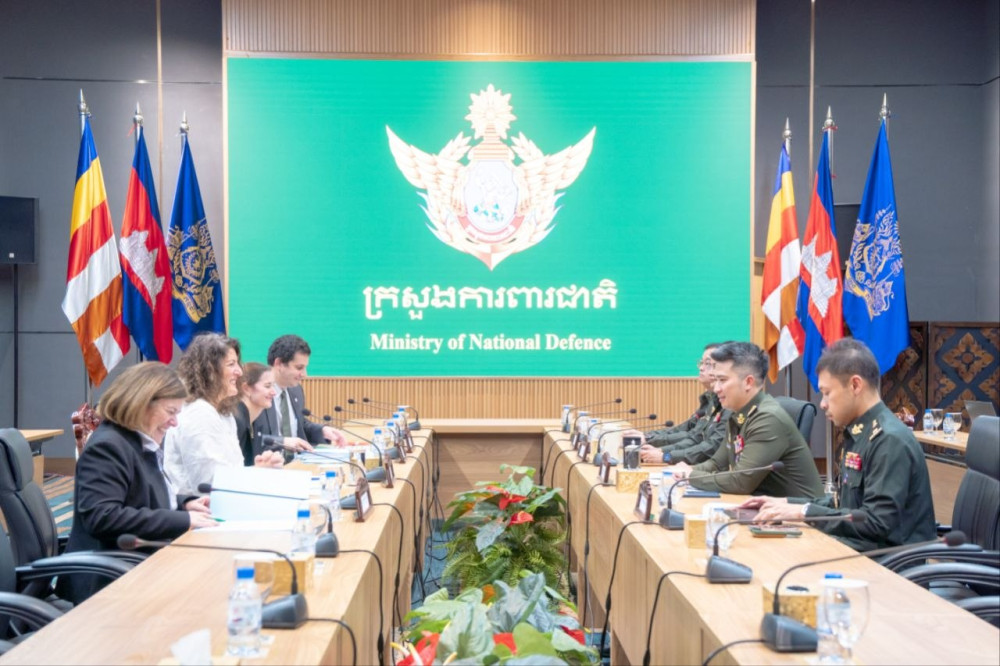
A secondary asymmetry emerged in the post-ceasefire humanitarian record. Between January and April 2026, Thailand’s Ministry of Foreign Affairs published two statements on ICRC field visits to Thai provinces affected by the fighting, identifying dates, provinces, and visit purposes: a January 20-23 mission to Sa Kaeo, Buri Ram, and Si Sa Ket, and a February 16-19 mission to Trat, Sa Kaeo, and Surin. Cambodia’s defence ministry met with ICRC delegations on January 12 and April 1. Both meetings were acknowledged in official Cambodian releases. Neither release identified provinces, dates, or findings from any Cambodian-side field assessment. The April 1 release referenced “a recent field visit to border areas” without further specification. The reason for the discrepancy in publication detail was not addressed in the official records reviewed for this report.
Neither government has placed in the public record any direct engagement with the internal tension in Thailand’s own legal position: the simultaneous invocation of Geneva Convention POW rules rules that exist only inside international armed conflict and the consistent avoidance, in official materials, of the phrase that makes those rules legally coherent.