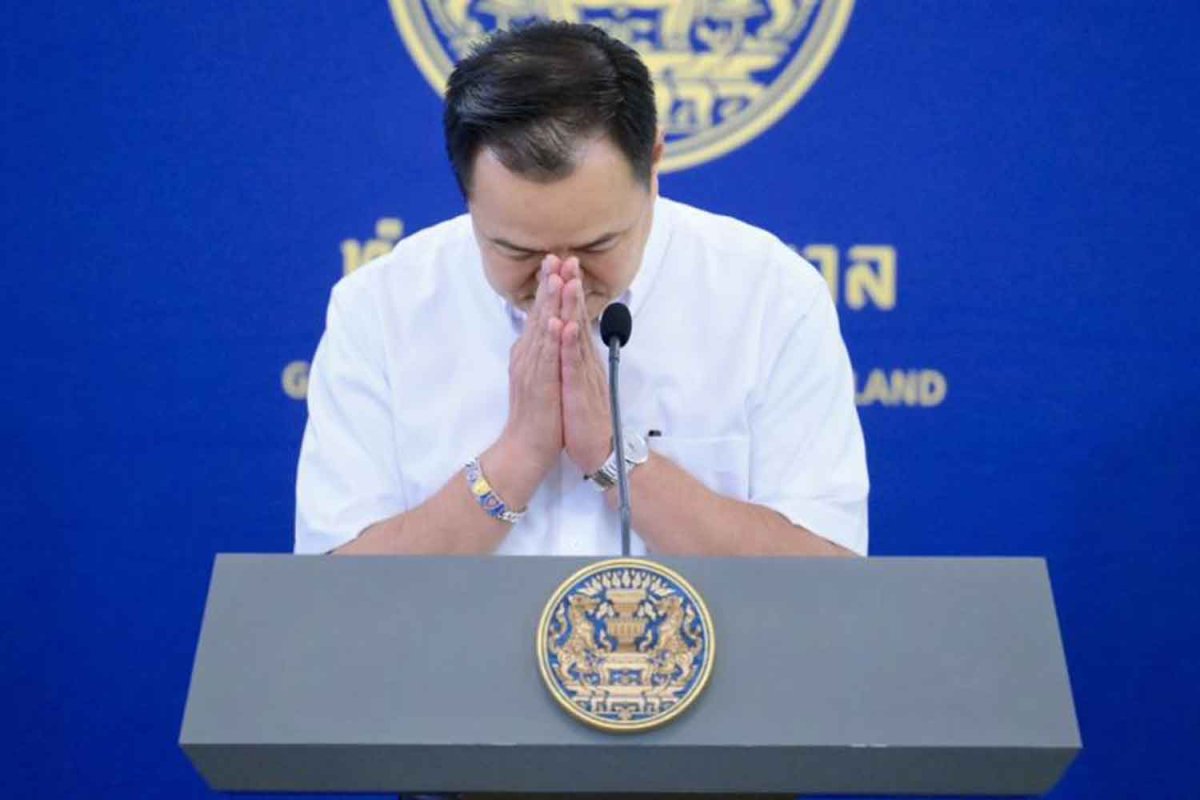
On 2 April 2026, Thailand’s Public Relations Department published an official government statement naming the smuggling of fuel to Cambodia a threat to national security. Three days later, a nationwide poll found 66.26 percent of Thai respondents felt little or no sympathy for Prime Minister Anutin Charnvirakul’s government handling the energy and economic crisis. No court filing, no police case number, no navy seizure record, and no customs file has been made public to support the security allegation.
The sequence matters because it is documented. A government with a collapsing domestic legitimacy base reached for a Cambodia-facing security narrative in the same week its polling numbers published. Whether fuel was being smuggled is a separate question from whether a government under acute domestic pressure chose to announce a security threat against Cambodia before it had evidence to prove one.
The confidence figures released on 5 April by the National Institute of Development Administration, drawn from 1,310 interviews conducted 31 March to 1 April, are specific. Finance Minister Ekniti Nitithanprapas, the technocrat Anutin retained to manage fiscal response to the crisis, recorded a combined low-or-no-confidence figure of 77.48 percent: 40.38 percent of respondents reported no confidence at all, 37.10 percent not very confident. Commerce Minister Suphajee Suthumpun recorded 62.59 percent low or no confidence. Foreign Minister Sihasak Phuangketkeow recorded 59.77 percent. The three ministers were presented as a crisis-management credential when Anutin retained them in his cabinet endorsed by royal warrant on 31 March. The polling found no stabilising effect on public sentiment. A separate King Prajadhipok’s Institute poll, published on 3 April, found 82.1 percent of respondents had little or no confidence in the new administration’s ability to manage the economy if the Middle East conflict persisted.
The domestic context for these numbers is an energy shock of unusual severity. The conflict that began in late February 2026 disrupted tanker movements through the Strait of Hormuz, driving Brent crude to $115.66 per barrel when markets opened on 31 March. Thailand, a net importer of petroleum, faced eight retail price adjustments since mid-March, reaching a record 50.54 baht per litre for diesel by 5 April. The Oil Fuel Fund, the state buffer mechanism, was carrying a negative balance of 48,217 million baht, with diesel compensation running at approximately 1,442 million baht per day, according to PRD figures published on 2 April. The fund’s financial position means the government cannot sustain current subsidy levels indefinitely without a policy change it has not yet announced.
The political deterioration is dated precisely. On 19 March, Anutin told reporters Thailand had no issues buying oil and that public confidence would be ensured. On 28 March, he issued a public apology for what Thai PBS described as turmoil in oil price management, acknowledging the conflict had proved more prolonged than his government had initially assessed. The nine-day distance between the assurance and the apology is on the record.
Into this environment, the PRD’s 2 April statement introduced Cambodia as the destination for fuel the government alleged was being smuggled out of Thailand. The language applied was a threat to national security. Anutin is reported to have ordered prosecutions. The statement did not address a contextual fact Reuters had reported on 18 March: that Thai-Cambodian fuel trade had already stopped following the bilateral border conflict, and that Cambodia was sourcing petroleum from Singapore and Malaysia because supply through Thailand had ceased. The Thai government’s statement named Cambodia as a smuggling destination while formal bilateral fuel trade between the two countries was not occurring.
Cambodianess, an independent Cambodian news outlet, reported on 3 April that Prime Minister Hun Manet ordered an investigation and said that if fuel companies were found to be involved, their licences had to be terminated. Energy Minister Keo Rottanak, who had previously coordinated Cambodia’s supply diversification to Singapore and Malaysia, was named to lead the inquiry. MQC has not independently verified the investigation’s current status against official Cambodian government sources.
The gap the PRD statement left open is Cambodia’s operational concern. The allegation is published and on the official record. The enforcement documentation that would confirm it seizures, prosecutions, chain of custody has not been published. If Thai enforcement subsequently produces case records, the analytical picture adjusts. On the present record: a government with a 66.26 percent low-or-no-sympathy rating named Cambodia a national security threat destination for an alleged criminal enterprise in the same week that figure was produced.
The strongest counter-reading is straightforward: the allegation and the confidence collapse are coincidentally timed. Fuel price shocks generate smuggling pressure at commodity borders; the absence of published case records reflects an enforcement process that is open, not a political construction that has none. Governments under legitimacy pressure also conduct routine law enforcement. That alternative is not ruled out by what is available. What the evidence does not support is the claim that the allegation’s political timing is irrelevant to how it should be read.
Thailand and Cambodia have bilateral mechanisms for fuel trade, border security, and economic coordination. None of those mechanisms were publicly invoked in the 2 April PRD statement. The statement named a national security threat. The enforcement record needed to prove it has not been published.