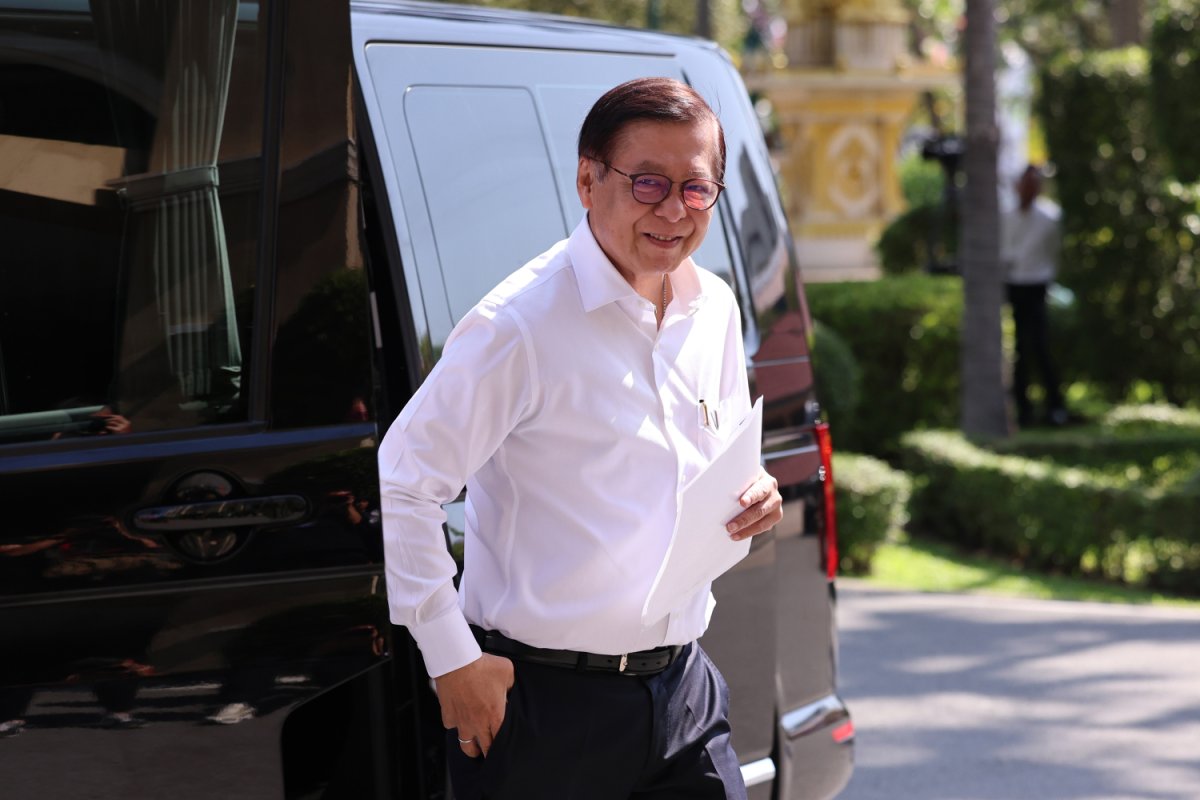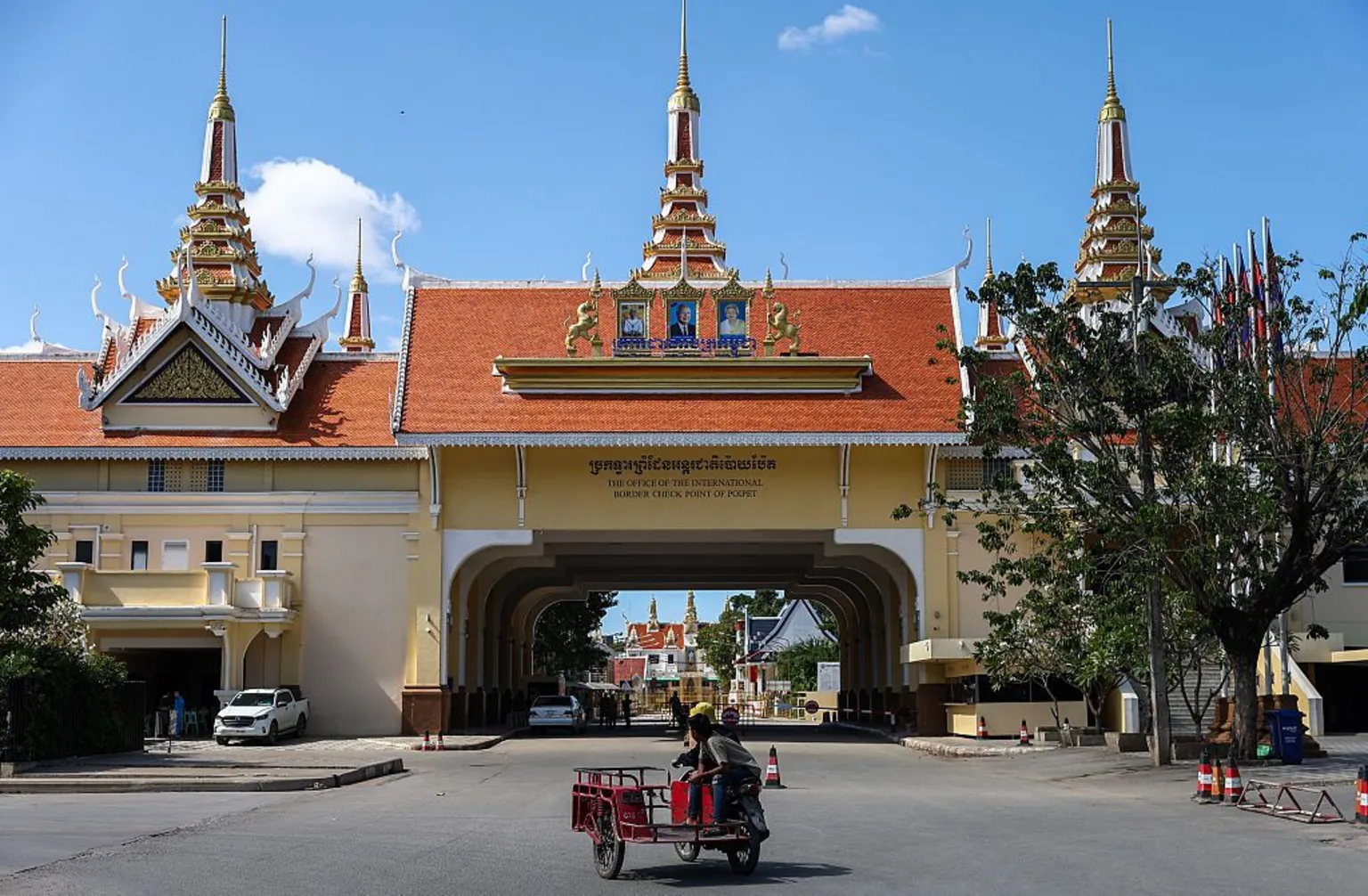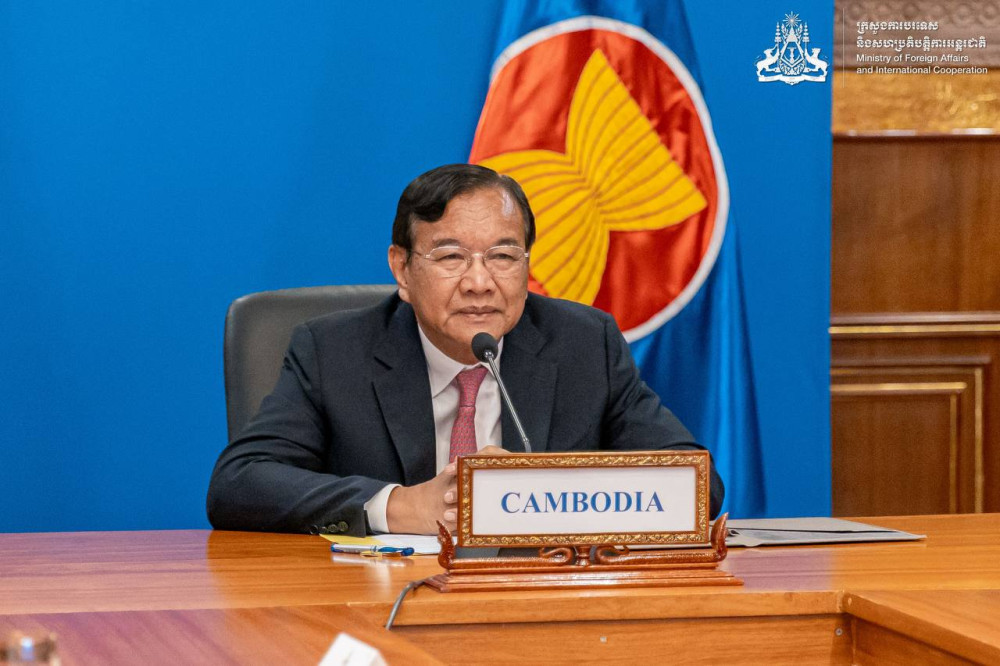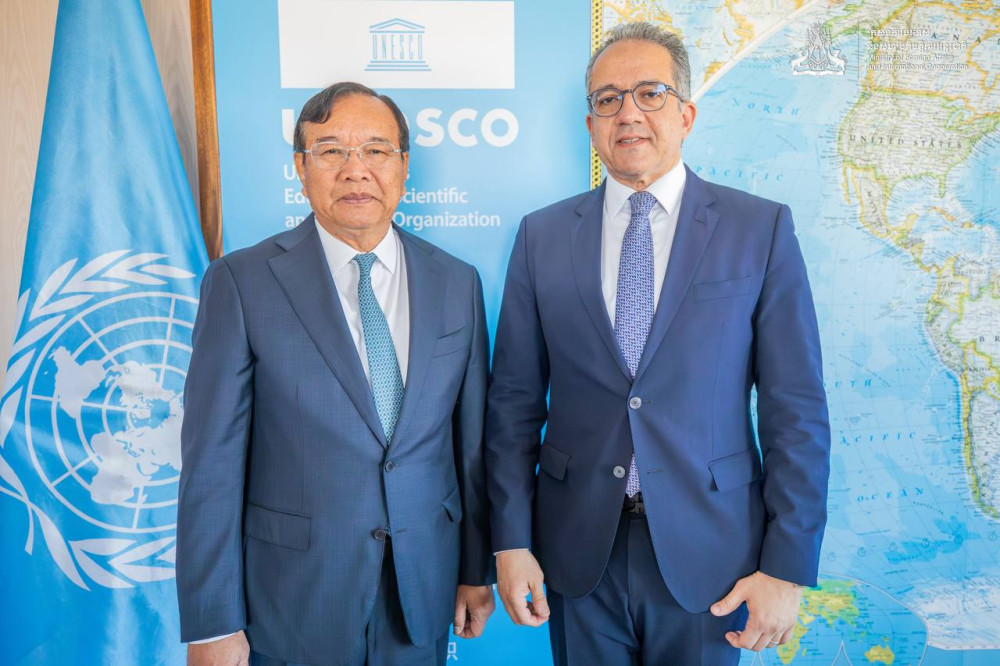
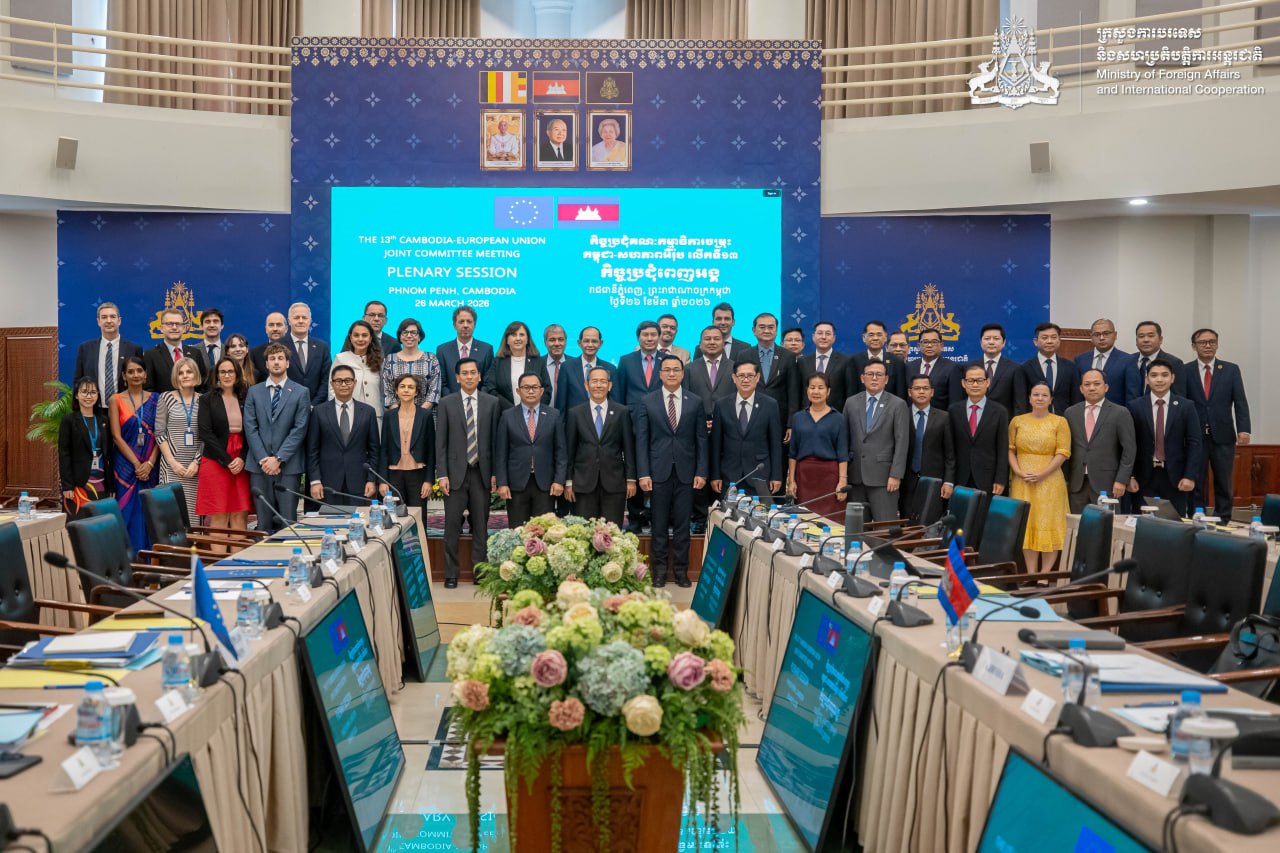
The European Union and Cambodia confirmed €7.2 billion in bilateral goods trade at their 13th Joint Committee meeting in Phnom Penh on 26 March, the first formal bilateral session between the two sides since Cambodia and Thailand declared a ceasefire in December 2025.
The meeting’s joint press release, published by the European External Action Service, handled EBA preferential trade, human rights, and the border conflict on three separate tracks. The EU’s partial withdrawal of Cambodia’s EBA preferences in force since August 2020 over civil and political rights violations was not extended or modified. The border conflict appeared in the press release’s final section, alongside Ukraine, the Middle East, and Myanmar.
The EBA framework
Cambodia’s preferential access to the European market rests partly on “Everything But Arms,” the EU’s duty-free quota-free preference for least-developed countries. In August 2020, the European Commission partially withdrew those preferences covering selected garments, footwear, travel goods, and sugar, amounting to approximately €1 billion of Cambodia’s annual EU exports citing serious and systematic violations of civil and political rights. The Commission has published no reinstatement act.
The withdrawal procedure is governed by Article 19 of GSP Regulation No. 978/2012, which requires a finding of serious and systematic violation of principles in a defined set of conventions, including the ICCPR and core ILO standards. The regulation does not list interstate border conflict as a trigger.
The period before the meeting
The EEAS last addressed the border conflict in a public statement on December 8, 2025 three sentences calling for maximum restraint and readiness to support demining. The ceasefire was declared on December 27. No further EEAS public statement on the conflict has been located in the period between December 8 and the March 26 Joint Committee.
During the same period, the US Embassy in Phnom Penh issued a security alert on January 2. The US government announced a $45 million package for border stabilisation, demining, and anti-trafficking support on January 9.
The Myanmar record
After Myanmar’s February 2021 military coup, the European Parliament called on the Commission to consider opening an EBA withdrawal investigation into Myanmar. The Commission did not act on the call. Per the Commission’s own country trade page, 90% of Myanmar’s eligible exports to the EU entered at preferential rates in 2023.
The meeting’s three tracks
On trade: both sides discussed Cambodia’s transition from EBA to standard GSP ahead of its projected LDC graduation in 2029, under which standard GSP replaces EBA’s duty-free quota-free depth. Two Global Gateway flagships the Bakheng Water Treatment Plant and the Partnership in Education for Green and Digital Jobs were reaffirmed. The 2025 bilateral goods figure of €7.2 billion compares to a 2024 Eurostat baseline of €6.440 billion.
On human rights: both sides acknowledged “significant divergences” on civil and political rights, freedom of expression and media freedom, labour rights and business accountability, and rule of law and justice reforms, and agreed to continue dialogue. The European Parliament recorded a 27-year sentence for former opposition leader Kem Sokha in a March 2023 resolution and named Cambodia among ten countries responsible for 80% of documented transnational repression cases in a November 2025 resolution. Cambodia’s 2024 UPR addendum states that its Criminal Code does not restrict legitimate expression or assembly.
On regional and global issues: the Cambodia-Thailand border conflict was addressed alongside Ukraine, the Middle East, Myanmar, and EU-ASEAN cooperation. The press release records no specific EU position on the MoU 2000 framework, the ASEAN Observer Team’s field operations, or the post-ceasefire territorial questions.
Structure and precedent
The 12th Joint Committee, held in Brussels in April 2024, used the same three-subgroup structure trade and investment, cooperation, and institution building/governance/human rights with regional issues handled separately. Comparable EU bilateral mechanisms with the Philippines, Lao PDR, and Vietnam follow the same compartmentalised format.
The 14th Joint Committee will be held in Brussels.