IFAD approved its first loan to Cambodia in 1996. The country was five years out from the Paris Peace Accords, rebuilding institutions that had been systematically destroyed, running a rural economy that had barely cleared subsistence. The loan was a food-security instrument for a country that needed one.
Thirty years later, the Ministry of Commerce announced on April 1 the allocation of USD 1.5 million in grant financing under the Accelerating Inclusive Markets for Smallholders project to expand commercial value chains for Khmer chicken, safe vegetables, and premium rice across 18 provinces, according to Agence Kampuchea Presse. The institutional distance between those two moments is the story.
AIMS is implemented by the Ministry of Commerce and co-financed by the Royal Government of Cambodia and IFAD. The ministry selects the priority commodities, directs provincial implementation, and decides which value chains enter or expand within the program. IFAD provides financing. Cambodia determines the program’s commercial architecture. That is not the framing in the press release. It is what the institutional structure shows when read against the record.
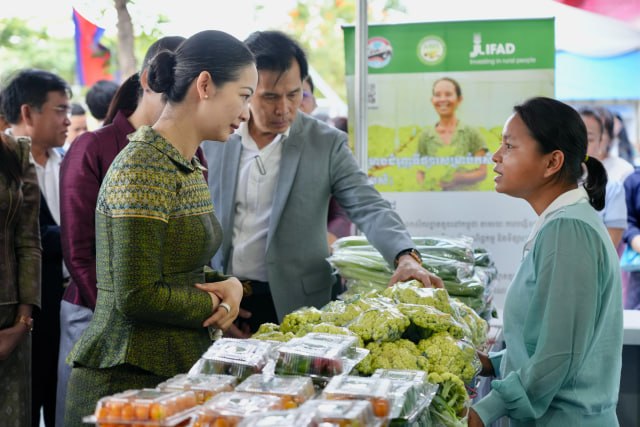
In 2025, AIMS disbursed nearly USD 1 million to support 686 rural households as initial market participants in the Khmer chicken and safe vegetable value chains, according to the AKP announcement. Households entered as what the project calls “first movers” — testing commercially viable technologies and business models before broader replication. In 2026, premium rice enters the portfolio for the first time. Support expands to an additional 1,400 households. As of the first quarter of 2026, total disbursements under the Value Chain Innovation Fund reached USD 6.21 million, benefiting 5,271 rural households since the project began.
“By reducing investment risks and promoting practical, market-oriented solutions, we are enabling smallholder farmers, particularly women and poorer households, to adopt improved technologies, increase productivity and strengthen their linkages to reliable markets,” said Eng Sothyvon, Director General of the General Department of Domestic Trade and Project Director, in the AKP statement.
The commodity choices are not arbitrary. Premium rice connects to Cambodia’s documented export position. The country’s Phka Rumduol variety won the World’s Best Rice award for the seventh time in November 2025. Khmer chicken occupies a domestic premium segment with distinct identity and price premium over industrially produced alternatives. Safe vegetables carry food-safety certifications that open formal retail and export channels closed to uncertified production. The Ministry of Commerce is not selecting crops for subsistence. It is selecting market positions for commercial entry.
That selection is happening against a specific deadline. Cambodia graduates from Least Developed Country status on December 19, 2029. Graduation is not a development milestone in the conventional sense. It is an exposure event. The EU’s Everything But Arms arrangement, which provides zero-tariff access for Cambodian exports, ends at graduation. Rules-of-origin thresholds rise from 30 to 60 percent domestic value-add. Trade preferences that have underwritten Cambodia’s garment and rice export competitiveness for years disappear simultaneously. UNDP estimates the unmitigated GDP impact at approximately 2 percent. The commercial infrastructure Cambodia builds before 2029 is what remains when the preference architecture is gone.
The 30-year IFAD partnership that frames the current announcement has a documented scale. Since 1996, IFAD has helped finance 12 rural development programs for a total investment of approximately USD 1 billion, of which USD 349 million came from IFAD’s own resources, according to IFAD documentation from May 2024. Those investments have benefited over 1.56 million households across Cambodia. The trajectory across that period runs from food security and rehabilitation through institutional capacity-building to the current market-commercialization orientation. AIMS, launched in 2017 with total project financing of approximately USD 45 million including a USD 36.3 million IFAD loan, sits at the end of that arc.
“As IFAD and Cambodia mark 30 years of partnership this year, this support underscores the importance of continuing to invest in solutions that help rural smallholders achieve deeper market integration, expand rural employment and strengthen resilience more effectively, with particular attention to women and other groups at risk of being left behind,” said Frew Behabtu, IFAD Country Director for Cambodia, in the AKP release.
Two figures associated with this program in prior coverage require flagging. A claim of nearly 95,000 households reached and USD 245 million in cumulative trade generated by the AIMS program have not been independently verified against primary documentation in the current review. VCIF Window 1 disbursements account for 5,271 households. The full 30-year IFAD portfolio reaches 1.56 million. The 95,000 figure sits between those reference points without a confirmed source. The USD 245 million cumulative trade figure does not appear in any primary IFAD, AIMS, or government document reviewed. Both figures are excluded from this analysis pending documentary confirmation.
What the confirmed record does show is a program designed to operate without permanent subsidy. AIMS is built to demonstrate commercially viable models that replicate through market incentives rather than continued grant dependency. The 5,271 households currently participating represent a small fraction of Cambodia’s estimated 6.8 million farmers, three-quarters of whom are classified as small-scale. The replication question whether the commercial models demonstrated under VCIF Window 1 scale beyond the grant phase and on what timeline is not addressed in the current announcement.
Institutional agency and institutional accountability are not competing demands. They are the same demand, directed at the same actor. A ministry that selects the commodities, directs the implementation, and runs the program through its own provincial departments is exercising authority. That authority carries a transparency obligation the confirmed record does not yet fully satisfy.