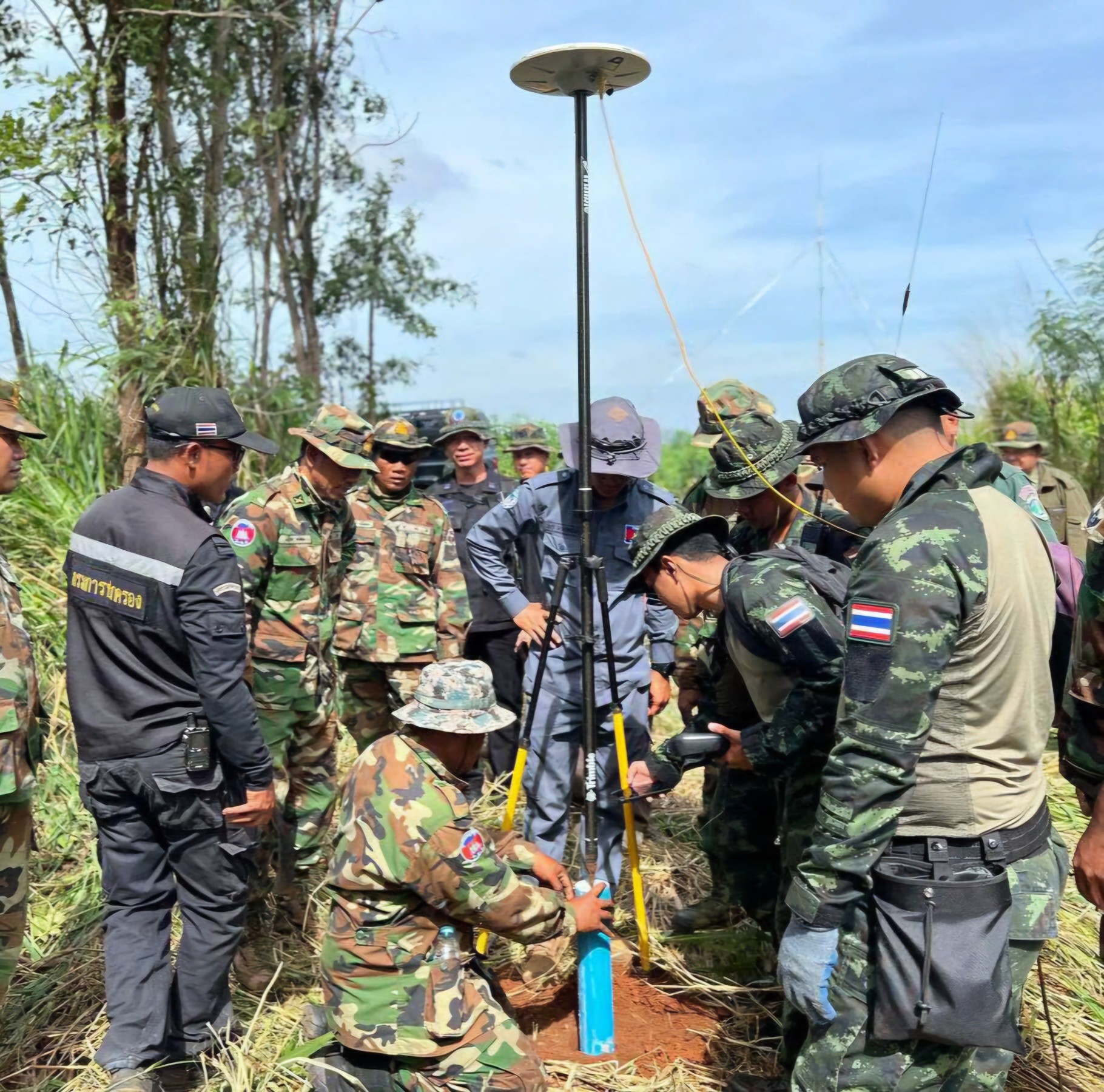
On April 11, Cambodia’s prime minister publicly asked Thailand to begin the border demarcation work both countries committed to when they agreed to stop fighting in December. The same week, Thai soldiers were building a fence on a segment of the border that Cambodia had just proposed surveying together, on which both countries had joint survey teams operating five months earlier.
Hun Manet’s Facebook post, published in both Khmer and English, quoted in full a provision of the December 27 Joint Statement requiring the Joint Boundary Commission to resume “at the earliest” survey and demarcation work, with “first and foremost priority” given to areas where displaced civilians once lived. “Cambodia is fully ready,” he wrote.
Since the ceasefire took effect on December 27, Cambodia’s State Secretariat of Border Affairs has sent at least five diplomatic notes to Thailand’s JBC requesting a special meeting and the deployment of joint survey teams, according to statements published by SSBA and the Agence Kampuchea Presse. Thailand has not agreed to a single meeting.
The first request, dated December 28, proposed convening in Siem Reap during the first week of January. Thailand asked to postpone, citing internal procedures. Cambodia re-proposed on January 5 for the second or third week of January. Thailand postponed again, citing the need to appoint a new JBC composition after the February 8 general election and the formation of a new cabinet. A third request on January 13 asked Thailand to at least dispatch joint survey teams to resume placing temporary boundary markers at segments both countries had previously agreed to work on. No deployment followed. A fourth note, dated January 31, urged Thailand to set a date. As of February 1, Thailand had not responded.
Thailand committed to this timeline at the United Nations. In a letter circulated to the General Assembly and the Security Council on January 19, Thailand’s Permanent Representative stated that Thailand “intends to resume the activities of the Joint Boundary Commission at the earliest practical opportunity” once the new cabinet is formed after the February election. The cabinet received royal approval on March 31. The government took office in early April with Sihasak Phuangketkeow retained as foreign minister.
Cambodia’s fifth Note Verbale, dated April 7, proposed a special JBC meeting in Siem Reap between April 17 and 22, with joint survey teams deploying between April 20 and 24 to boundary pillars 42 through 47 in Chouk Chey and Prey Chan villages in Banteay Meanchey, and pillars 52 through 59 in Kamrieng district, Battambang.
Both countries had joint survey teams actively working on the segment between pillars 52 and 59 in November 2025. According to Royal Thai Navy spokesperson Rear Admiral Parach Rattanachaiphan, the joint Thai-Cambodian survey team completed temporary boundary marking along that 8.3-kilometre stretch over 16 days, placing 166 reference points.
On March 18, Thailand’s military announced plans to begin constructing a border fence in April in Chanthaburi province, covering the stretch between boundary markers 52 and 54. Thai officials said the 1,310-metre pilot project was “not linked to any territorial dispute.”
Thailand’s foreign minister has outlined conditions for JBC engagement that do not appear in the December 27 agreement. Speaking after a cabinet meeting on March 10, Sihasak told Nation Thailand that mine clearance and the suppression of scam networks were matters Cambodia must address, and that if Cambodia was not ready for mine clearance while Thailand was, Cambodia would still have to cooperate. A Thai MFA press release on March 11 added that survey and demarcation “cannot proceed while the situation along the border has not yet stabilized.”
The December 27 Joint Statement treats mine safety differently. Point 3 states that both parties agreed to “utilize Joint Boundary Commission’s existing mechanisms to ensure safety and security of the joint survey team on the ground, including its safety from landmines.” The MoU on Survey and Demarcation of Land Boundary, signed by both countries in 2000, contains the same formulation: “the joint survey team shall first be assured of its safety from landmines.” Both texts assign mine safety as an operational responsibility of the joint survey team during field work, not as a precondition one party must complete before the mechanism activates.
Thailand’s own UN filing draws the same distinction. In the same January 19 letter, paragraph 9, Thailand stated that “humanitarian demining, through existing practical cooperation between National Mine Action Centres and other mechanisms, operates in parallel with, and without prejudice to, the survey and demarcation work.”
Cambodia’s government spokesman Pen Bona said in March that the SSBA had requested joint survey teams resume installing temporary markers at Chouk Chey, Prey Chan, and Kamrieng, as well as the reconstruction of 15 boundary pillars based on original French-era models at agreed locations. Cambodia’s position “remains clear and consistent,” he said.
Four days before Cambodia sent its April 7 Note Verbale, Thailand’s military invited journalists to tour the O’Smach compound in Oddar Meanchey province, an area Thailand seized during the December fighting. The AP reported the complex spans 197 acres and housed an estimated 10,000 scam workers. O’Smach is one of the locations Cambodia’s April 7 Note Verbale proposed for joint survey and temporary marker installation.
Manet’s April 11 post contained no accusation, named no Thai official, and did not mention the unanswered requests or the fence construction. He quoted the Joint Statement, expressed hope Thailand would “continue to adhere,” and stated Cambodia’s readiness.
Whether Thailand responds to the fifth request before the proposed April 17 meeting date will test whether the mechanism the ceasefire created to prevent the next war is operating or empty.