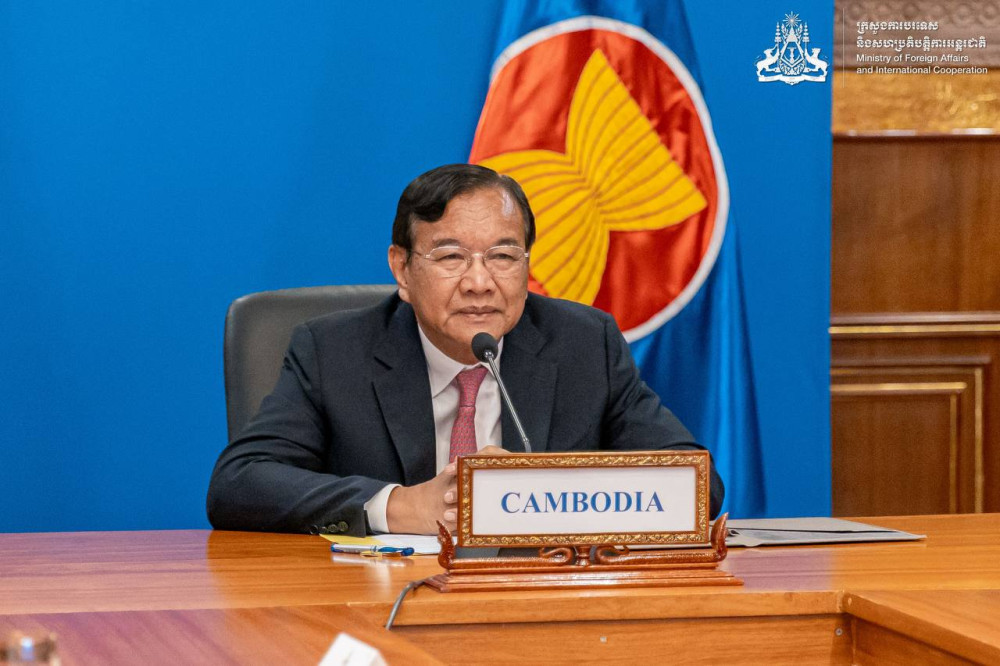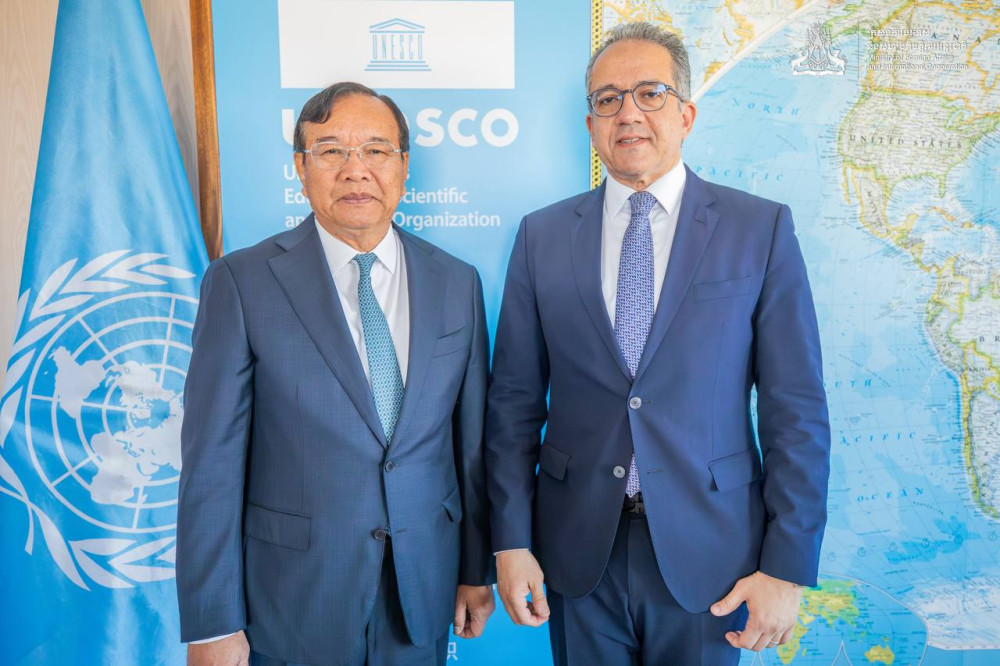

Cambodia and the Asian Infrastructure Investment Bank held high-level talks in Phnom Penh on April 1, with Cambodian official channels reporting that both sides are advancing a proposed Country Cooperation Framework for 2026 to 2030 with a reported value of up to approximately $2 billion. The meetings involved Prime Minister Hun Manet, who received AIIB President Zou Jiayi at the Peace Palace, and Deputy Prime Minister Aun Pornmoniroth, Cambodia’s finance minister and AIIB governor, who held a separate session focused on the framework negotiations according to reporting attributed to the Ministry of Economy and Finance.
The proposed successor framework has not been confirmed in any primary AIIB document located before this report. The $2 billion figure rests on Cambodian-side reporting carried across AKP, Fresh News, and the Cambodian People’s Party website, with a Khmer-language release attributed to MEF stating that AIIB committed to pushing for CCF approval and signing priority projects by year according to plan. No signed framework text, AIIB board paper, or formal AIIB announcement confirming the amount has been located.
Cambodia is scheduled to graduate from Least Developed Country status in 2029, a threshold that will terminate preferential trade access under the European Union’s Everything But Arms arrangement and equivalent GSP schemes. A World Bank regional connectivity assessment places Cambodia’s annual public infrastructure investment at approximately 3.2 percent of GDP against an estimated annual need of around 10 percent of GDP. At $2 billion disbursed over five years, the proposed framework would average $400 million per year an amount equal to, on an analytical computation conditioned on static GDP, approximately 12 percent of the implied annual infrastructure investment gap at current GDP levels. That calculation is not a disbursement projection; it is a measure of the gap the framework would need to address if fully drawn.
The prior Cambodia-AIIB Country Cooperation Framework, endorsed by both sides in July 2023 and covering 2023 to 2025, carried a $1.3 billion proposed-project pipeline. AIIB confirmed in June 2025 that its $100 million CAISAR climate-resilient irrigation loan was aligned with that framework. The proposed 2026 to 2030 successor would represent a 54 percent increase over the prior planning envelope.
The Architecture Behind the Figure
AIIB primary documents do not support treating the reported $2 billion as a binding loan commitment or an already-booked portfolio increase. AIIB’s Corporate Strategy Midterm Review describes the bank’s multi-year rolling pipelines as instruments built to improve pipeline predictability and foster closer client relations, with separate legal agreements and project-by-project approvals still required before individual financing is activated. An AIIB appraisal document for a Türkiye sovereign facility describes a project under such a pipeline as having a “preliminary indicative pipeline” subject to further adjustment during implementation. AIIB’s February 2026 announcement of a Partnership Framework Agreement with Kazakhstan described a $6 billion MYRP for 2025 to 2029 explicitly as a “strategic planning framework,” distinct from the legal and operational agreement that AIIB signed alongside it.
The Cambodian release attributed to MEF uses language consistent with that architecture. The Khmer-language text, as mirrored by Fresh News, attributes to Zou Jiayi a commitment to continue coordinating and pushing for CCF approval and signing priority projects by year according to plan. That language describes process, not disbursement certainty.
The unresolved question in the record whether the $2 billion represents an agreed ceiling, a Cambodian negotiating target, or an AIIB indicative planning envelope cannot be answered from the sources retrieved before this report. It is the question a primary signed document would settle.
Cambodia’s Confirmed AIIB Portfolio
AIIB’s confirmed sovereign loan record in Cambodia covers six facilities approved since the country joined as a founding member in May 2016, totaling $403 million in sovereign approvals: the $60 million National Restoration of Rural Productive Capacity Project approved in December 2020; the $50 million Rapid Immunization Support and Resilient Health Infrastructure Project approved in March 2022; the $33 million Cross-border Livestock Health and Value-chain Infrastructure Improvement Project approved in September 2023; the $80 million Integrated Water Resources Management Project approved in December 2024; the $100 million CAISAR loan signed in June 2025; and the $80 million NRRPCP-II approved in December 2025. Two nonsovereign COVID-era facilities a $75 million response facility for PRASAC and a $100 million emergency facility for ACLEDA bring the broader identified portfolio to approximately $578 million in combined sovereign and nonsovereign approvals, alongside grant and interest buy-down support through AIIB’s Special Fund Window for Less Developed Members.
Cambodia’s $403 million in identified sovereign AIIB approvals represents approximately 3.1 percent of Cambodia’s total public debt stock. MEF’s Public Debt Statistical Bulletin, cited by AKP in March 2026, placed Cambodia’s total public debt at $13.05 billion at year-end 2025, of which $12.81 billion was public external debt. MEF data places the face-value public debt ratio at approximately 26.59 percent of GDP.
The Debt Arithmetic
The IMF’s 2025 Article IV assessment projects Cambodia’s public debt rising moderately to 27.6 percent of GDP by 2030 and characterizes overall debt distress risk as low. An additional $2 billion in external borrowing, fully contracted and drawn at static nominal GDP, would move the face-value ratio to approximately 30.7 percent — above the IMF’s 2030 projection by approximately 3.1 percentage points. The IMF low-distress characterization was rendered at current debt levels; the assessment at 30.7 percent would require a separate IMF analysis to confirm.
The practical disbursement picture is more gradual. CCF financing flows project by project across multiple years, not as a single drawing. Cambodia has consistently deployed AIIB support as part of a multi-financier architecture: the CAISAR project combines AIIB’s $100 million with $40 million in GCF loans, a $40 million GCF grant, $45 million from IFAD, and a $15 million Cambodian government counterpart contribution. The proposed CCF is presented in Cambodian reporting as a framework within which additional co-financing and concessional instruments, including grants, will be sought.
AIIB’s Wider Programming Context
Cambodia is not the only country for which AIIB is advancing multi-year planning frameworks. AIIB’s Corporate Strategy Midterm Review confirms that developing such pipelines across the membership is an institution-wide strategy to build robust project pipelines and improve deployment predictability, as part of AIIB’s target to deploy at least another $75 billion by 2030 and scale annual financing toward $17 billion. Kazakhstan’s publicly disclosed $6 billion MYRP and AIIB’s documented programming engagement in Indonesia, Türkiye, and Bangladesh position Cambodia’s proposed framework inside an institution-wide rollout, not exclusively as a bilateral response to Cambodia’s 2029 graduation timeline.
Cambodia’s reported sector priorities within the framework clean energy, transport logistics, digital infrastructure, and private sector development align with AIIB’s stated institutional priorities of climate change and clean energy, regional connectivity, technology-enabled infrastructure, and private capital mobilization. Hun Manet is reported by Fresh News to have referenced a national target of 70 percent renewable energy by 2030 during talks with Zou Jiayi.
AIIB’s governance structure is relevant to how the financing relationship should be characterized. China holds 26.54 percent of AIIB’s voting power. OECD member states collectively hold above 25 percent. Major institutional decisions require approval by two-thirds of members and three-quarters of voting power. Cambodia’s AIIB relationship operates through a multilateral governance architecture.
Status
The CCF for 2026 to 2030 has not appeared in published AIIB board documentation in the record retrieved before this report. AIIB’s next governors’ meeting is identified in Cambodian reporting as a likely venue for formal framework endorsement. Aun Pornmoniroth is reported to have raised the possibility of additional concessional facilities and grants within the framework, and the MEF-attributed release references AIIB’s willingness to support Cambodia’s energy transition through climate-focused policy-based financing instruments, which AIIB’s existing programming architecture includes as a product category.
Until a primary AIIB document or official Cambodian government publication confirms the $2 billion envelope, its sector allocations, and the financing instruments to be deployed, the figure carries the status of a proposed planning target publicly attributed to Cambodian official channels.
This report draws on AIIB primary project documents and corporate strategy materials; MEF debt reporting via AKP; World Bank regional connectivity analysis; UNCTAD Cambodia graduation workshop documentation; IMF 2025 Article IV press material; and Cambodian official media including AKP, Fresh News, and CPP. The primary AIIB document confirming the 2026 to 2030 CCF and its stated value was not located before publication. Output B.