Australia has funded Cambodia’s principal mechanism for public-private dialogue for more than two decades. The Government-Private Sector Forum, established in 1999 at the initiative of then-Prime Minister Hun Sen, provides a platform for consultation between the Cambodian government and business on investment climate issues. No publicly available independent evaluation has assessed whether the forum delivers on that mandate.
The Council for the Development of Cambodia serves as the forum’s secretariat. Australia was among its earliest international backers, channeling support through the International Finance Corporation before re-entering directly in 2023 through its flagship bilateral economic program, the Cambodia Australia Partnership for Resilient Economic Development.
CAPRED is an AUD 87 million initiative funded by the Australian Department of Foreign Affairs and Trade and implemented by Cowater International, a Canadian consulting firm. The program runs from 2022 to 2027. Through CAPRED, Australia provides secretariat support for the CDC, the Cambodia Chamber of Commerce, and the forum’s 16 working groups. Australian Ambassador Derek Yip attended the forum’s 25th anniversary workshop in November 2025, where Cowater described the event as a major milestone for Cambodia’s economic development.
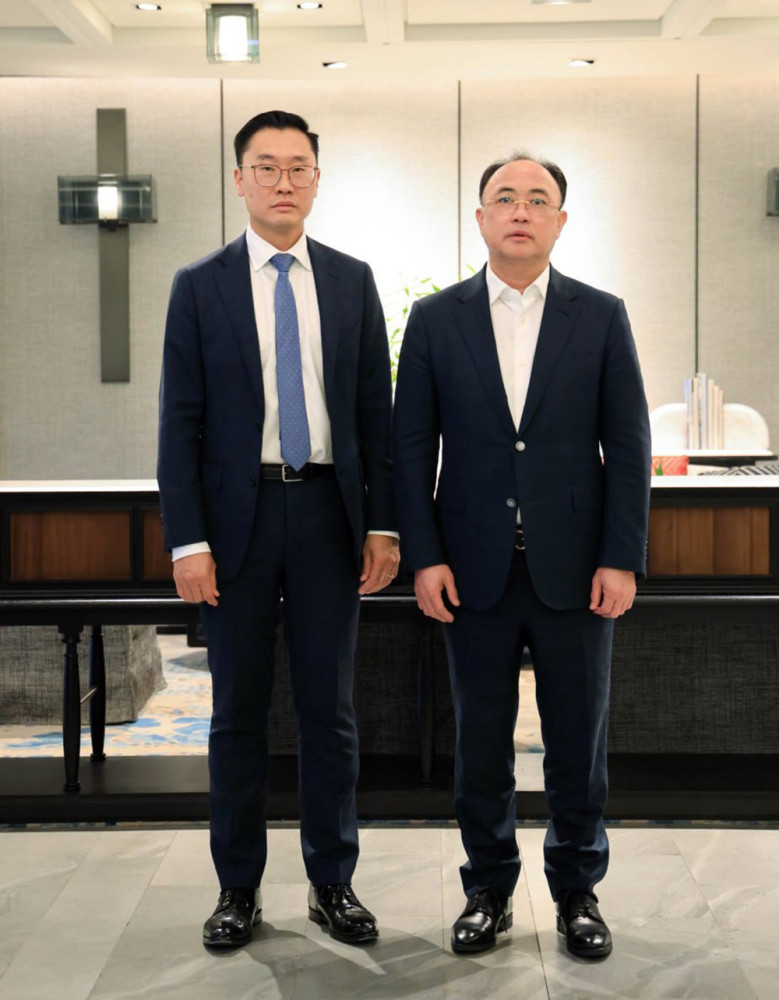
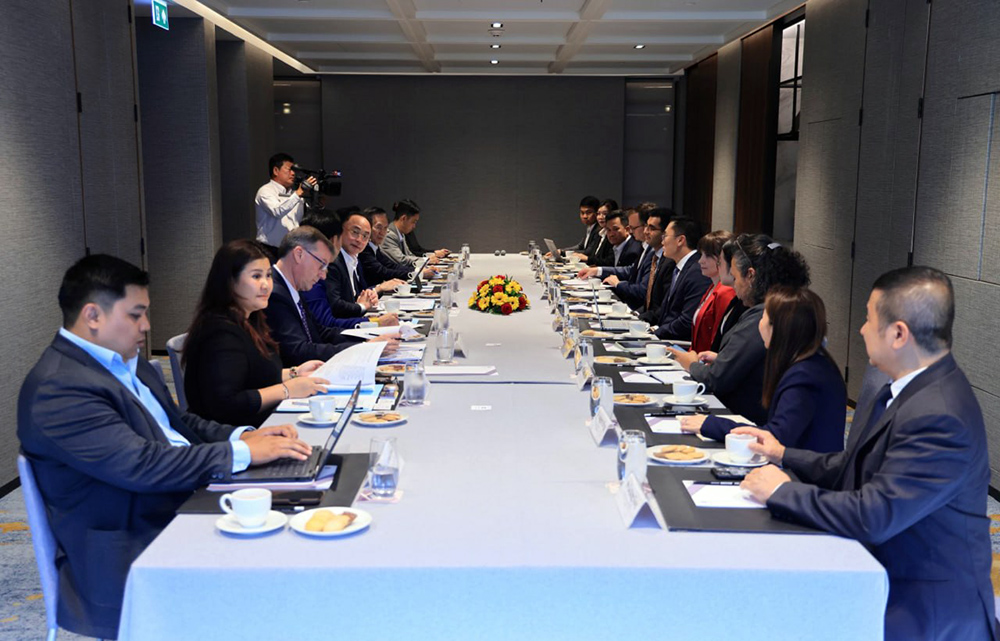
On April 6, the CCC and CAPRED held a meeting to discuss strengthening the forum’s coordination mechanisms, according to Agence Kampuchea Presse. The Australian delegation was again led by Yip. The private sector was represented by Neak Oknha Kith Meng, whom AKP identified as President of the CCC and Chairman of the Private Sector Coordinating Working Group. Both parties said they aimed to accelerate reform priorities essential for Cambodia’s economic growth. No reform specifics, financing figures, or outcome targets were disclosed.
Kith Meng’s chairmanship of the forum’s private sector coordinating committee is a government appointment. Prime Minister Hun Manet formally named him to the role in January 2025, according to Khmer Times.
Meng is chairman and chief executive of the Royal Group of Companies, Cambodia’s largest business conglomerate, with holdings in telecommunications, banking, media, real estate, and transport. He is a dual Cambodian-Australian citizen. A 2007 US diplomatic cable from the embassy in Phnom Penh, released by WikiLeaks in 2011, identified him as an advisor to then-Prime Minister Hun Sen and a member of the board of the Cambodian Red Cross, whose president is Hun Sen’s wife, Bun Rany. A 2015 joint report by Reporters Without Borders and the Cambodian Center for Independent Media found that Meng and three other individuals collectively controlled 83 percent of Cambodia’s media at the time. He has chaired the CCC since 2007 and serves as Cambodia’s chair of the ASEAN Business Advisory Council.
In June 2025, Meng established the CTN Foundation for Border Defence at the request of Senate President Hun Sen, a fund to support Cambodia’s potential legal action against Thailand at the International Court of Justice, according to Nation Thailand. In January 2026, Meng told the CCC Annual General Meeting that the chamber was a “partner of the Royal Government,” according to the Phnom Penh Post.
None of these positions or affiliations are secret. All are documented in Cambodian and international media. Whether the G-PSF’s private sector representation functions as an independent channel for business concerns or as a managed interface between the government and its own economic programming is a question the publicly available record does not address.
The forum’s own reporting says more than 4,000 issues have been reviewed, discussed, and resolved over 25 years, according to a CCC statement delivered by Meng at the November 2025 anniversary event. A CDC progress report, approved by the Council of Ministers in October 2025, said 93 percent of reform measures introduced at the 19th forum plenary had been implemented. These figures are self-reported by the CDC and CCC. The metric “resolved” is not defined in the available reporting.
The forum’s institutional architecture has consolidated since 2023. At the 19th plenary in November of that year, the secretariat was transferred to the CDC, which serves as the Royal Government’s investment promotion arm. Sun Chanthol, Deputy Prime Minister and First Vice Chairman of the CDC, chairs the forum’s government-side coordinating committee. Kith Meng chairs its private sector counterpart. Decisions made by the Prime Minister at the biannual plenary sessions have the status of cabinet decisions and are binding.
DFAT commissioned an independent mid-term review of CAPRED, published in 2025, to assess whether the program was targeting the right levers of change. The review document and management response are publicly available on DFAT’s website. The review’s findings on the forum component specifically could not be confirmed from the sources available for this analysis. That document is the only publicly known independent assessment of whether Australian support for the forum is producing structural change or sustaining an existing arrangement.
Yip was most recently Assistant Secretary of DFAT’s East Asia Political Branch and has served on two postings to China. He speaks Mandarin. His appointment was announced by Foreign Minister Penny Wong under Australia’s “Invested: Australia’s Southeast Asia Economic Strategy to 2040,” which identifies increasing trade and investment links with Cambodia as a priority.
CAPRED’s programming extends well beyond the G-PSF. The program operates across agriculture, trade, and infrastructure, with concrete outputs including a water treatment plant in Kampong Thom providing clean water to more than 10,000 residents, an infrastructure bond regulation developed with Cambodia’s securities regulator, and a rice export partnership that sent 400 metric tonnes of Cambodian jasmine rice to Australia in early 2026.
The G-PSF component produces a different kind of output: working group meetings, reform tracking, secretariat capacity. Whether that institutional process serves the businesses the forum claims to represent is a question the publicly available record does not address.
The AKP report on the April 6 meeting cited only a CCC statement. No independent business voice appeared. No reform detail was specified.