
A United Nations report published on February 20, 2026 found that survivors of Southeast Asia’s scam compound industry face arrest, detention, fines and criminal prosecution after being freed from the compounds that held them. The report, titled “A Wicked Problem,” documented abuses affecting an estimated 300,000 people from 66 countries trafficked into forced online fraud operations, according to the OHCHR. Its central recommendation was the implementation of a non-punishment principle: the legal standard that trafficking victims should not be prosecuted for crimes they were coerced into committing. As of April 2026, no Mekong state has fully implemented it.
International coverage has framed the crisis primarily through Cambodia. That framing obscures a record that is more complicated than any single country narrative allows.
Cambodia’s Commission for Combatting Online Scams reported sealing 190 compound locations and arresting 173 senior figures by February 2026. A cumulative operational tally showed 5,106 suspects detained across 118 locations over seven months. The Interior Ministry cited more than 30,000 suspected foreign scammers detained or deported since the campaign intensified in June 2025, with a further 210,000 reported to have left voluntarily; the broader ministerial figure encompasses a different denominator than the operational suspect count. Cambodia extradited Prince Group founder Chen Zhi to China in January 2026 and arrested casino owner Ly Kuong on charges including fraud, money laundering and unlawful recruitment for exploitation. The National Bank of Cambodia froze Prince Bank’s operations. At the ASEAN-U.S. Summit the same month, the United States and Cambodia agreed to expand cooperation on combating transnational crime organizations including scam centers, and the United States removed its arms embargo on Cambodia, citing Cambodia’s “diligent pursuit of peace and security.”
No other Mekong state has produced a comparable public enforcement record. Thailand’s Central Investigation Bureau reported arrests in 29,413 cases in 2025, with a separate operation targeting personal data trade involving nine million records and 14 billion baht in USDT cryptocurrency transactions. Those numbers point to financial policing rather than compound-clearing raids. No publicly available Thai government data provides a compound-closure count. Myanmar’s most visible action was the October 2025 military raid on KK Park, which resulted in 2,198 detentions and the seizure of 30 Starlink terminals, but Reuters and the Global Initiative Against Transnational Organized Crime reported up to 100,000 people still working in scam operations along the Thai-Myanmar border, with roughly 40 compounds running along a 200-kilometre stretch. Lao PDR conducted raids in the Golden Triangle Special Economic Zone with Chinese cooperation. Shan Herald and UN-linked sources described the result as displacement rather than eradication: 75 new scam operations appeared across 34 townships after earlier disruption.
On April 3, Cambodia’s Senate unanimously passed the Law on Anti-Technology Fraud. The law imposes penalties up to life imprisonment for ringleaders whose operations result in death, 15 to 30 years for operating scam networks, and up to 20 years for trafficking and torture within compounds. According to an ASEAN guideline on the non-punishment principle adopted in 2025, the law also reportedly establishes non-criminal liability for individuals forced or coerced into participating in online scams, with a cooperation clause that may exempt or mitigate criminal exposure for victims who assist investigations. The full text was not publicly available at the time of writing.
That same ASEAN guideline named Cambodia and Singapore as the two member states without an explicit domestic non-punishment provision at the time of adoption. Vietnam had closed its gap through an amendment effective July 1, 2025. Cambodia’s April 2026 law narrows the opening, though it operates through scam-specific legislation rather than through Cambodia’s core trafficking law.
The legal comparison across the region complicates the frame that positions Cambodia as an outlier. The Philippines maintains the broadest non-punishment provision on paper, exempting trafficking victims from penalization for unlawful acts directly resulting from their trafficking. Myanmar’s 2022 anti-trafficking law is relatively strong in statute, though enforcement capacity where compounds actually operate remains limited. Thailand’s provisions are narrower than Cambodia’s new law. They cover immigration violations, document offenses and prostitution-related charges. They do not cover forced criminality: victims compelled to commit financial fraud, identity theft or cryptocurrency scams. A Thai survivor cited in the OHCHR report was imprisoned for one year and seven months after being misidentified as a perpetrator. Lao PDR’s provisions are similarly narrow, focused on prostitution and illegal immigration.
In February 2026, the Associated Press reported that the Caritas shelter in Phnom Penh, the only facility in Cambodia that takes in scam compound survivors, was carrying approximately 150 people. It had turned away more than 300. The shelter had previously received funding from USAID through Winrock International and from the International Organization for Migration. Both funding streams had been cut. Rescuers told AP that people who could not reach the shelter ended up in immigration detention or went back to compounds because there was nowhere else to go.
Jacob Daniel Sims, a visiting fellow at Harvard University’s Asia Center who has conducted field research on Cambodia’s scam industry, described the enforcement as “real” and a “material divergence” from what he characterized as earlier performative action. He also called the crackdown “politically motivated,” best understood as a government effort to mitigate reputational, legal and financial risks to connected elites.
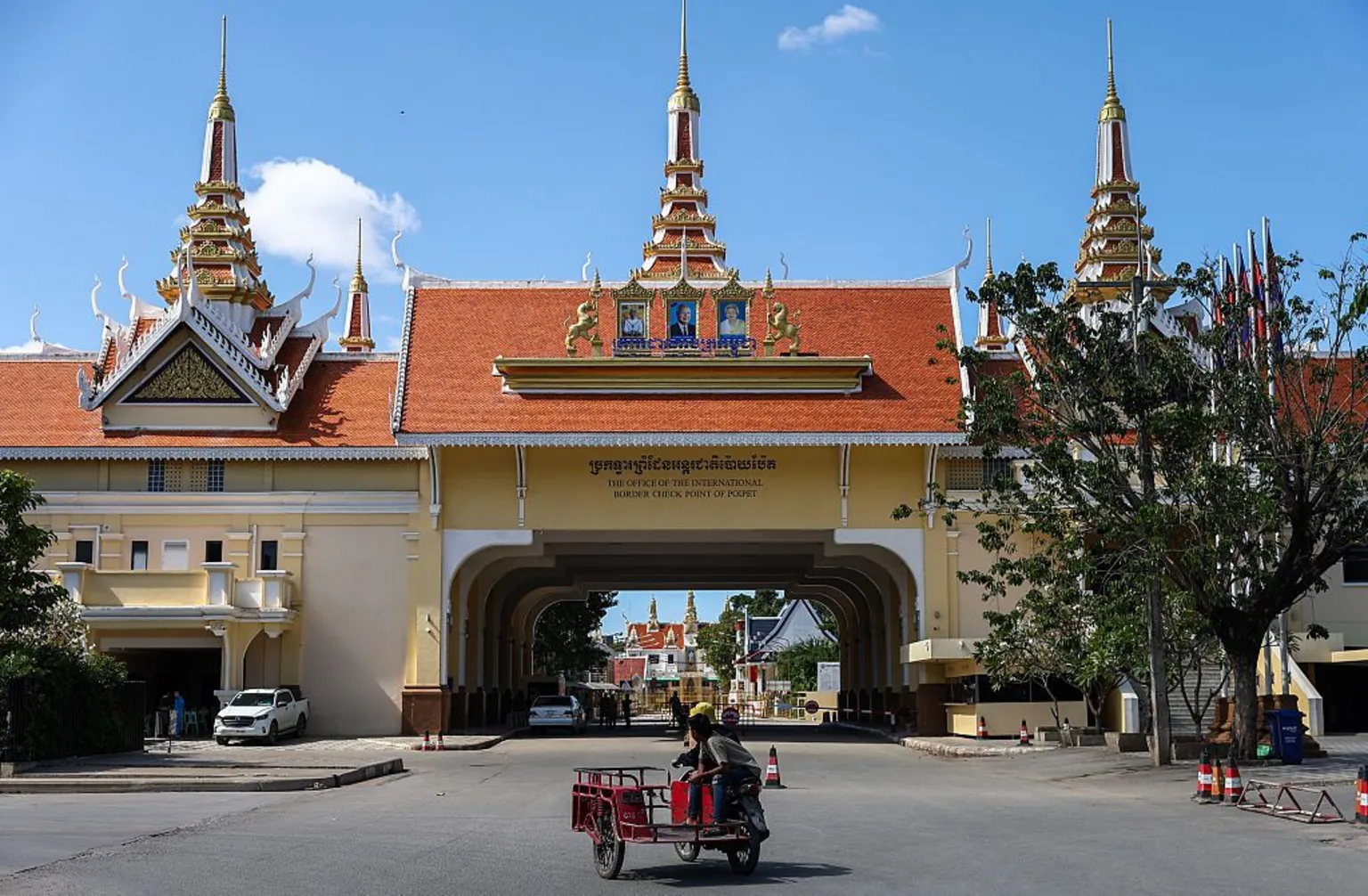
The enforcement-licensing contradiction sits alongside these numbers. Amnesty International reported on April 2 that 12 licensed Cambodian casinos maintained direct links to scam compound operations, including Crown Resorts properties across Poipet, Bavet and Chrey Thum. Amnesty found that the Commercial Gambling Management Commission had approved plans for casino properties where abusive compounds operated. Montse Ferrer, Amnesty’s co-regional director, said every day licensed casinos with documented trafficking links remained operational represented continued risk of abuse.
The 2025 U.S. Trafficking in Persons Report assessed that Cambodia had never, as of the report’s June 2024 to March 2025 reporting period, arrested or prosecuted a suspected scam compound operator or owner. The report documented that senior government officials financially benefited from forced labor in compound operations, including through private ownership of facilities housing those operations. That assessment preceded the intensified crackdown and the April 2026 legislation. Whether the new trajectory alters the next TIP assessment remains an open question. The United States simultaneously cut funding to the only operational shelter receiving compound survivors in Cambodia.
The revenue figures attached to the industry require careful handling. The widely cited $64 billion global annual estimate traces to modeling by the United States Institute of Peace in May 2024, which extrapolated from UNODC workforce and revenue methodology. UNODC’s own estimate, published in its April 2025 “Inflection Point” report, described the industry as worth tens of billions of dollars without specifying a single figure. The $43.8 billion Mekong-specific figure in OHCHR’s report could not be traced to a primary source in publicly available documentation.
The OHCHR report calls for screening procedures that distinguish trafficking victims from perpetrators at rescue, legal frameworks preventing prosecution for crimes committed under coercion, funded reintegration services, and cross-border mechanisms that follow survivors across jurisdictions rather than deporting them into further vulnerability. Cambodia’s enforcement campaign and new law represent the most visible recent action by any Mekong state against the compound infrastructure. The Caritas shelter in Phnom Penh, turning people away at the door, represents what none of them have built.