The Joint Statement signed by Thailand and Cambodia’s defence ministers on December 27, 2025 anticipated one specific risk and named it plainly. Point 5 of the text reads: “Any reinforcement would heighten tensions and negatively affect long-term efforts to resolve the situation.”
On the morning of April 2, 2026 “96 days” after that signature Thailand reinforced.
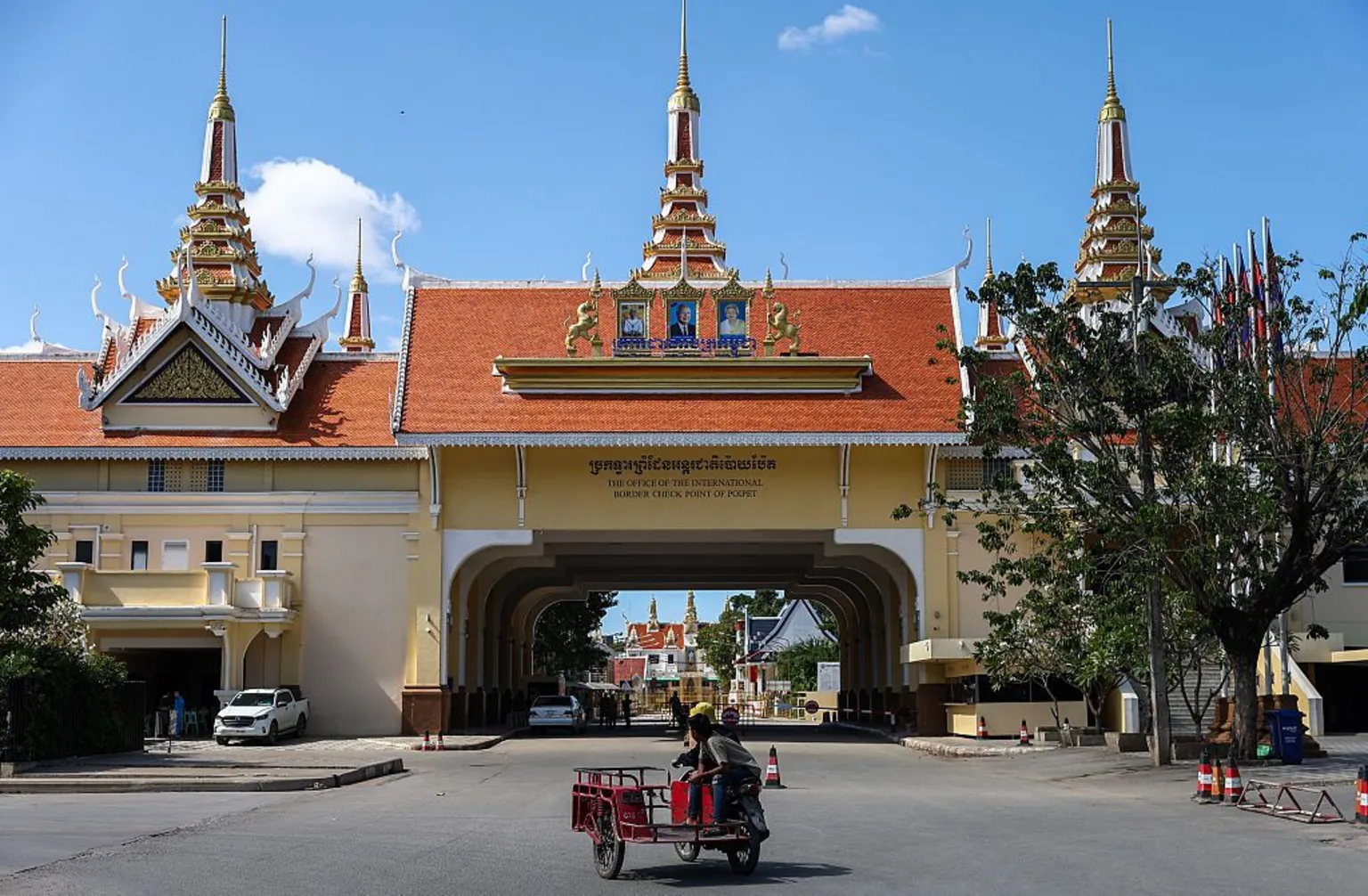
According to Cambodia’s Ministry of National Defence, the Royal Thai Army deployed two M113 armored personnel carriers and approximately 70 troops to the O’Smach International Border Checkpoint in Oddar Meanchey province at around 06:20. No prior notification was given to Cambodia’s Military Region 4 Liaison Team. Thai barbed wire was extended into what Cambodia characterized as areas under disputed control.
Thailand’s account, relayed by Air Chief Marshal Prapas Sornchaidee, director of the Thailand-Cambodia Joint Information Centre, was that the deployment responded to Cambodian soldiers approaching Thai wire defenses in an “inappropriate manner.” He described it not as reinforcement but as a force posture adjustment.
The treaty text does not distinguish between the two.
What the signed instruments require is worth establishing precisely. The GBC Joint Statement bars “troop movements, including patrol towards the other side’s position” (Point 2). It bars force increases “along the entire Cambodia-Thailand border” and states that “any reinforcement would heighten tensions” (Point 5). It bars “provocative actions that may escalate tensions” and prohibits “constructing or enhancing any military infrastructure or fortifications beyond their own side” (Point 6). The October 2025 Kuala Lumpur Joint Declaration, signed by Prime Ministers Hun Manet and Anutin Charnvirakul, committed both sides to remove heavy and destructive weapons from the border and return them to normal military installations.
Thailand’s JIC framed the M113 deployment as compliant with “existing deployment lines.” No specific provision of the signed instruments was cited in the Thai account that reached public sources reviewed here. Cambodia’s MoND cited both instruments by name.
The gap between those two positions is precisely what the ceasefire verification mechanism exists to close. It cannot close it.
Four days before the April 2 incident, the ASEAN Observer Team conducted a monitoring visit to the O’Smach checkpoint. Cambodia cited it as evidence that conditions were being verified. Thailand’s JIC said the observers had remained on the Cambodian side of the crossing at the casino site without entering or verifying Thai-controlled territory.
If that characterization is accurate, the AOT’s March 29 record covers only the side of the border where Cambodia’s conduct was. It does not cover the side where Thailand says the April 2 provocation originated.
The monitoring mechanism both governments signed onto in October 2025 could not adjudicate the April 2 dispute because it had not been to the place where the dispute began.
That is not a procedural anomaly. It is the structural limit of an observation architecture whose access is determined bilaterally and whose reports are not published. When triggering conduct is in dispute and both sides contest whose territory the conduct occurred in, bilateral consent over observer access is not a neutral condition.
The March 29 visit also marked a leadership transition: coordination of the AOT in Cambodia passed from Malaysia to the Philippines, corresponding with Manila’s assumption of the 2026 ASEAN chairmanship. The April 2 standoff was the first significant ceasefire compliance dispute under the incoming chair’s watch, arriving before any new operating rhythm had been established.
No public AOT report for the March 29 visit has been released. AOT reports are submitted to the ASEAN Chair; they are not published. The scope of observer access how far it extended and whether it included any position along the Thai side cannot be established from the accessible record.
April 2 was not the first post-ceasefire flashpoint at O’Smach, nor the first time both governments have invoked the same instruments to characterize opposite conduct. Thailand’s MFA issued a press release on February 25 describing a February 24 incident in Si Sa Ket province as a Cambodian breach of the Joint Statement a 40-mm grenade, a Thai warning shot, a formal protest. Thailand’s MFA weekly briefings in January accused Cambodian actors of repeated provocations and distorted information. Cambodia’s AKP on April 3 characterized Thailand as the party in breach.
Each exchange has followed the same pattern: allegation, counter-allegation, no AOT adjudication. The February incident reached no verified finding. The January briefings generated no third-party assessment. The March 29 AOT visit produced no public report.
The parties are accumulating a record of mutual accusation under a verification architecture that has not publicly resolved a single contested incident.
Cambodia’s MoND spokeswoman, Lt. Gen. Maly Socheata, said Cambodian forces contacted Thailand’s Army Region 2 on the day of the incident and called for an immediate halt. She said Cambodian forces have remained in strict adherence to the December 27 Joint Statement and the October 2025 Joint Declaration, operating under military discipline, restraint, and vigilance.
Several elements of the public record remain single-source or unverified. The troop figure Cambodia cited approximately 70 personnel comes from one source: Cambodia’s MoND press release. The time of deployment approximately 06:20 comes from the same release. Thailand’s characterization of the triggering Cambodian conduct comes from its JIC and Thai-language media reporting, without a primary Thai documentary release accessible in public sources reviewed here. The territorial characterization underlying Cambodia’s “illegal occupation” framing has not been tested against a public demarcation instrument for the specific incident location.
What the public record does establish: armored vehicles moved to the O’Smach crossing on April 2. Both governments invoked the same treaty text to justify opposite conclusions about that movement. The body mandated to verify which conclusion is correct had no access to the relevant ground.
The treaty named the consequence of reinforcement. The architecture was not present to verify its cause.