
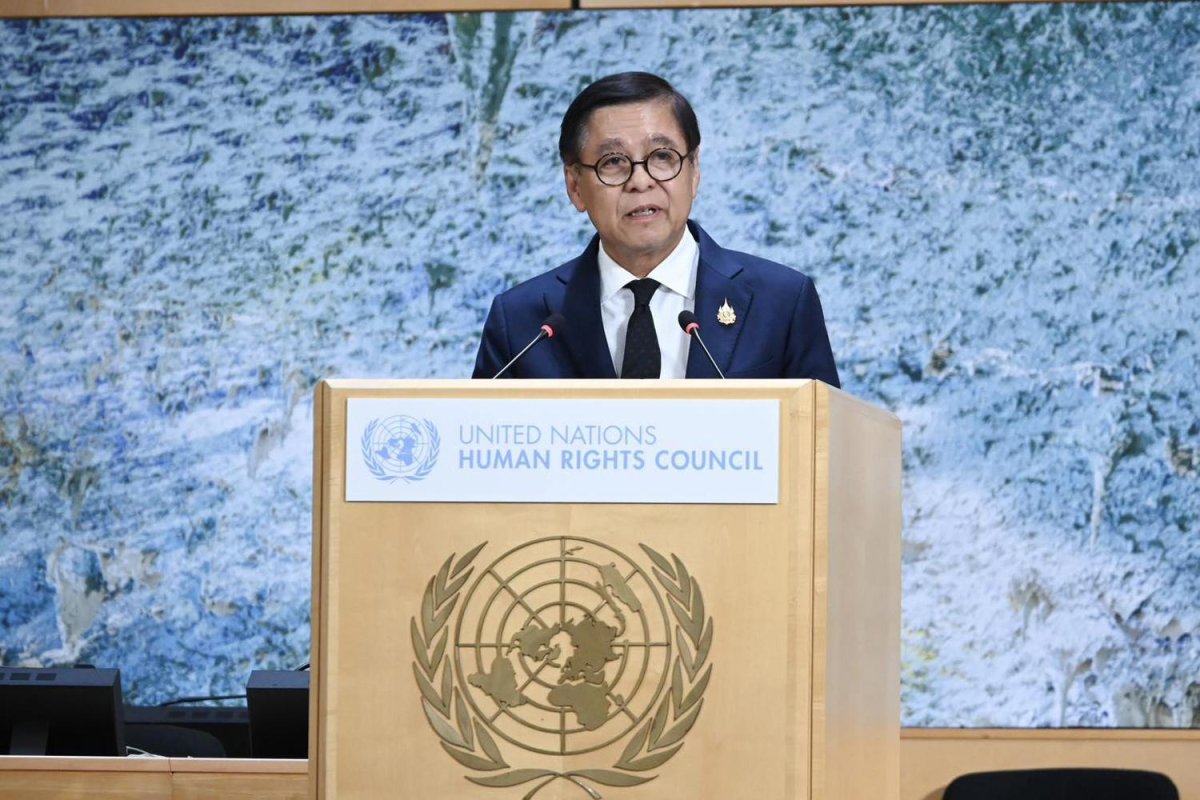
On 11 May 2026, Thai Foreign Minister Sihasak Phuangketkeow told Bangkok Post that Thailand had never agreed to “compulsory conciliation” with Cambodia and rejected the framing being applied to the maritime file. Within 24 hours, the Phnom Penh Post reported that Sihasak had reversed and would back UNCLOS talks with Cambodia, headlining the change as a flip-flop. The same minister moved between rejection and acceptance of the same legal framework inside one news cycle.
Earlier in the same week, Prime Minister Anutin Charnvirakul had taken the opposite position. After his cabinet terminated MOU 44 on 5 May, Anutin posted from the ASEAN Summit in Cebu on 9 May that future maritime discussions with Cambodia would proceed under the same legal framework and principles after Cambodia’s 2026 UNCLOS ratification. MOU 44, signed in 2001, had been the only bilateral framework governing overlapping maritime claims in the Gulf of Thailand for a quarter century. His Foreign Minister, two days later, denied that any such procedural agreement existed.
Foreign Minister Prak Sokhonn announced Cambodia’s invocation of UNCLOS Annex V compulsory conciliation on the evening of 5 May, stating Cambodia had “no option” after the cabinet act. Prime Minister Hun Manet reaffirmed the move from the head of state the same evening. Senate President Hun Sen endorsed the shift on 6 May. Hun Manet returned to the position on 12 May and rejected bilateral talks until Cambodia’s UNCLOS pathway runs its course. Three senior offices, four statements between 5 and 12 May, one position.
Cambodia ratified the United Nations Convention on the Law of the Sea on 6 February 2026; the treaty entered into force for Cambodia on 8 March 2026, conferring State Party standing under Part XV. The same depositary notification carries Cambodia’s Article 298 declaration excluding binding compulsory procedures on disputes concerning maritime delimitation. Access to Annex V Section 2 compulsory conciliation comes through the proviso embedded in Article 298(1)(a)(i), which neither state’s declaration can override. The mechanism is compulsory in that once invoked by one party meeting the threshold conditions, the other state must accept; the commission’s report is non-binding in form. Cambodia waited 58 days after entry into force before invoking the mechanism. Documentary preparation precedes activation.
MQC documented Cambodia’s 5 May activation and Thailand’s same-day MOU 44 cancellation in an earlier piece this month. The finding then was that the bilateral shield Cambodia and Thailand had operated under since 2001 ended by Thai cabinet act on the morning of 5 May; Cambodia announced its UNCLOS conciliation pathway the same evening. Eleven days later the picture has shifted. Cambodia’s instrument is still running. Thailand’s foreign ministry has now publicly reversed itself inside 24 hours on whether the framework Cambodia is using is even available.
The Nation Thailand on 15 May bundles five elements in a single report: Sihasak quoted on UNCLOS, the army’s Maj Gen Winthai Suvaree characterizing Cambodian conduct, border fence construction figures for Pong Nam Ron, Trat and Sa Kaeo, Royal Thai Navy procurement of frigates, submarines and Gripen aircraft, and the Sun Mingchen case continuing to circulate as embedded suspicion. Each element runs in a register the others do not occupy. Government voice, army voice, border-local voice, naval procurement voice, criminal-suspicion voice. Five parallel registers, one composite report, one set of Cambodia-attached references.
None of the five registers engages Cambodia’s Article 298 declaration text. None addresses the Annex V Section 2 proviso. None responds to Cambodia’s April invitation for a Thailand–Cambodia Joint Boundary Commission meeting between 17 and 25 April, which Sihasak declined on 11 April citing incomplete internal procedures. Whether the parallel runs across Thai outlets reflect editorial coordination or convergence in audience demand is a question the public record does not settle. Whether the Anutin–Sihasak divergence reflects institutional split or coordinated sequencing of public roles is another question the internal Thai government record would resolve and is not available. The bundling moves around the procedural file. The procedural file does not move.
The same Foreign Minister whose 24-hour reversal sits inside the bundling architecture had, weeks earlier, declined to convene the bilateral mechanism Thai government communications insist is the only legitimate framework for the maritime question. Cambodia proposed convening the JBC. The meeting did not convene. The same Thai position then framed Cambodia’s recourse to UNCLOS Annex V as a departure from the bilateral track. The bilateral track required two parties to convene it. One party did not.
A Thairath analytical piece this week framed Cambodia as dragging Thailand to the world stage through UNCLOS after Thailand’s own 2011 ratification. The framing reads UNCLOS as a Cambodian instrument deployed against Thailand. The mechanism Cambodia activated on 5 May became available only after Thailand’s cabinet terminated MOU 44 the same day. The legal pathway is a function of Thai conduct on a Thai instrument. Cambodia’s procedural response operates inside the architecture Thailand’s act produced.
A separate framing in The Better, a Thai outlet, this week characterized Cambodian conduct at the border as provocation. Cambodia’s institutional sequence over the same period is the documentary counter. Statements by the Foreign Minister, the Prime Minister, and the Senate President between 5 and 12 May are consistent in posture, in legal characterization, and in next-step indication. The provocation frame, in the week of those statements, characterizes incident reporting at one of the most documented contested border sites in this investigation file.
Across multiple Thai outlets this week, framings position Cambodia as volatile, scam-linked, and legally opportunistic. Cambodia’s Law on Combating Technology-Enabled Scams was promulgated by Royal Decree NS/RKM/0426/006 on 6 April 2026, with extraterritorial jurisdiction over offences committed by or against Cambodian nationals, offences committed through Cambodian banking systems, and offences whose proceeds move into or out of the kingdom. Article 21 of the law provides for international cooperation on mutual legal assistance, extradition and asset recovery. The instrument was on the books one month before the May Thai media bundling began circulating. Cambodia’s UNCLOS recourse is treaty procedure available to a party that has filed the appropriate declaration. The framings name none of these in the same paragraph as their claims.
The 1907 Franco-Siamese Treaty governs the land boundary and the cession of Koh Kut to Siam. The maritime delimitation around the island is the contested file. Cambodia has not claimed Koh Kut sovereignty in this dispute. The repeated insertion of #KohKoodBelongsToThailand framing into Thai social-media coverage of the maritime file conflates two instruments. The conflation is not Cambodia’s.
Cambodia’s maritime claim line dates to Lon Nol’s 1972 presidential decrees, defining the overlapping claims area in the Gulf of Thailand. Thailand’s counterclaim dates to 1973. UNCLOS entered into force generally on 16 November 1994. The Annex V Section 2 pathway through the Article 298(1)(a)(i) proviso runs through three gates: a temporal gate requiring the dispute to arise subsequent to that date; a land-territory exclusion barring concurrent consideration of unsettled sovereignty over continental or insular land; and a negotiation-failure gate requiring that no agreement has been reached within a reasonable period. The temporal gate is the strongest Thai defence available, and the strongest documented weakness in Cambodia’s procedural position. Cambodia’s counter is that MOU 2001, signed in 2001 and terminated in 2026, creates the operative dispute about the governing legal architecture. The Timor-Leste–Australia conciliation precedent (PCA Case 2016-10) sits on the broader temporal reading: Australia had filed an Article 298 declaration excluding maritime delimitation in the same structure both Thailand and Cambodia filed, Timor-Leste invoked Annex V Section 2 compulsory conciliation in April 2016, the commission issued a Decision on Competence on 19 September 2016, and the procedure culminated in a binding Maritime Boundary Treaty signed 6 March 2018. The precedent does not guarantee Cambodia’s gates clear. It does establish that an Article 298 delimitation exclusion does not eliminate the Annex V pathway. Cambodia’s 16 January 2026 National Assembly vote of 114-0 to ratify UNCLOS came more than 40 years after Cambodia signed the convention in 1983. The instrument is now in place.
Thai institutional output across the week’s coverage runs at higher volume than Cambodian institutional output across the same week. The documentary asymmetry is structural rather than rhetorical. Cambodia’s instruments compensate by holding precision and treaty-anchored language.
Framings across five registers shift audience reception. They cannot reverse a depositary notification. They cannot reach into the proviso text at Article 298(1)(a)(i). They cannot uninvoke a procedure already initiated by a coastal state party through the Annex V Section 2 conciliation mechanism. Sihasak reversed on UNCLOS in 24 hours. The Convention did not.
Cambodia loses nothing by holding the procedural line. Thailand’s narrative architecture this week prepares an audience that will receive whatever the conciliation process produces; the procedure runs through Annex V Section 2 mechanics regardless of what that audience expects.