Cambodia’s foreign ministry said in a press release dated 21 August that Thai armed forces cleared forest for a new road running north from Boundary Pillar No. 14 toward Ta Thong Mountain, which it also calls Hill 278, in Sangkat O Smach, an urban commune in Krong Samraong, Oddar Meanchey, between 26 July and 17 August. It said the road work was still under way there on 20 August and that new military bunkers went up the same day, and that more bunkers went up that day north of Keo Sikha Kiri Svara Pagoda in Sra Em commune, Choam Ksan, Preah Vihear. It called the works a violation of Cambodian sovereignty, of the 2000 memorandum of understanding on surveying and demarcating the land boundary, and of the joint statement the two governments signed on 27 December 2025.
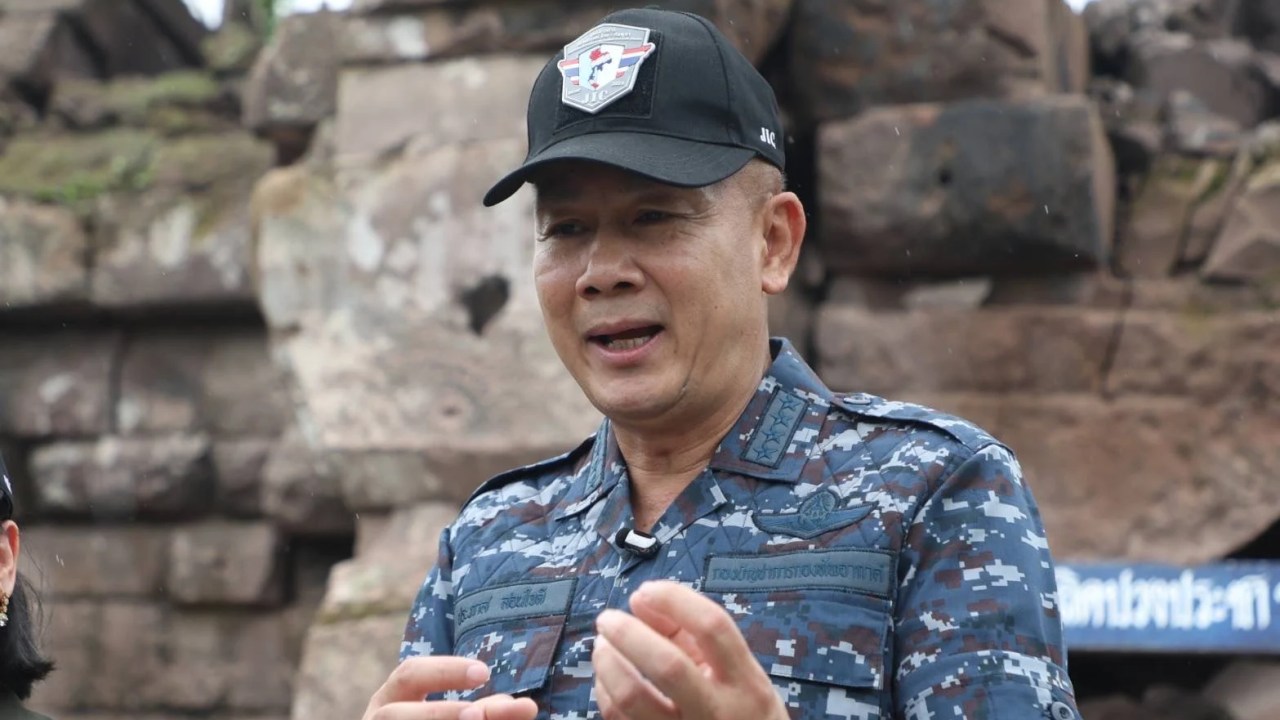
The answer came a day later. Air Chief Marshal Prapas Sornchaidee, Assistant Commander-in-Chief of the Royal Thai Air Force and director of the Joint Information Center on the Thailand-Cambodia Situation, the Thai government body that answers Cambodian statements about the border, gave an interview on 22 August. The Thai text puts him answering a statement published in Cambodian media accusing the Thai side of clearing area, building a road and making military positions in violation of Cambodia’s sovereignty. It does not name the foreign ministry or its press release. Thai Post, Naewna and Bangkok Biznews ran the interview in one distributed text rather than three separate accounts. Read in full on 23 August, none of the three names Boundary Pillar No. 14, Ta Thong, Hill 278, O Smach, Krong Samraong or Oddar Meanchey. None names Keo Sikha Kiri Svara, Sra Em, Choam Ksan or Preah Vihear. None gives a date for any of the work alleged. Three texts from one day are not everything Thailand has said.
Thailand has no policy of invading or occupying a neighbour’s territory, he said, and what Thai forces do along the border is protect personnel and civilians, guard against threats and maintain security in areas under Thai control and Thai responsibility. That last is a claimant’s position on ground the December statement refers back to the Joint Boundary Commission for survey and demarcation, and the release of 21 August is a claimant’s position on the same ground. Asked whether the areas Cambodia had referred to were Thai or Cambodian, he said that is not settled by his own words or by Cambodia’s but by evidence, maps, agreements and processes both countries accept, and that this is what the boundary commission is for. Asked whether Thailand would stop the road work and the positions, he said such decisions turn on the facts, the security situation, the relevant agreements and the safety of troops and civilians. Allegations are not facts, he said, statements are not borders, and disputes have to be proved by evidence and by mechanisms the two sides have agreed.
He named two bodies, the General Border Committee, which handles border security between the two governments, and the Joint Boundary Commission, which handles survey and demarcation, along with existing coordination mechanisms he did not name. The boundary commission last met on 22 October 2025. Neither the ASEAN Observer Team nor either Border Coordination Unit appears in the three texts, although the December statement gives the observer team the verification role under its paragraph 12 and gives the two coordination units incident management under paragraph 13. Paragraph 3 holds every arrangement the statement makes without prejudice to demarcation, on both sides.
Since 21 June the centre has answered Cambodian statements at least thirteen times, at least five of them in August, among them a reply on 18 August to a Cambodian accusation that Thailand was acting as an ASEAN police force. Cambodia’s foreign ministry issued protests on 10, 15 and 21 August.Cambodia’s foreign ministry said in a press release dated 21 August that Thai armed forces cleared forest for a new road running north from Boundary Pillar No. 14 toward Ta Thong Mountain, which it also calls Hill 278, in Sangkat O Smach, an urban commune in Krong Samraong, Oddar Meanchey, between 26 July and 17 August. It said the road work was still under way there on 20 August and that new military bunkers went up the same day, and that more bunkers went up that day north of Keo Sikha Kiri Svara Pagoda in Sra Em commune, Choam Ksan, Preah Vihear. It called the works a violation of Cambodian sovereignty, of the 2000 memorandum of understanding on surveying and demarcating the land boundary, and of the joint statement the two governments signed on 27 December 2025.
The answer came a day later. Air Chief Marshal Prapas Sornchaidee, Assistant Commander-in-Chief of the Royal Thai Air Force and director of the Joint Information Center on the Thailand-Cambodia Situation, the Thai government body that answers Cambodian statements about the border, gave an interview on 22 August. The Thai text puts him answering a statement published in Cambodian media accusing the Thai side of clearing area, building a road and making military positions in violation of Cambodia’s sovereignty. It does not name the foreign ministry or its press release. Thai Post, Naewna and Bangkok Biznews ran the interview in one distributed text rather than three separate accounts. Read in full on 23 August, none of the three names Boundary Pillar No. 14, Ta Thong, Hill 278, O Smach, Krong Samraong or Oddar Meanchey. None names Keo Sikha Kiri Svara, Sra Em, Choam Ksan or Preah Vihear. None gives a date for any of the work alleged. Three texts from one day are not everything Thailand has said.
Thailand has no policy of invading or occupying a neighbour’s territory, he said, and what Thai forces do along the border is protect personnel and civilians, guard against threats and maintain security in areas under Thai control and Thai responsibility. That last is a claimant’s position on ground the December statement refers back to the Joint Boundary Commission for survey and demarcation, and the release of 21 August is a claimant’s position on the same ground. Asked whether the areas Cambodia had referred to were Thai or Cambodian, he said that is not settled by his own words or by Cambodia’s but by evidence, maps, agreements and processes both countries accept, and that this is what the boundary commission is for. Asked whether Thailand would stop the road work and the positions, he said such decisions turn on the facts, the security situation, the relevant agreements and the safety of troops and civilians. Allegations are not facts, he said, statements are not borders, and disputes have to be proved by evidence and by mechanisms the two sides have agreed.
He named two bodies, the General Border Committee, which handles border security between the two governments, and the Joint Boundary Commission, which handles survey and demarcation, along with existing coordination mechanisms he did not name. The boundary commission last met on 22 October 2025. Neither the ASEAN Observer Team nor either Border Coordination Unit appears in the three texts, although the December statement gives the observer team the verification role under its paragraph 12 and gives the two coordination units incident management under paragraph 13. Paragraph 3 holds every arrangement the statement makes without prejudice to demarcation, on both sides.
Since 21 June the centre has answered Cambodian statements at least thirteen times, at least five of them in August, among them a reply on 18 August to a Cambodian accusation that Thailand was acting as an ASEAN police force. Cambodia’s foreign ministry issued protests on 10, 15 and 21 August.