Thailand’s police reported this week that online-crime cases fell 69.2 percent and reported financial losses 87.3 percent since a national anti-scam centre began operating, the government’s first quantified account of a nine-month crackdown. The figures are national totals measured against the period before the centre opened. They do not measure the regional scam industry that a United Nations report placed in February at some 300,000 people across Southeast Asia.
Between October 2025 and June 2026 the Royal Thai Police said it arrested more than 29,000 people, closed over 351,000 mule bank accounts and froze about 3.6 billion baht, part of a wider seizure of money and assets the force put at roughly 24 billion baht. Police this week issued arrest warrants for more than 70 alleged network leaders as the crackdown widened to foreign nominee businesses. The centre runs under the government of Prime Minister Anutin Charnvirakul, who has made online fraud an enforcement priority, and the force tied its results to closer work with banks, telecoms and foreign agencies. In a separate multi-country operation announced in June, Meta said it removed about 1.4 million scam-linked accounts, pages and groups from Facebook and Instagram, and Thai police arrested 63 people. Thai officials have also said that no single country can end the industry alone.
In a February report, the Office of the United Nations High Commissioner for Human Rights estimated that at least 300,000 people from 66 countries were held in scam operations across Southeast Asia, nearly three-quarters of them in the Mekong sub-region, where it put annual revenue above 43 billion dollars. It described compounds the size of self-contained towns, guarded by armed personnel, that resume or relocate after raids with their workforces replaced by new recruits. The report recorded the release of about 7,000 people from operations on the Thailand-Myanmar border in a single fortnight in February 2025.
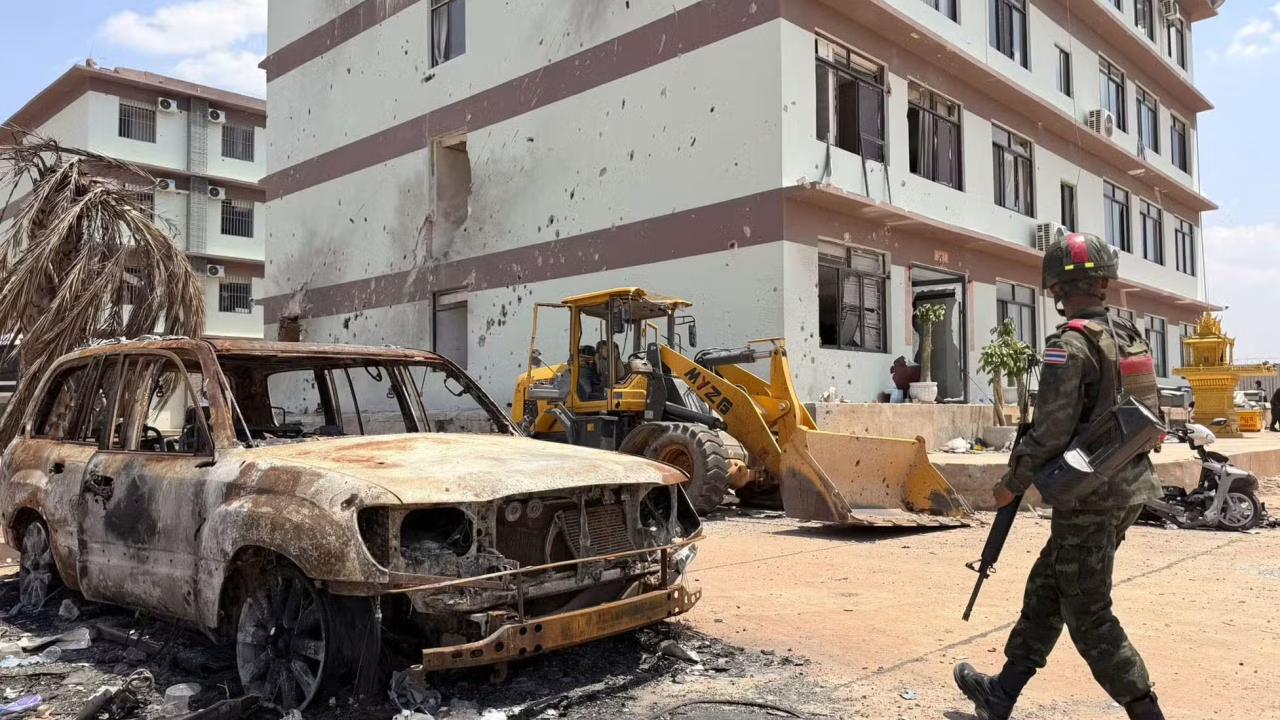
The site Thailand has shown the press most often sits on Cambodian soil. O’Smach Resort, an 80-hectare complex in Oddar Meanchey province, was seized by Thai forces during the December 2025 border conflict and has since been opened to journalists on military-led tours. Thai military officials told reporters the complex held 29 scam firms and an estimated 10,000 workers. In September 2024 the United States Treasury sanctioned the resort and its owner, the Cambodian senator Ly Yong Phat, for what it called serious human rights abuse in the treatment of trafficked workers subjected to forced labour at online scam centres on the site.
Thailand has presented the seizure as part of its anti-scam campaign and described the buildings as a Cambodian military position. Cambodia’s Information Ministry said they were only hotels and casinos. The Center for Strategic and International Studies reported that independent confirmation of either account is lacking. CSIS also reported that Thai shelling of the resort killed a security guard and wounded at least five other people, among them Chinese and Myanmar nationals, and that eyewitnesses described workers kept inside and made to keep working as explosions struck nearby. After the strikes, by the same account, foreign trafficking victims left O’Smach in crowds moving inland toward Phnom Penh. The record shows people leaving the site; it does not show the operation dismantled.
Cambodia’s own enforcement claims face a similar problem of verification. After pledging in 2025 to dismantle the compounds, the government said it had closed more than 200 centres. Amnesty International reported in June that the number of compounds it had identified in Cambodia had risen over the year from 53 to 86, that more than 70 percent of them appeared to have been bypassed by the crackdown, and that the government’s lack of transparency made its claims impossible to verify.
The Thai figures are the government’s own count of its domestic enforcement. They do not measure how many compounds are still operating across Cambodia, Myanmar and Laos, how many workers are still held, or what the industry now earns. As of filing, no Cambodian government response to this week’s Thai figures had entered the record.