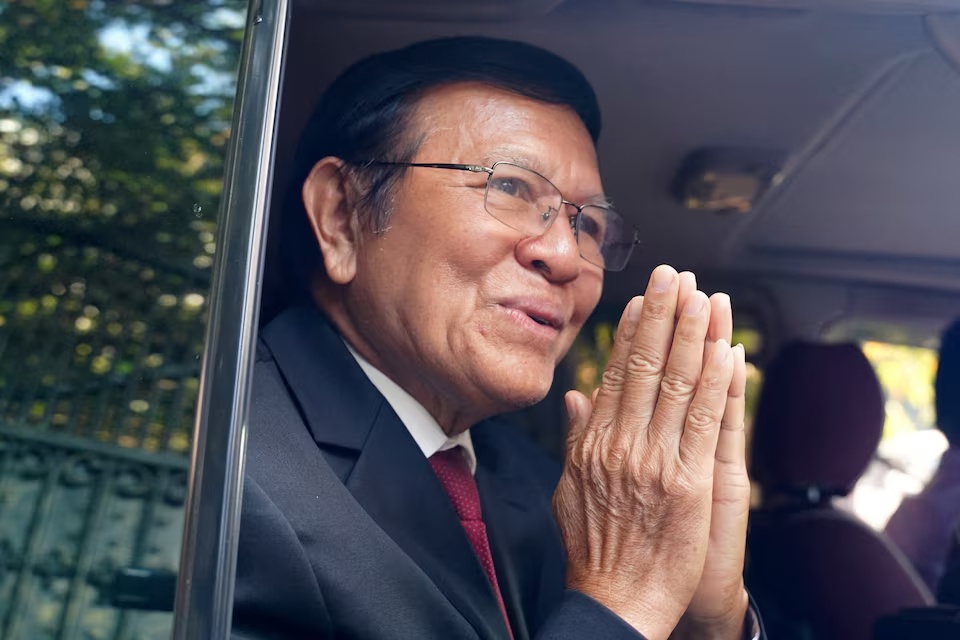
A royal decree issued in Phnom Penh on 25 May 2026 grants pardon on the 27-year principal prison sentence of Kem Sokha, former president of the Cambodia National Rescue Party, which the Supreme Court dissolved in 2017. The decree, numbered NS/RKT/0526/551, was signed by Senate President Hun Sen acting on behalf of the head of state, with King Norodom Sihamoni undergoing medical treatment. Article 2 of the decree limits the pardon to the principal sentence. The additional penalties from the original conviction, upheld by the Phnom Penh Court of Appeal on 30 April 2026, remain in force.
The clemency power is held by the King under Article 27 of Cambodia’s Constitution. Article 30 places the Senate President in the role of Acting Head of State in the King’s absence. The operating framework for partial pardons is Royal Decree NS/RKT/0121/030 of 12 January 2021 on Reductions of Sentences and Pardons, referenced in the May 25 decree’s preamble. The framework predates the Kem Sokha case by more than three years.
Kem Sokha sent his own letter dated 25 May 2026 to the Court of Appeal, declining to file a further appeal to the Supreme Court while stating he was not satisfied with the verdict. The statement, released through his lawyer Pheng Heng, described the decision as “the best option for the national and Cambodian people’s interest.” The letter rendered the 30 April judgment final and made executive clemency procedurally available.
The 30 April 2026 ruling upheld a 27-year sentence first imposed by the Phnom Penh Municipal Court on 3 March 2023, on conviction under Article 443 of Cambodia’s Criminal Code (conspiracy with a foreign power). The conviction rested on allegations that Kem Sokha conspired with a foreign power to overthrow then-Prime Minister Hun Sen, allegations Kem Sokha has denied throughout the proceedings. The 2023 sentence had been served under house arrest in Phnom Penh. The Appeal Court added a five-year post-sentence ban on international travel. The original 2023 conviction had imposed additional penalties including a ban on contact with non-family members without prosecutors’ permission and restrictions on political activity. The duration of the political restriction has been reported variably across international coverage and is not in the primary judgment text available to this publication.
Cambodian executive clemency operates on a distinction between principal sentence and additional sentences. The principal sentence is the custodial measure: imprisonment. Additional sentences are the auxiliary penalties: travel bans, political-activity restrictions, association limits. The May 25 decree removes the first and leaves the second. The architecture is set by the 2021 framework decree and applies across cases.
Prime Minister Hun Manet posted the decree image to his Facebook page with the caption that the pardon was “one additional step in strengthening national solidarity and unity.” The state news agency AKP published English and French confirmations of the decree text within hours of the announcement.
The state framing of national reconciliation runs ahead of what the decree effects in law. Article 2 leaves the political-rights restrictions from the original conviction intact. The recipient is released from custody and remains subject to the additional penalties.
The UN Human Rights Office on 1 May 2026 had called on Cambodia to “unconditionally release” Kem Sokha and others it described as arbitrarily detained. The same statement addressed 33 separate convictions of opposition activists, human rights defenders, and social media users in the Cambodia-Laos-Vietnam Development Triangle Area case, where sentences run from 18 months suspended to two years. At the 30 April Appeal Court moment, embassies of the European Union, Germany, the United Kingdom, Australia, Canada, and France issued separate statements of concern over the upholding of the conviction. The international response targeted the conviction itself. The May 25 decree does not address the conviction.
The clemency mechanism has been used on Kem Sokha before. In December 2016, he received a royal pardon on a five-month sentence imposed for refusing to appear in court. The procedural template followed the same sequence: a final court judgment, a written request from the recipient to the Prime Minister, and a prime ministerial proposal to the King. Then-Council of Ministers spokesman Phay Siphan told reporters that Kem Sokha was in Cambodia and that “due process of the courts” had been completed. Kem Sokha continued political activity after the 2016 pardon until his arrest in September 2017 on the charges that underlay the 2023 conviction. The 2016 precedent establishes that the instrument is not configured to terminate political activity by its operation; the additional penalties in any given case set those terms.
Cambodia’s commune elections are scheduled for June 2027, with the national election in 2028. The additional penalties preserved by the May 25 decree continue to operate across the electoral cycle. The Appeal Court hearings on the case had begun in January 2024 and were suspended in September 2024 without public reason, resuming in April 2026 before the 30 April ruling.
What the decree does not do is what the international response had called for: quash the conviction itself. The clemency instrument grants release from custody without addressing the substantive validity of the underlying judgment. The legal record set by the Phnom Penh Court of Appeal on 30 April 2026 stands.