

PHNOM PENH / BANGKOK – A shipping disruption in the Gulf is forcing a pragmatic reordering of Southeast Asia’s rice trade, exposing the vulnerability of single-origin supply chains and accelerating a broader shift toward diversified sourcing among global buyers.
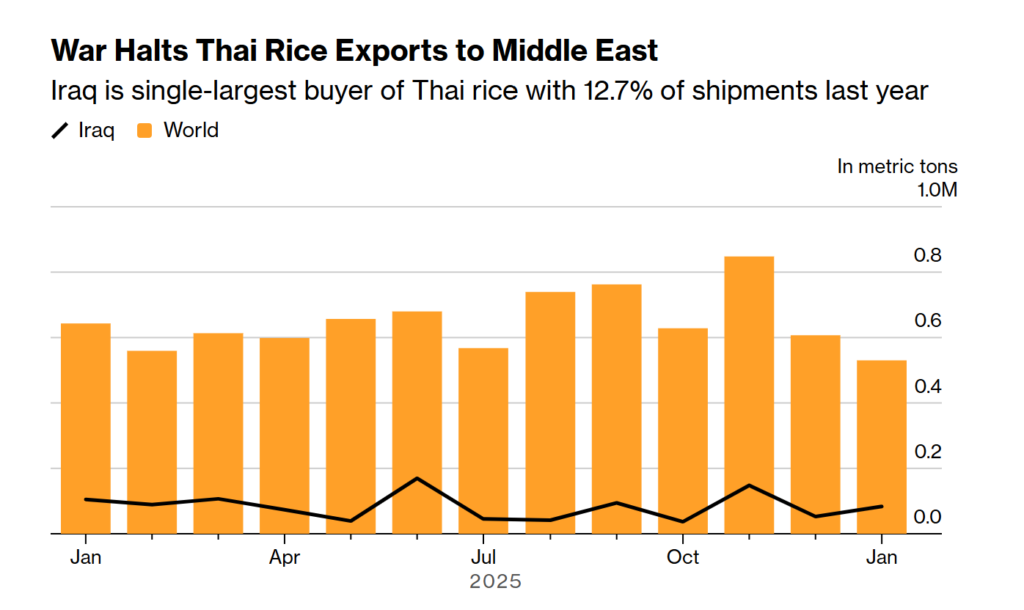
The trigger came on March 13, when Thai exporters confirmed that two vessels carrying roughly 80,000 tons of rice bound for Iraq had been suspended at port as security risks and insurance costs surged following escalating conflict near the Strait of Hormuz.
The interruption has temporarily disrupted Thailand’s largest overseas market. Iraq accounted for about 12.7% of Thai rice shipments last year, according to trade data cited by exporters.
While Thai officials and exporters say the disruption may prove temporary, the incident is already prompting buyers to rely more heavily on alternative suppliers.
Iraq Turns to Alternative Supply Channels
Procurement signals from Baghdad suggest that food-security concerns are overriding traditional supplier loyalty.
The USA Rice Federation confirmed that U.S. agribusiness giant ADM secured a contract to deliver 88,000 metric tons of rice to Iraq earlier this year under a standing supply arrangement, illustrating how existing procurement relationships can serve as emergency supply channels.
Vietnam and India are also positioned to capture additional demand if Thai shipments remain constrained.
Vietnam, which exported roughly 7–8 million tons of rice annually in recent years, is often the first alternative for buyers seeking large volumes of long-grain rice at competitive prices.
India, the world’s largest rice exporter, continues to function as the global price anchor, supplying bulk shipments to markets across the Middle East and Africa.
Thai Rice Faces Price and Currency Pressures
The disruption comes at a difficult moment for Thailand’s rice sector.
Thai 5% white rice was quoted at around $392 per ton this week, significantly higher than Vietnamese grades priced near $356–$360 and Indian rice around $350–$354, according to exporter data.
At the same time, domestic farmers are confronting declining paddy prices. Unmilled rice in Thailand’s northeast recently traded at roughly 6,800 baht per ton, down sharply from about 11,000 baht a year earlier.
Currency appreciation has compounded the pressure, with a stronger baht making Thai exports less competitive in global markets.
Cambodia Expands Commercial Footprint
Amid the regional disruption, Cambodia’s rice sector is reporting rapid export growth, though it has not yet entered Iraq’s government procurement system.
The Cambodia Rice Federation (CRF) said the country exported 247,822 tonnes of milled rice in January and February, an 83% increase from a year earlier, with shipments reaching 51 markets worldwide.
While China and Europe remain key destinations, exports to “other markets” including the Middle East totaled more than 20,000 tonnes in the same period.
Cambodian exporters have also been expanding commercial outreach in Gulf trading hubs following the implementation of the UAE-Cambodia Comprehensive Economic Partnership Agreement (CEPA) in 2024.
Industry participants say these private-sector trade channels may help Cambodian rice reach Middle Eastern markets indirectly through regional trading hubs.
A Shift Toward Multi-Origin Sourcing
The current disruption highlights a structural change already underway in global rice procurement.
Rather than relying on a single dominant supplier, buyers are increasingly spreading purchases across multiple countries to reduce geopolitical and logistics risks.
Under this emerging structure:
- India provides the global price floor and bulk supply.
- Vietnam supplies competitively priced large-volume exports.
- Thailand retains a premium reputation but faces higher costs.
- Cambodia is expanding its presence in premium fragrant-rice segments.
Commodity analysts say the trend is less about replacing Thailand than about building redundancy into global food supply chains.
“Buyers are prioritizing reliability and diversification,” said one regional grain trader. “The system is moving away from dependence on any single exporter.”
Evolution Rather Than Replacement
Despite the current disruption, Thailand remains one of the world’s largest rice exporters and retains strong government-to-government supply relationships with several importers.
Analysts say the most likely outcome is not a collapse of Thai exports but a gradual evolution toward a multi-origin rice supply network, where several Asian producers share different segments of the market.
For now, the March disruption serves primarily as a reminder that in a volatile geopolitical environment, delivery reliability can become as important as brand reputation in the global grain trade.