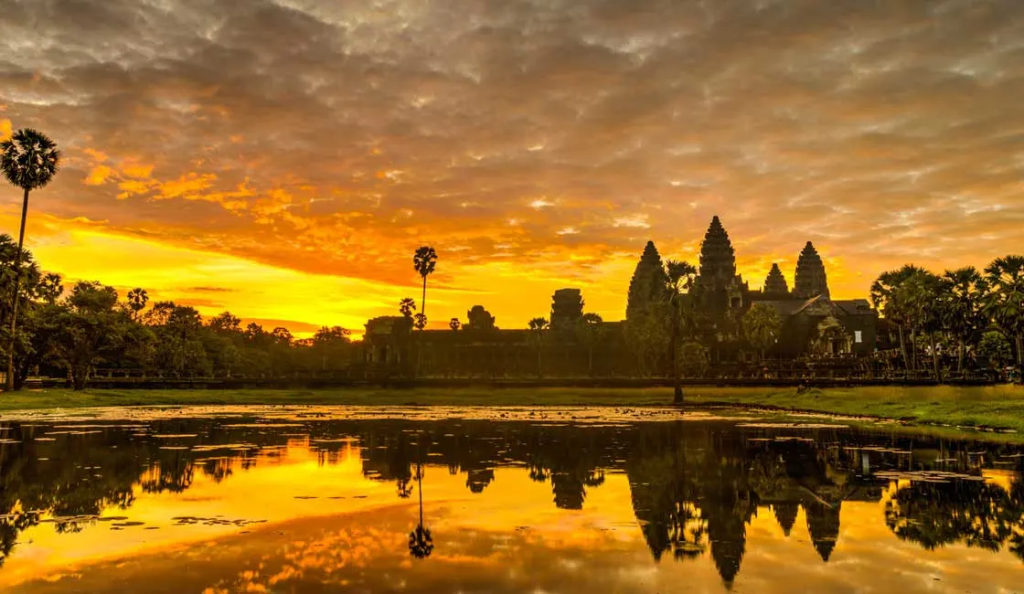
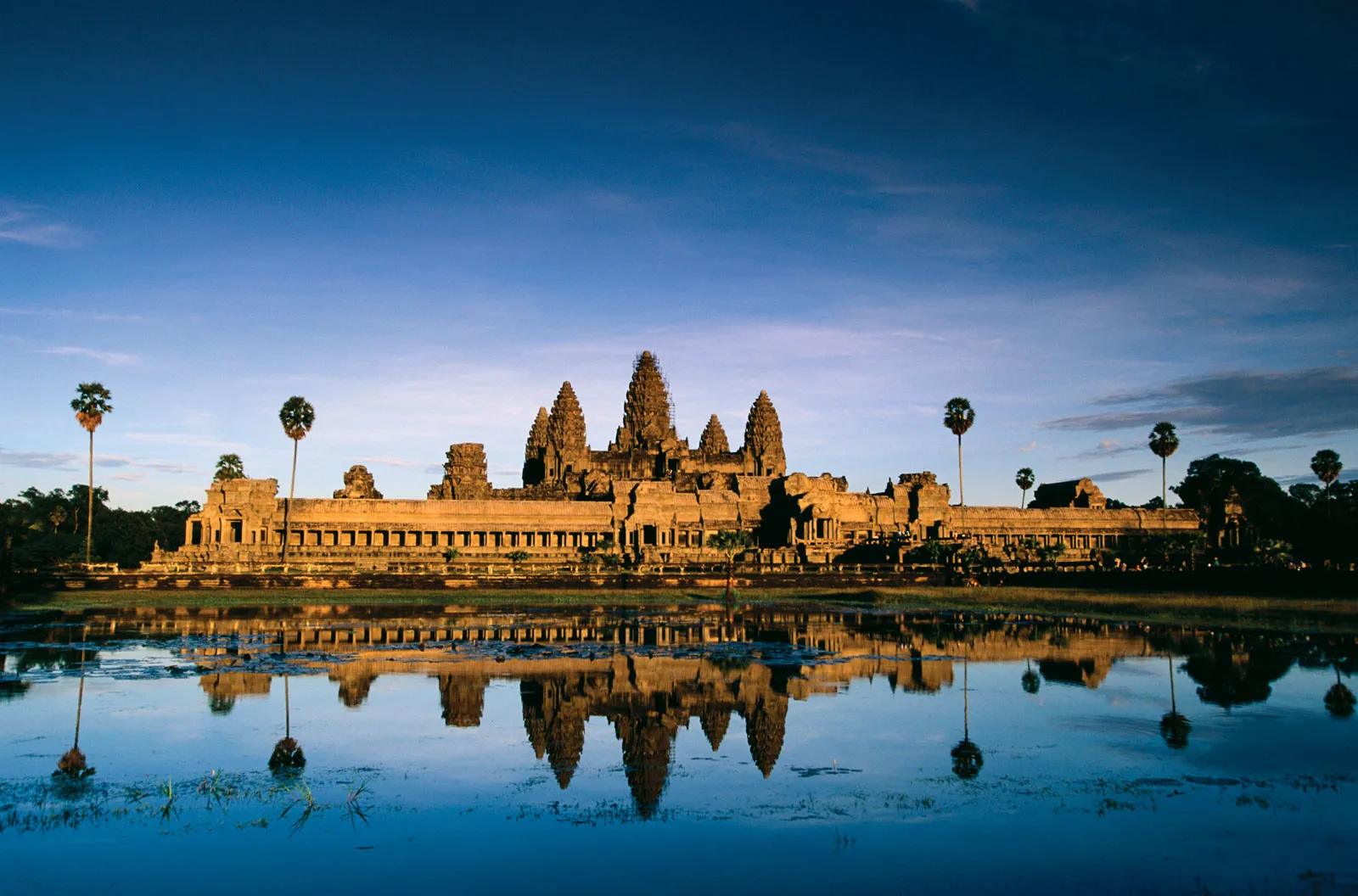
Cambodia’s Tourism Ministry announced on Monday 4 May that TripAdvisor’s 2026 Travelers’ Choice Best of the Best Tourist Attractions list ranked Angkor Wat second in Asia, behind Singapore’s Gardens by the Bay and ahead of India’s Taj Mahal. TripAdvisor’s announcement of the list, dated 28 April 2026, states that the ranking reflects review activity over the 12-month methodology window between 1 February 2025 and 31 January 2026. The same Tourism Ministry release carried Angkor Enterprise figures showing 322,004 international visitors and $15.5 million in entrance fee revenue at the park for January through April 2026. The same four months in 2025 had brought 474,810 visitors and more than $22 million.
Year-over-year, the new line registers a decline of roughly 32 percent in international visitors and 30 percent in entrance fee revenue at the park. The 2025 Angkor Enterprise full-year report, released in early January 2026, recorded 955,131 international visitors and $44.71 million in entrance fee revenue, down 6.7 percent and 6.5 percent on 2024. December 2025 alone registered 87,936 visitors and $4.23 million, down 30 percent and 28.5 percent year-over-year. Three months earlier, Xinhua had reported Prime Minister Hun Manet’s 30 August 2025 announcement that Angkor Wat had ranked first in Asia on the TripAdvisor 2025 list. The 2026 list moves Angkor to second.
The two figures share a Tourism Ministry release. They do not share a data series. TripAdvisor aggregates traveler reviews on its own platform; Angkor Enterprise records ticket-pass entries at the park. The methodology window covered by the recognition runs through the same period the visitor figures cover.
Both periods are Cambodia’s.
The land border closed on 23 June 2025 after a brief 28 May skirmish at the Emerald Triangle. All seven Cambodia-Thailand land crossings have remained closed since. Direct armed clashes followed on 24-28 July 2025, ending in a Malaysian-mediated ceasefire on 28 July; a Kuala Lumpur Joint Declaration followed on 26 October. Fighting resumed on 7 December and ran through to a 3rd Special General Border Committee ceasefire signed on 27 December 2025, with an initial 72-hour observation window. Cambodia’s Foreign Ministry filed a formal protest on 3 January 2026 (No. SM 01/2026 MFA.IC) invoking UN Charter Articles 2(3) and 2(4), Article 53 of the Fourth Geneva Convention, and Article 52 of Additional Protocol I, naming specific occupied areas across Banteay Meanchey, Pursat, Preah Vihear, and Oddar Meanchey provinces, and demanding withdrawal. On 6 January, an explosion in a rubbish heap on Cambodia’s side of the border in Preah Vihear province injured two Cambodian soldiers; Thailand reported a Thai soldier wounded in the same incident, and Cambodia’s Defence Ministry conveyed through military channels that any cross-border effect was unintended and resulted from operational error. Travel advisories from the United States, United Kingdom, Australia, Canada, and Korea remained in force across the period the new figures cover.
Tourism Minister Huot Hak said on 30 April 2026 that more than 240,000 Chinese visitors had arrived in Cambodia in the first quarter of 2026, putting China at the top of the country’s source-market table for that period. The shift compounded a substitution already documented in full-year 2025: Ministry of Tourism figures released in late January 2026 placed Vietnam first at 1.22 million, China second at 1.2 million (up 41.5 percent), and Thailand third at roughly 1 million (down 52.4 percent). The 2024 composition recorded by the National Bank of Cambodia had placed Thailand first at 32 percent, Vietnam second at 20 percent, and China third at 12.7 percent.
Angkor was inscribed on the UNESCO World Heritage List in 1992. Cambodia is a State Party to the 1972 World Heritage Convention and to the 1954 Hague Convention for the Protection of Cultural Property in the Event of Armed Conflict. UNESCO issued a statement on 10 December 2025 over renewed Cambodia-Thailand tensions in the vicinity of the Preah Vihear Temple, reminding all parties of their obligations under both conventions and recording that UNESCO had communicated to the parties the geographical coordinates of World Heritage sites and sites of national significance to avoid potential damage. The Ministry of Culture and Fine Arts submitted detailed damage assessments to UNESCO on 12 January 2026, citing obligations under both conventions. Cambodia’s National Authority for Preah Vihear has recorded 562 distinct points of damage at the temple complex from the 2025 conflict, in a preliminary assessment presented to the ICC-Preah Vihear plenary in March 2026. The 11th plenary, co-chaired by China and India, included delegates from Belgium, France, Japan, Thailand, and the United States. Routine conservation activities at Preah Vihear were halted during the conflict period, and supporting infrastructure was destroyed.
Closure has held for ten months.
Cambodia recorded 6.7 million international arrivals and $3.6 billion in tourism receipts in 2024, 9.4 percent of GDP. Angkor international arrivals reached 46.4 percent of 2019 that year and tourism revenue 73.9 percent. Q1 2025 had brought a partial recovery: Angkor entrance fees rose 13.2 percent year-over-year to $18.7 million, 52 percent of the equivalent quarter in 2019. The Q1-April 2026 line moves below that recovery point. The ASEAN+3 Macroeconomic Research Office set out three 2026 scenarios in November 2025: a baseline assuming gradual border normalization with arrivals up 10-15 percent year-over-year; an adverse scenario with prolonged closure and tourist arrivals declining year-over-year; a severe scenario with renewed armed incidents through 2026 and tourism receipts down 40 percent. The Q1-April 2026 figures sit inside the adverse scenario qualitatively, with the revenue line moving toward the severe range. AMRO had revised Cambodia’s 2025 growth forecast from 5.2 percent to 4.9 percent the same November.
The Tourism Ministry’s pilot visa-free policy for Chinese nationals, scheduled to run from 15 June to 15 October 2026, was approved by Royal Government Notification No. 2070 on 2 December 2025 and announced publicly that month, during the renewed December fighting cycle. Tourism Minister Huot Hak referenced the pilot at a Cambodia-China cultural event at Angkor on 30 April 2026, alongside the Q1 2026 Chinese arrivals figure. The pilot opens on 15 June; by that date the land border crossings will have been closed for nearly a year.