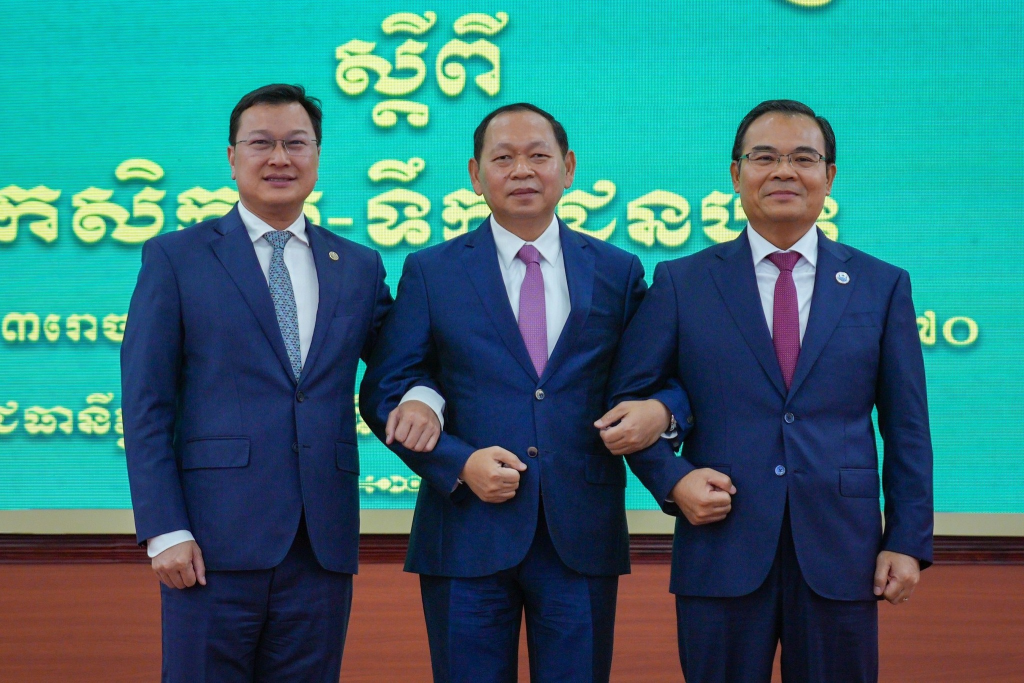
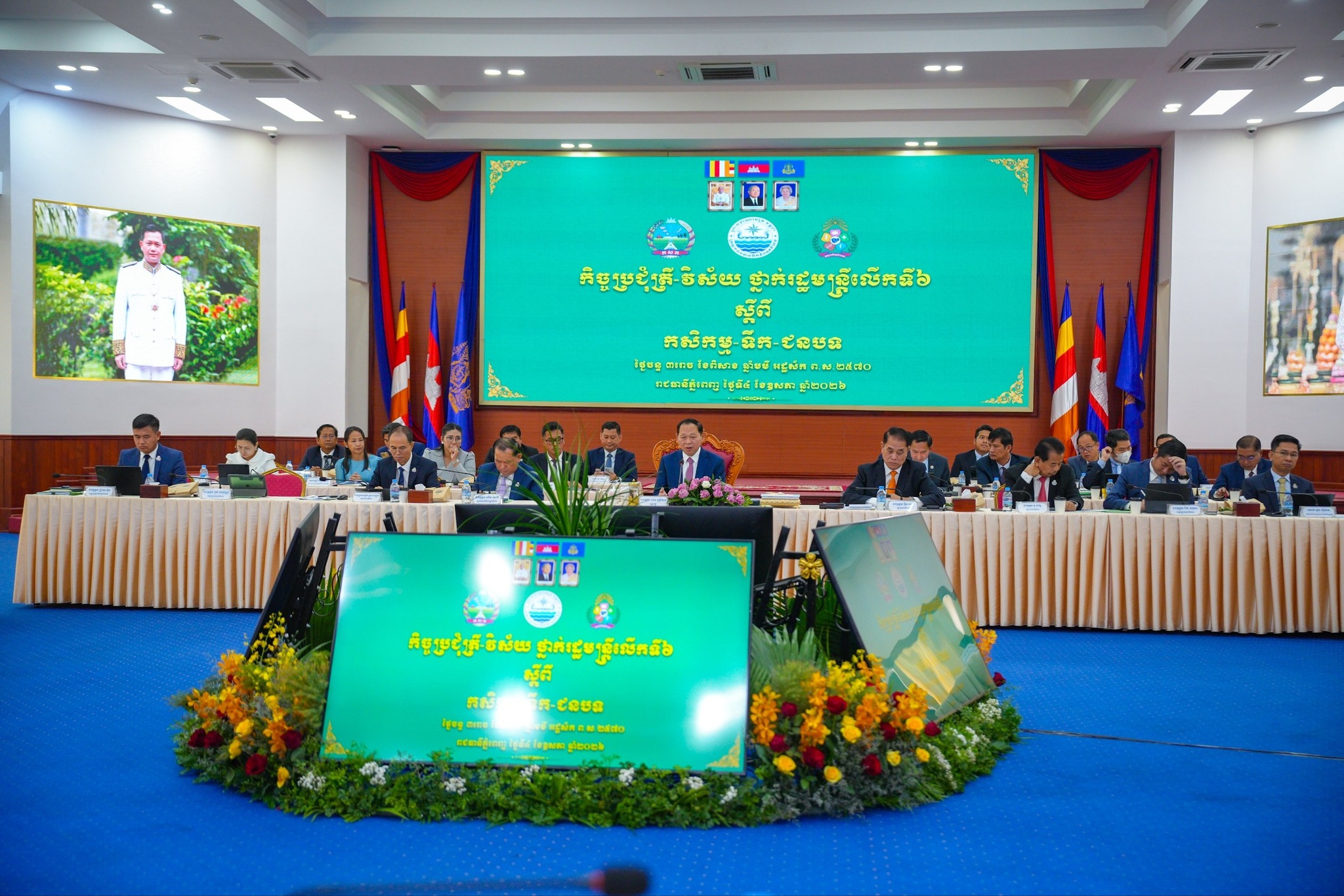
Three Cambodian ministers convened on Monday at the Ministry of Rural Development for the sixth meeting of an inter-ministerial cycle that began on 6 May 2024.
The agenda was the reference conditions for a 2026-2030 strategic plan whose drafting is now scheduled for June through December under an Australian-funded consultancy. Chhay Rithisen of Rural Development, Dith Tina of Agriculture, Forestry and Fisheries, and Thor Chetha of Water Resources and Meteorology co-chaired. The meeting reviewed progress since the fifth ministerial gathering, set directions for expanding to additional target communities, and reviewed the reference conditions for the strategic plan. The Ministry of Agriculture, Forestry and Fisheries hosts the Working Group Secretariat that supports the cycle.
The plan appears in primary documents under two different period brackets. AKP’s account of Monday’s meeting describes the document as the Tri Sector Strategic Plan for 2027-2031. The Request for Proposals issued in early 2026 by the technical assistance partner names the same document the Cambodia Tri-Sectoral Strategy and Implementation Plan 2026-2030, with the consultancy beginning June 2026 and concluding December 2026.
Cambodia has built a six-cycle inter-ministerial mechanism for production-side rural-sector coordination. The first five cycles produced agreement on the working-group structure with quarterly meeting cadence, integration of community-level frameworks across the three ministries, and a Concept Note approved by the Working Group. The sixth cycle is reviewing the reference conditions, the parameters the consultancy will work from to draft the plan.
The plan period falls inside a compound rural pressure landscape that has tightened over the past eighteen months. Cambodia’s Least Developed Country graduation is scheduled for 2029, with projected GDP loss of $750.4 million and approximately 432,000 people projected to slip into poverty across 2027 to 2030 (UNDP, LDC Graduation Policy Brief, 2024). Approximately 0.9 million Cambodian workers have returned from Thailand since June 2025 following border tensions (AMRO, Analytical Note on the Impact of Cambodia-Thailand Border Conflicts, 17 November 2025). Agriculture provides 33.4 percent of total employment but contributed only 0.2 percentage points to real GDP growth between 2021 and 2024.
The strategic plan being drafted in the next seven months will set the production-side three-ministry architecture for the 2026-2030 period.
The 2007 Water Resources Management Law established the framework for Farmer Water User Communities. The National Policy on Rural Development 2025-2035 was launched at the Ministry of Rural Development on Tuesday 2 December 2025, with the Minister of Rural Development presiding at the closing ceremony and the Prime Minister stating in a press release that the Royal Government had officially implemented the policy. The policy was disseminated to all 25 provincial departments through a workshop on 1 December 2025. The Cambodia Climate Resilient and Integrated Water Resources Management Action Plan 2026-2030 was launched in July 2025 by the Ministry of Water Resources and Meteorology alongside the National Action Plan on Drought Management and Adaptation 2025-2030. The modern agricultural community framework, announced by the Prime Minister at the end of 2023, has expanded from nine communities in five provinces in early 2024 to 31 communities across 14 provinces by March 2026, per MAFF spokesperson Khim Finan, with pre-arranged market linkages central to the selection process.
The consultancy supporting the strategic plan is the Cambodia Agriculture, Productivity, Resilience and Economic Development facility, an AUD $87 million Australian Department of Foreign Affairs and Trade program covering 2022-2027 and implemented by Cowater International. The Concept Note for the plan was approved by the Working Group before the Request for Proposals went out on the open market. The consultancy timeline runs from June through December 2026.
Cambodia’s Constitution places state duty on economic development in remote areas, especially in agriculture, with attention to policies on water, electricity, roads and means of transportation in Article 61. Article 62 places state duty on improving the means of production, protecting the price of products for farmers and crafters, and finding marketplaces for them to sell their products.
The Tri-Sector mechanism handles three of the Article 61 domains and the production component of Article 62. The marketplace and pricing duty in Article 62 sits outside the Tri-Sector coordination, in adjacent state architecture.
Six cycles in, the production-side three-ministry composition is the same three founding ministries. Documented expansion has run at the community layer rather than the ministry layer.
The World Bank’s June 2025 update described the agricultural sector as facing structural challenges including dependence on weather conditions and volatile commodity prices, which constrain its potential as a driver of broader economic growth. The 2024 paddy rice harvest reached 13.9 million metric tons, up 11.0 percent year-on-year. Agricultural sector contribution to real GDP growth held at 0.2 percentage points across the four years 2021-2024.
The Royal Government’s 2025 figures, reported through MAFF, place the sector at 16.1 percent of GDP and $8.3 billion in value, with 2025 agricultural exports at approximately 15 million metric tons, up 27.8 percent, generating roughly $5 billion in revenue (AKP and Phnom Penh Post citing MAFF, 19 March 2026). Both figures originate in MAFF self-reporting and have not been independently audited at the time of writing. Both sit above the World Bank’s 2024 baseline.
The target communities and provinces under coverage are not in the public meeting record. The development partners present at Monday’s meeting are not named in the announcement. The Council for Agriculture and Rural Development chaired by Ouk Rabun is the existing inter-institutional coordinating body for agriculture and rural development. CARD predates the Tri-Sector Working Group. The relationship between the two coordinating bodies is not documented in available institutional materials at the time of writing. The fifth meeting’s exact date appears in a March 2026 photo caption rather than published directly. The plan period appears in two different brackets in two different primary documents from the same source environment.
The published plan, due December 2026, will show whether the marketplace and pricing duty in Article 62 is addressed inside the production-side architecture or referred to adjacent ministries.