
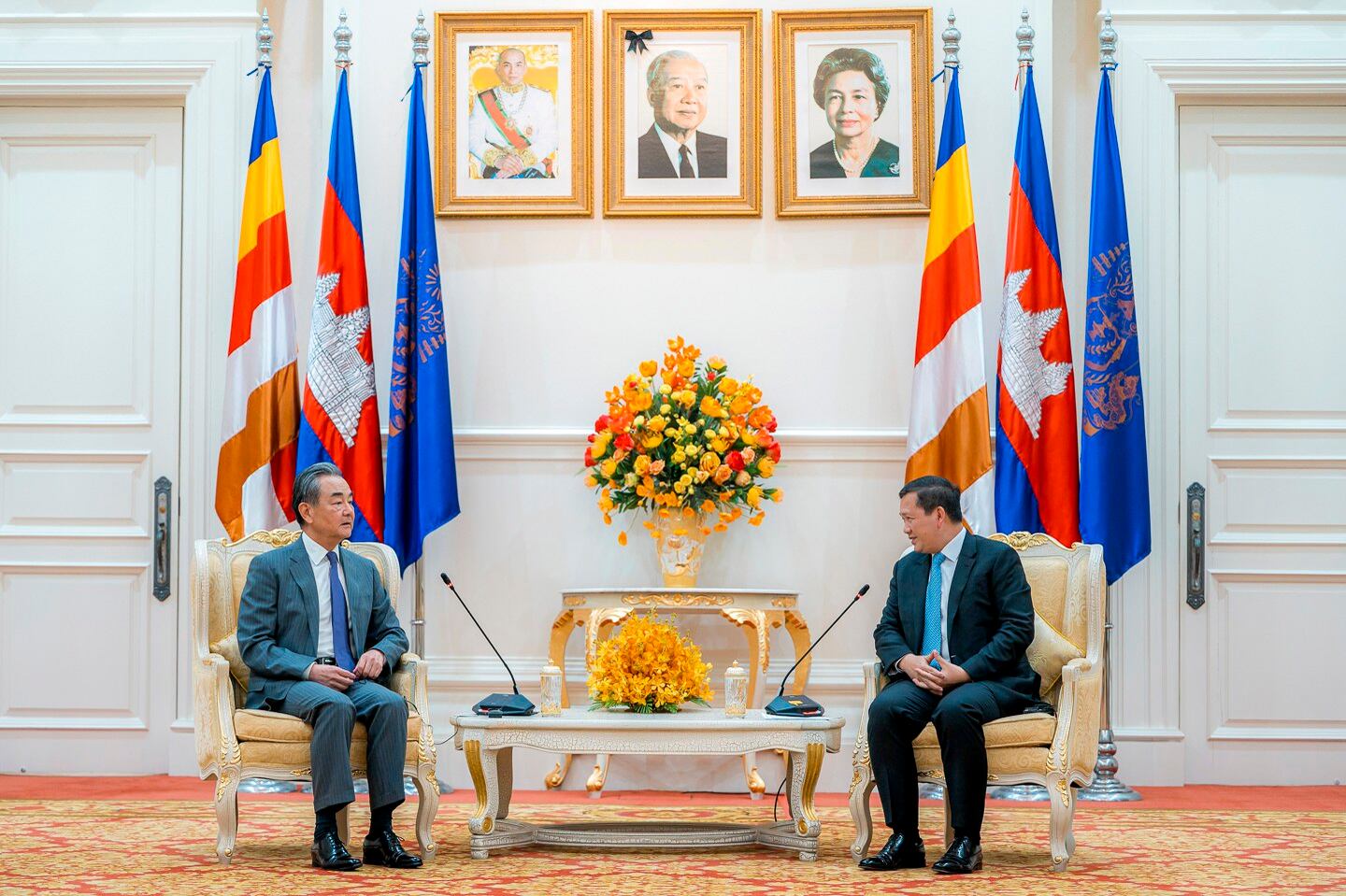
Wang Yi sat across from Hun Manet in the Peace Palace on Wednesday, April 22, and across from Anutin Charnvirakul at Government House in Bangkok on Friday, April 24. Between those two meetings, Thailand’s National Security Council voted to scrap MoU 44, the 2001 maritime memorandum with Cambodia. The Chinese foreign minister had been in two ASEAN capitals inside forty-eight hours. Thailand’s cabinet had not yet seen the proposal. Cambodia’s declarations under the United Nations Convention on the Law of the Sea had been on deposit at the UN treaty registry since March 8.
The NSC’s second meeting of 2026, chaired by Anutin in his dual capacity as prime minister and interior minister, resolved that MoU 44 had delivered no benefit in twenty-five years and would be replaced with negotiations under UNCLOS. Royal Thai Navy Chief of Staff Adm Thadawut Thatpitakkul put the rationale plainly. “Cambodia became a member of UNCLOS in March 2026,” he told reporters after the meeting, adding that Thailand could now negotiate within the convention’s member-state framework for its benefit. Anutin told Pattaya Mail that Thailand maintained the right to cancel the agreement unilaterally.
What that framework looks like with both states’ declarations on file and MoU 44 removed is a question Thailand’s own foreign ministry answered fifteen months ago. On November 13, 2024, then Vice Foreign Minister Russ Jalichandra used the Public Relations Department’s English-language channel to call MoU 44 “Thailand’s most effective tool” for managing the overlapping continental shelf dispute. The same statement recorded that an attempted cancellation in 2009 was reversed in 2014 after subsequent studies identified strategic advantages in keeping the framework intact.
Russ Jalichandra’s November 2024 statement was the first of five points in Thailand’s own record running against the cancellation. The Thai foreign ministry warned against revocation in August 2025. Assistant Foreign Minister Ras Chaleechan told reporters in the same month that cancellation might not hold under international law. Thailand’s letter to the UN Security Council on January 19, 2026 relied on MoU 2000, the 2000 land-boundary memorandum, to characterise the bilateral framework. Council of State Secretary-General Pakorn Nilprapunt told Thai media on February 17, 2026 that any cancellation would require a formal process and that he was not himself a specialist in international law.
The political record after the February 8 election ran the other direction. The Senate’s special committee voted unanimously to recommend cancellation of both MoUs, the 2000 land-boundary and the 2001 maritime, on March 24, 2026. Anutin’s policy statement to parliament on April 9 pledged to expedite study of MoU 44 termination while invoking “peaceful means and existing bilateral mechanisms.” Foreign Minister Sihasak Phuangketkeow described the procedural pathway on April 11: a foreign ministry proposal to the NSC, an NSC decision, a cabinet vote. The April 23 NSC meeting completed the second of those three gates. Cambodia was not part of the procedure.
Cambodia’s letter to the UN Security Council on January 26, 2026 (UN Doc A/80/587-S/2026/7) registered the Royal Government’s institutional position on the post-ceasefire situation. Foreign Minister Prak Sokhonn raised the border situation at the UN Human Rights Council in February 2026. On February 4, Hun Manet wrote to French President Emmanuel Macron formally requesting cooperation on access to the Archives nationales d’outre-mer, specifically the Indochina records and the 1904/1907 Franco-Siamese Border Commission documents that MoU 2000 names as the legal foundation for joint demarcation. The State Secretariat of Border Affairs filed a Note Verbale dated April 7 proposing a Joint Boundary Commission special meeting in Siem Reap from April 17 to 22, a Joint Survey Team deployment from April 20 to 24, and the next Joint Technical Sub-Commission meeting in early May. Each proposal was declined or left unanswered.
The foreign ministry’s April 9 statement on MoU-2001 called the agreement a reflection of the “genuine political will and common intent” of both governments and said it remained in force until its objectives were achieved. The ministry returned to the position the day after the NSC vote, calling any unilateral withdrawal a step “departing from the cooperative spirit underpinning the signing of this document.”
Cambodia’s accession instrument was deposited on March 8, 2026, with the depositary notification circulated as CN.85/2026. Cambodia’s declaration under Article 298 covers all three permissible categories of exclusion under paragraph 1, sub-categories (a), (b), and (c). Thailand’s depositary notification CN.291/2011 covers the same three categories in mirrored scope. Either state can decline binding adjudication by the other on a maritime boundary.
Article 298(1)(a)(i) provides that a state having declared under paragraph 1(a) shall accept submission of a sea boundary dispute to compulsory conciliation under Annex V, Section 2, at the request of either party, where the dispute arises subsequent to the convention’s entry into force and no agreement is reached in negotiations within a reasonable time. The proviso excludes disputes that necessarily involve concurrent consideration of unsettled sovereignty over land territory. The conciliation commission’s report is not binding; its function is documentary. The Timor-Leste conciliation against Australia under the same procedure ran from 2016 to 2018 and culminated in a binding maritime boundary treaty.
Article 281 of the convention applies the Part XV dispute settlement procedures only where parties to a peaceful-settlement agreement have not reached settlement, and Article 298(1)(a)(iii) excludes from the conciliation proviso any sea boundary dispute “to be settled in accordance with a bilateral or multilateral agreement binding upon those parties.” MoU 44 currently functions as both shields. The November 2024 PRD statement named precisely this architecture. Cancellation removes Article 281’s anchor and Article 298(1)(a)(iii)’s carve-out simultaneously. What remains is Article 298(1)(a)(i)’s conditional pathway, available to either party.
Wang Yi and Defense Minister Dong Jun arrived in Phnom Penh on April 22 for the first session of a 2+2 Strategic Dialogue Mechanism with Cambodian Foreign Minister Prak Sokhonn and Defense Minister Tea Seiha. The Chinese delegation met Hun Manet the same day at the Peace Palace. The format was proposed by Xi Jinping during his April 2025 state visit. The Chinese foreign ministry’s readout from the prime ministerial meeting recorded Wang’s statement that China was willing to continue building platforms for direct dialogue between Cambodia and Thailand. Hun Manet briefed on the border situation and asked for a greater Chinese role in advancing peace talks. The mechanism had been on the diplomatic calendar for a year.
The Bangkok meeting came mid-way through Wang Yi’s four-day Southeast Asia tour, covering Cambodia, Thailand, and Myanmar from April 22 to 26. The Chinese foreign ministry’s readout recorded Anutin thanking China for its “unremitting efforts in helping properly resolve the border conflict between Thailand and Cambodia.” Wang said China would expand cooperation with Thailand in new energy, infrastructure construction, and agriculture. Anutin told reporters Wang had conveyed Beijing’s assessment that Cambodia did not want further conflict.
The conduct in the two capitals overlaps, and the framing diverges. Cambodia’s engagement was a pre-scheduled mechanism founded a year earlier. Thailand’s engagement was a stop on a regional tour the day after the cabinet had been bypassed. The architecture earning Cambodia the “China-captured” framing has Cambodia receiving its first US Navy warship at Ream in January 2026, the first Japanese naval visit to the base after its April 2025 renovation, the US arms embargo lift confirmed at the Kuala Lumpur Joint Declaration in October 2025, and an active French archives channel running out of the ANOM at the Cambodian foreign ministry’s request since February 4, 2026.
The conciliation pathway under Article 298(1)(a)(i) is conditional, not automatic, and the post-November 1994 temporal gate together with the land-territory exclusion are genuine legal obstacles, with Koh Kut sovereignty on the land side of the line and the Overlapping Claims Area (OCA) delimitation on the maritime side. Some readings of MoU 2001’s residual character treat the prior-agreement architecture under Article 281 as surviving cancellation in attenuated form, particularly where progress under Article 70 of the Vienna Convention on the Law of Treaties, which preserves rights and obligations crystallised before termination, is documented. The Wang Yi visit can be read as standard regional diplomacy, with Beijing’s stops reflecting Chinese mediation initiative rather than Thai dependency. Each holds at the level of legal and diplomatic interpretation. None displaces the documentary finding that Thailand’s own foreign ministry, in November 2024 and again in August 2025, named cancellation as the move that would surrender the framework’s protective function.
The Thai cabinet has not yet decided. The foreign ministry has not yet sent a notification under Article 65 of the Vienna Convention on the Law of Treaties. The Joint Boundary Commission has not met. Cambodia’s foreign ministry on April 24 said the 2001 framework remained binding and that any unilateral withdrawal would depart from the cooperative spirit underpinning the agreement. The next institutional gate is the cabinet. The framework Thailand’s foreign ministers had called the most effective tool was the framework Thailand’s National Security Council, on April 23, voted to remove.