
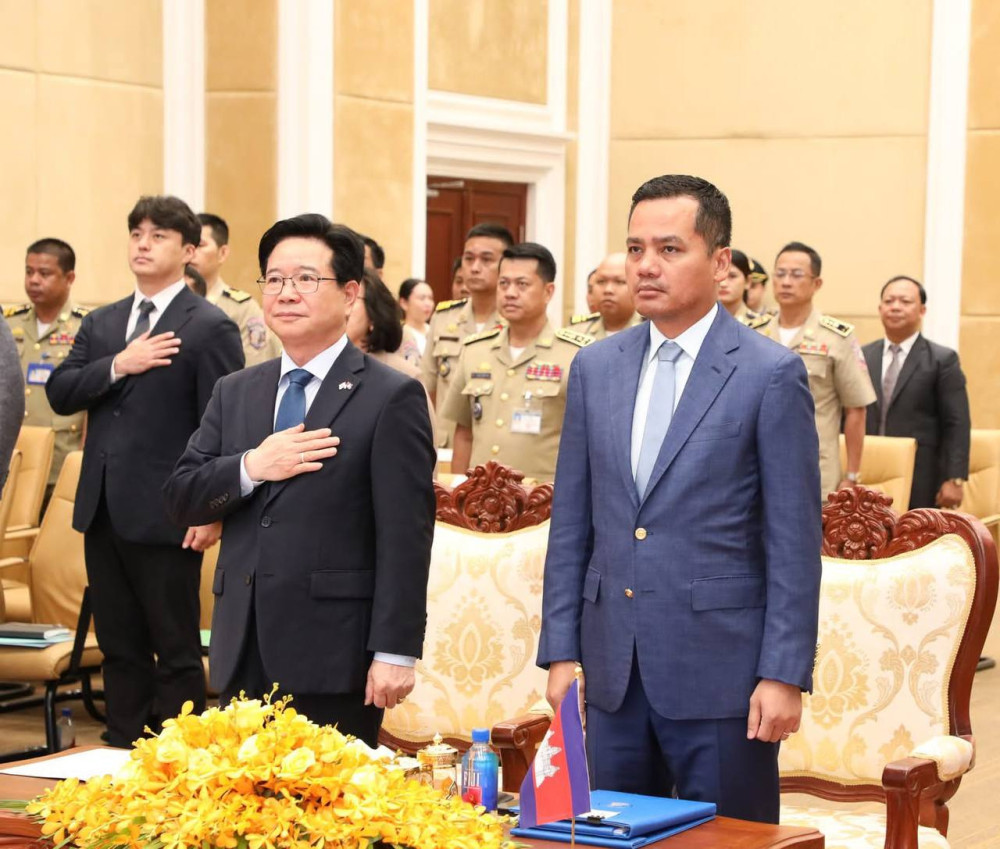
On March 31, Cambodia’s Ministry of Interior and the Korea International Cooperation Agency signed a $13.5 million agreement to build forensic science laboratories inside the national police. The project’s official title frames it as capacity development. The bilateral timeline tells a more specific story.
The Record of Discussion, signed by KOICA Cambodia country director Choi Moon Jung and Interior Minister Sar Sokha, formalizes a project called “Strengthening the CSI and Forensic Science Capacity of Police in Cambodia.” Under the agreement, a forensic science and research facility will be built at the Police Academy of Cambodia, while existing crime scene investigation and digital forensic laboratories at the General Commissariat of National Police will be upgraded to meet what officials described as international standards. Advanced training in DNA analysis, toxicology, and digital forensics will accompany the infrastructure investment.
South Korean Ambassador Kim Chang-yong witnessed the signing and addressed the complexity of cross-border crime. “No single country can successfully dismantle sophisticated criminal networks independently,” Kim said. “Only through close cooperation and consistent information sharing can we uproot transnational crime.”
The ceremony took place five months after the two countries’ national police agencies signed a Memorandum of Understanding establishing a joint working group dedicated to handling crimes involving Korean nationals. That agreement was concluded during South Korean Foreign Minister Cho Hyun’s visit to Phnom Penh in November 2025, which followed a summer of escalating bilateral tension over the deaths and captivity of South Korean citizens inside Cambodian scam compounds. In October 2025, South Korean police sought arrest warrants for 58 of 64 Korean nationals repatriated from Cambodia on suspicion of involvement in online fraud operations.
Cambodia is South Korea’s largest ODA recipient in 2025, with an expected $315 million in assistance covering education, water management, health, sanitation, transportation, and rural development. Forensic policing appears in neither Cambodia’s official sectoral cooperation framework nor the 2025 bilateral development meeting agenda, which was co-chaired by CDC Second Vice Chairman Chhieng Yanara and the South Korean ambassador in March 2025.
The project’s official positioning places it alongside the 30th anniversary of the re-establishment of Cambodia-South Korea diplomatic relations in 2027 and describes it as aligned with Cambodia’s Pentagonal Strategy Phase 1 and Vision 2050. Cambodia’s Interior Ministry formally received the project within its institutional planning framework. Officials described the initiative as evidence of deepening bilateral partnership in security and development.
What the public record does not yet show is any legal framework governing how the forensic data produced by these new laboratories will be handled. DNA samples, toxicological results, and digital evidence generated through KOICA-funded infrastructure will feed into national police operations that carry both a transnational crime mandate and domestic security functions. No accreditation body for the laboratories has been named in any public document. No data retention, sharing, or admissibility standards have been published. The Record of Discussion has not been made available in full text through any official channel.
The governance architecture for the capacity being built does not appear in the public record at the time of signing.