
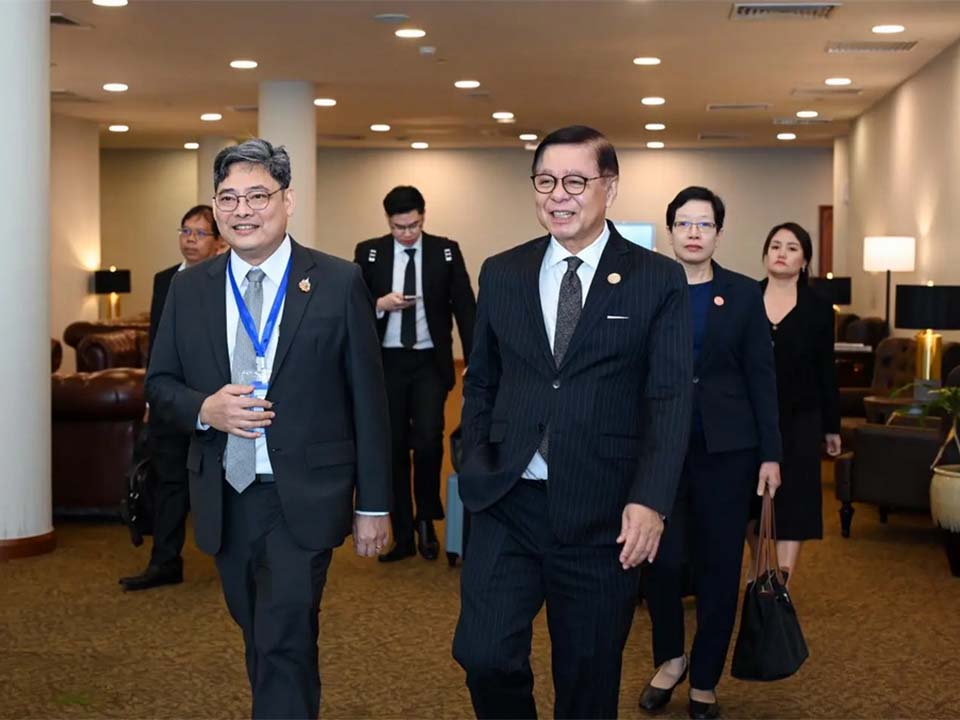
On 28 April in Bandar Seri Begawan, Thailand’s foreign minister told the Philippine secretary of foreign affairs that Cambodia had abruptly announced a Joint Boundary Commission meeting date without the Thai side having known beforehand, in a way akin to pushing Thailand into the position of being the side that refused. The account is reported by Nation Thailand from a Thai foreign ministry readout.
Sihasak Phuangketkeow had received the Cambodian Note Verbale proposing those dates twenty-one days earlier. He had refused it on 11 April. The bilateral talks took place on the sidelines of the 25th ASEAN-EU Ministerial Meeting in Brunei. Sihasak met Cambodia’s Prak Sokhonn on 27 April, then Maria Theresa Lazaro of the Philippines and Vivian Balakrishnan of Singapore on 28 April.
The bilateral mechanism Thailand publicly insists is the only legitimate forum for the Cambodia-Thailand dispute is the same mechanism Thailand has refused to convene through three successive Cabinets. MOU 2000 Article II.2 obligates the Joint Boundary Commission to “hold its meeting once a year alternately in Cambodia and Thailand.” Thirteen years separated the 5th JBC in 2012 from the 6th JBC, hosted by Cambodia in Phnom Penh on 14 June 2025. Thailand hosted the Special JBC at Chanthaburi on 21–22 October 2025. The 7th JBC, which Cambodia proposed for early January 2026, was postponed twice at Thai request, on 8 January and 14–15 January. Cambodia’s Note Verbale of 7 April proposed a Special JBC in Siem Reap from 17 to 22 April, a Joint Survey Team deployment from 20 to 24 April, and a 12th Operational Group meeting and 5th Joint Technical Sub-Commission meeting in the first week of May. The Thai foreign minister characterised the proposal to Lazaro as a surprise.
Sihasak’s 11 April statement is on the public record. He told reporters Thailand was “not yet ready,” cited the need to reconstitute its JBC team, and said “the first task would be to discuss procedures, methods and the substance of the talks, rather than move straight into delimitation.” A Note Verbale received and refused twenty-one days earlier was known beforehand.
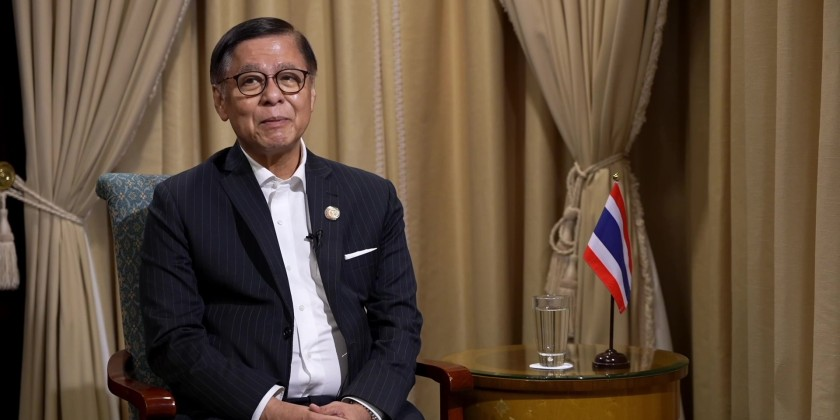
Cambodia’s Permanent Representative to the United Nations filed identical letters to the Secretary-General and Security Council on 3 January 2026, listing JBC progress at the segments between border pillars 52–59 and 42–47, citing the Agreed Minutes of the Special JBC of 22 October 2025. Thailand’s Permanent Representative filed sixteen days later. The Thai filing recorded that the Thai side of the JBC was “currently finalizing internal procedures, including the formal mandate, to be issued following the formation of the new Cabinet” after the 8 February 2026 election. The Anutin II Cabinet was sworn in on 6 April. Cambodia’s Note Verbale arrived the day after the new Cabinet’s first meeting approved its policy statement. Sihasak’s 11 April refusal cited internal procedures still in progress.
The second move at Brunei was rhetorical. Sihasak told Lazaro that the conflict required both a “ceasefire” and a “halt” to verbal warfare, and that the dispute involved a “lack of trust” that could not be resolved without sincerity from the Cambodian side; the operative ceasefire instrument is the Joint Statement of the 3rd Special General Border Committee of 27 December 2025, which addresses use of force, and treating diplomatic protest formally framed in Note Verbale and UN filings as functionally equivalent to the armed action that statement suspended rewrites the ceasefire’s scope through assertion at a multilateral venue.
The strongest reading available to Thailand turns on transitional Cabinet realities. The Anutin II government had been in office for one day when Cambodia’s Note Verbale arrived. A demand for a Special JBC inside ten days of a new Cabinet taking office is, on its face, tight. Two facts limit the reading. The thirteen-year JBC gap antedates the February 2026 election, and the Cambodian Note Verbale included graduated subsequent dates, the 12th Operational Group and 5th JTSC, in the first week of May.
On 13 March, Sihasak accused Cambodia of complicating the situation by raising the dispute at the UN Security Council, UNESCO, and the International Court of Justice. On 28 April, the same foreign minister briefed two ASEAN ministerial peers on the bilateral dispute on the sidelines of an EU dialogue meeting in Brunei. Cambodia’s filings to the Security Council and UNESCO are public documents, addressed to multilateral bodies whose function is dispute scrutiny. They appear in the UN record under Cambodia’s name. Sihasak’s account to Lazaro is reported through Thailand’s news outlets and Thailand’s Foreign Ministry. It was conveyed to two ASEAN ministerial peers without Cambodia in the room. Thailand criticises the multilateral leg of Cambodia’s posture. Thailand uses ASEAN sidelines to convey the bilateral leg.
The bilateral with Balakrishnan focused on Myanmar. According to the Thai readout, Sihasak said ASEAN must choose between maintaining the restriction on Myanmar’s senior representation at ministerial meetings and “opening space for the revival of relations.” Sihasak agreed with Balakrishnan’s “concern about timing” on Myanmar and said Thailand had to engage because it shared a border. The Myanmar engagement pitch sat in the same Brunei sitting as the Cambodia grievance account.
On 27 April, Sokhonn told Sihasak that lasting peace required “genuine commitment and full respect for international law, the ASEAN Charter, as well as all existing treaties and agreements that bind us.” Cambodia’s Foreign Ministry recorded that statement. The MFAIC readout characterised the meeting as a “candid discussion” on the border situation, confidence-building measures, and broader aspects of diplomatic relations. Sokhonn’s bilateral with Sihasak preceded the Lazaro and Balakrishnan bilaterals by a day. The MFAIC readout speaks for one party, to its own ministry. Nation Thailand’s report speaks for both parties, to two ASEAN counterparts. The two records sit alongside each other in the AEMM archive.
The 7th JBC has not convened, the Thai chair has not been appointed, and the 7 April Note Verbale has not been answered formally. The bilateral mechanism the foreign minister of Thailand named in Brunei as the proper forum still belongs, by treaty text, to both governments to convene.