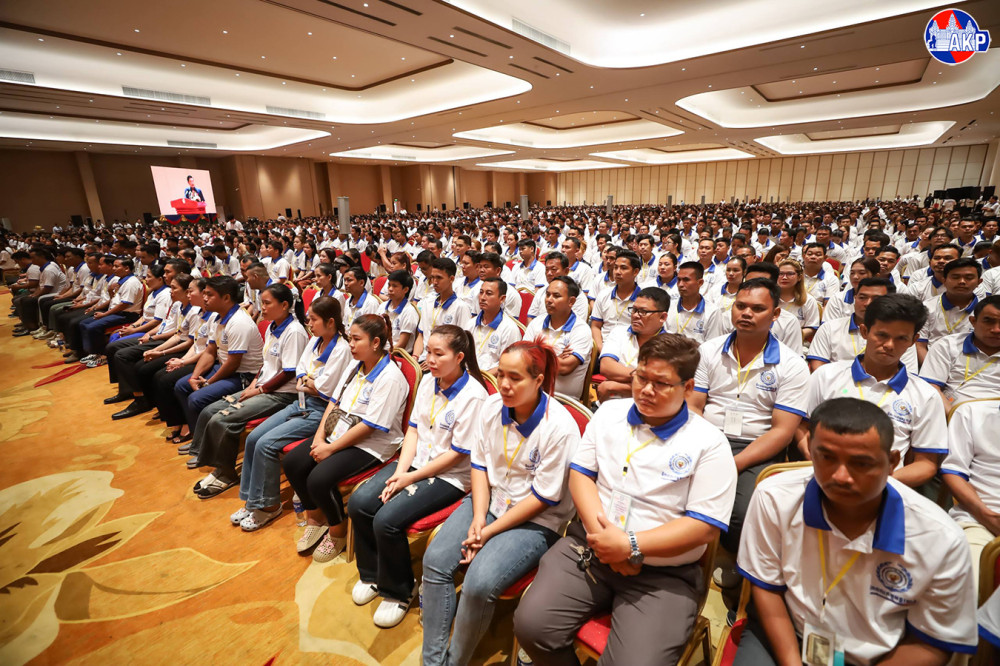
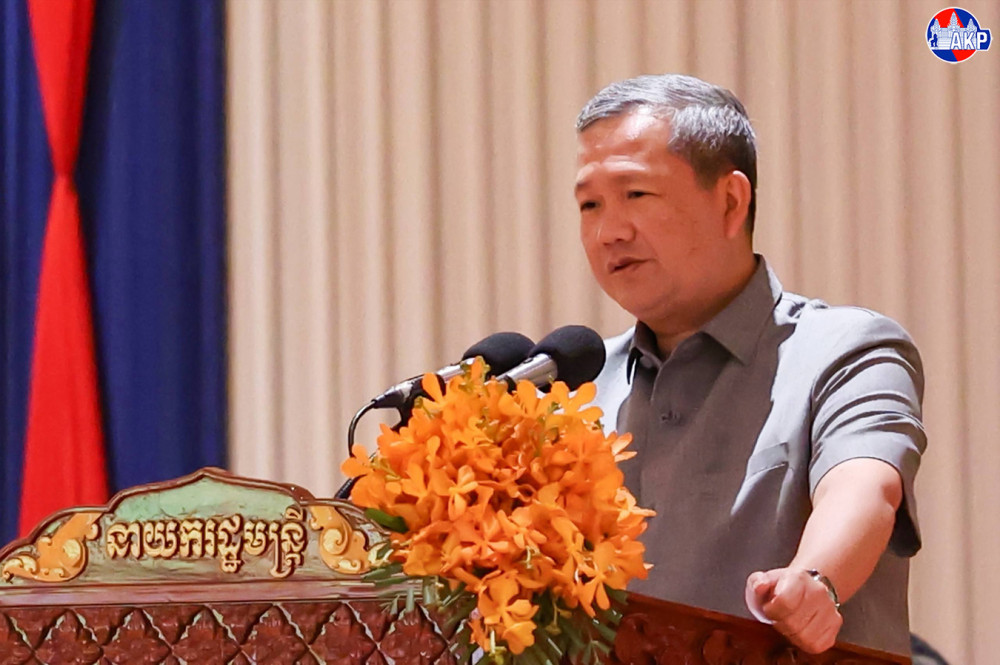
Prime Minister Hun Manet told a Koh Pich audience of trade unionists, informal economy workers, and education staff associations on 26 April that Cambodia could not create jobs that offer high salaries while turning people into “modern-day servants,” and that employment must respect the law.
Twenty days earlier, on 06 April, the King promulgated Royal Decree NS/RKM/0426/006, the Law on Combating Online Scams. Article 6 of that law punishes anyone who organises or leads a technology-enabled scam centre with five to ten years’ imprisonment. Where the offence involves human smuggling, human trafficking, labour exploitation, forced criminality, or other exploitation, the penalty rises to ten to twenty years. Where it causes death, fifteen to thirty years or life imprisonment.
The phrase “modern-day servants” sits in the same conceptual register as “labour exploitation, forced criminality.” Twenty days separates the statutory text from the head-of-government formulation. In January 2025, at the 45th Central Committee Conference of the ruling party, Hun Manet framed online scams and fraud as “linked to modern-day international human trafficking”, per Khmer Times. Same register, same conduct, fifteen months earlier. The 26 April formulation extends that vocabulary onto the conduct the criminal code now criminalises by name.
Cambodia’s 1993 Constitution had already done the underlying work. Article 36 establishes the rights of citizens to choose employment, to receive equal pay for the same work, to obtain social security, and to form and be members of trade unions. Article 37 establishes the right to strike within the framework of law. Article 45 prohibits the exploitation of women in employment. Article 46 prohibits trading in human beings and the termination of a woman’s employment because of her pregnancy. Article 48 commits the state to protect children from any forms of labor injurious to their educational opportunities, health, and welfare.
The 2026 Labour Day theme the Royal Government adopted, “Building Resilience Together for Decent Work,” runs in the constitutional register. The criminal-code instrument promulgated three weeks earlier puts statutory penalty behind the same conduct the constitutional articles already prohibit. The reading the international record has not yet performed, and that no Cambodian official has articulated as a connection in the public record, is that the Labour Day address was not ceremonial.
On 18 February 2026, MLVT and the International Labour Organization signed a one-million-dollar Japan-funded reintegration program for returning migrant workers, with Minister Heng Sour and Japanese Ambassador Ueno Atsushi present. The program addresses a population of roughly 950,000 Cambodian workers MLVT spokesperson Sun Mesa said had returned from Thailand during the 2025 border crisis, in a 13 March 2026 Khmer Times attribution. The Cambodian government has stated approximately two-thirds of returnees were re-employed; Human Rights Watch documented in November 2025 returned workers carrying debt without adequate support, and Cambodian rights groups have flagged loan-relief gaps for displaced border farmers.
The Thai Ministry of Labour, on 22 March 2026, acknowledged that its private sector wanted urgent solutions to shortages of Cambodian workers in industrial, construction, and agricultural sectors. Cambodian labor builds supply chains across a border the criminal code cannot reach, including supply chains that exploit it. Article 6 applies to operations physically present in Cambodia.
The Labour Day address was one of three threads from the same speech. AKP rendered them as three separate releases. The Royal Government on 23 April approved a draft conscription law requiring military service for citizens aged eighteen to twenty-five, with female participation voluntary. Hun Manet proposed sending gang-affiliated youth to the frontline for social service. One address moved on labor, conscription, and gang-youth policy in sequence, the same head of government making three institutional claims on the same population in the same morning.
Cambodia’s scheduled 2029 graduation from Least Developed Country status is the horizon the speech speaks into. UNDP modeling projects 165,000 to 168,000 jobs lost post-graduation, fifty-seven to fifty-eight percent of them held by women, with approximately 432,000 non-poor persons projected to slip into poverty under a graduation shock scenario absent intervention. EU tariffs on Cambodian garments rise from zero percent under Everything But Arms to 8.8 percent under standard GSP and 11.5 percent under MFN. Rules of origin tighten from thirty percent local value added to sixty percent for preferential treatment, with double transformation required for garments. Preferential access is conditioned on application of human and labour rights and environmental and climate considerations. The graduation runway and the rights conditionality are the same instrument.
A scam-law that puts criminal liability on labour exploitation also strengthens the formal-sector compliance record LDC graduation is conditioned on. The criminal code and the trade preferences hold the same conduct accountable from different directions, in the same period.
Cambodia’s labor system absorbed nearly a million returnees in roughly nine months without a recorded mass unemployment crisis. The gaps in that absorption are documented: returned workers carrying debts that pre-date their return, a re-employment claim no independent body has confirmed, loan-relief programs that ended before displaced border farmers had recovered. Whether the law is enforcement or vocabulary turns on the first prosecution under Article 6 against an operator who can be named.