Four months after the ceasefire committed both sides to refrain from constructing military infrastructure beyond their own side, Cambodia’s Ministry of Foreign Affairs and International Cooperation named seven sites where it says Thai armed forces have done exactly that.
The ministry’s 19 April press release listed activities reported to have taken place on 18 April 2026 across three provinces. In Preah Vihear, an observation post in Sra Em Commune, Choam Ksan District, inside the Preah Vihear Temple area. In Oddar Meanchey, road construction near Boundary Pillar No. 2 in Anlong Veng District and in the Doeum Ta Trav area of Trapeng Prasat District; bunker-digging near the Chup Koki International Border Checkpoint in Banteay Ampil District; an observation post east of Chup Doeum Knul with land-clearing to the north, in Sangkat Kon Kriel, Samraong City; a concrete walkway, bunkers, and a road east of Thmar Daun border checkpoint. In Pursat, heavy-machinery land-clearing in the O’Plouk Domrey area of Thmar Da Commune, Veal Veng District. The release characterised the activities as intended to further consolidate what it called an “illegal occupation” and said they were not limited to the seven named locations.
The 27 December 2025 Joint Statement of the 3rd Special General Border Committee, signed by the two defence ministers at Ban Pak Kard and circulated at the UN Security Council as a Thai-submitted annex, includes at Paragraph I.6 an explicit provision that both sides “refrain from constructing or enhancing any military infrastructure or fortifications beyond their own side.”
If the activities described in the Cambodian release occurred as described, they match the language of the provision. Whether they occurred as described is the question.
The mechanism installed to answer that question has not done so in public.
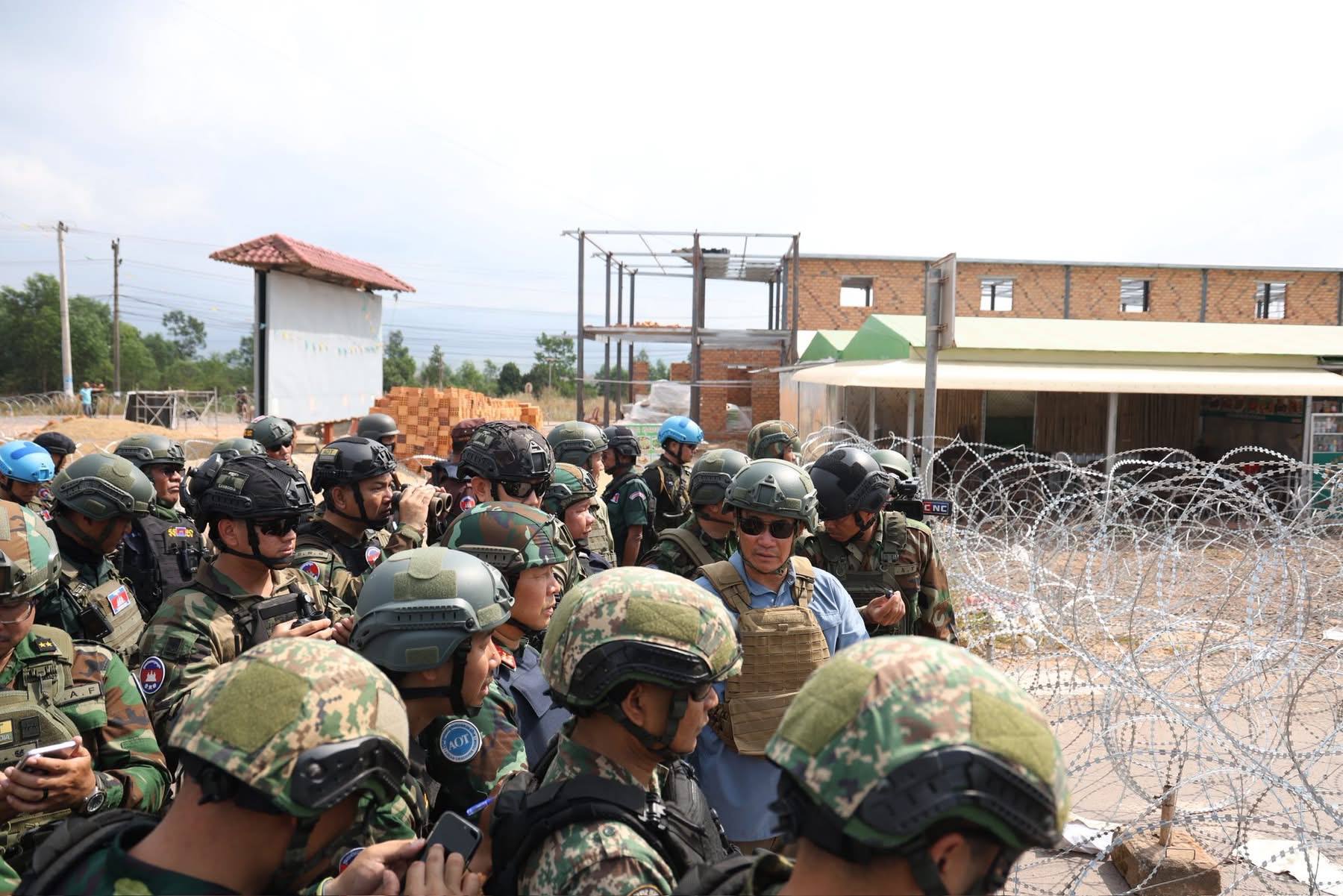
The ASEAN Observer Team was established by the Terms of Reference signed at Kuala Lumpur on 26 October 2025 and given the task, under Paragraph 12 of the December 27 agreement, of verifying effective implementation of all the measures in the Joint Statement. Philippine and Malaysian officials have publicly described the AOT role as “strictly limited to observing, verifying, and reporting developments on the ground,” consistent with ASEAN protocols and the principle of non-interference. The full Terms of Reference text remains outside the public record.
The AOT has conducted field visits to at least eight distinct border sites in three Cambodian provinces between January and March, according to reporting by Agence Kampuchea Presse, Cambodia’s state news agency. The visits include sites in Banteay Meanchey, Oddar Meanchey, and Preah Vihear provinces. No mission report, no findings document, has been publicly released by the AOT, by the ASEAN Secretariat, by either government, or by any ASEAN member state participating in the observer structure.
Into that documentary absence, Cambodia’s ministry has now issued three site-itemised protests in four months. The first, a formal UN Security Council filing dated Phnom Penh 2 January 2026, identified Thai operations across four Cambodian provinces: Banteay Meanchey, Pursat, Preah Vihear, and Oddar Meanchey. The filing named specific villages, temples, and border areas in each province and attached enclosures illustrating sites in Banteay Meanchey and Pursat. The second, a ministry release on 18 March 2026, listed fourteen border-area items including concrete bunkers, Buddha statues, and newly constructed roads. The third is the 19 April release.
The sites named on 18 April recur in three of the four provinces from the January UN filing. Banteay Meanchey, the province from which the January filing drew its illustrative enclosures, is absent from the April list. The other three provinces are the same.
Thailand’s stated position on post-ceasefire construction at contested sites has been consistent. Royal Thai Army spokesperson Winthai Suvaree stated on 4 February that the army considers the O’Smach area in Oddar Meanchey to be under Thai sovereign control pursuant to Clause 2 of the December 27 agreement, which commits both sides to maintain current troop deployments without further movement. Thailand’s 19 January UN counter-filing, annexed to the Joint Statement at the Security Council, cited Cambodia’s “unilateral assertion of sovereignty through unilaterally defined understandings, coordinates or depictions” and demanded Cambodia cease what it described as provocative actions. Thailand has also issued its own site-itemised allegations of Cambodian encroachment: an 11 March Thai Ministry of Foreign Affairs press release cited Cambodian structures at the An Mah-An Ses point of entry and an administrative building in Ta Phraya District, Sa Kaeo Province, and characterised a 24 February grenade incident as a ceasefire violation by Cambodia.
The Thai institutional posture on the underlying bilateral framework has hardened since the ceasefire. AFP reported that on 18 March, upon taking office, Prime Minister Anutin Charnvirakul authorised Thai forces on the border to act at their discretion. On 24 March, a Thai Senate special committee voted unanimously to recommend cancellation of the 2000 Memorandum of Understanding governing land-boundary work, the same MoU Thailand’s foreign ministry had described as the “sole framework” for demarcation thirteen days earlier. None of those institutional moves alters the text of the December 27 Joint Statement, which remains the controlling instrument at the site level.
What the 19 April release calls “illegal occupation” is a legal characterisation. The documentary content of the release is the itemised list of dated construction activities at named sites. The legal finding depends on boundary questions the International Court of Justice has not fully adjudicated: the 2013 interpretation of the 1962 Preah Vihear judgment determined that Thailand must withdraw from the whole promontory of Preah Vihear but did not address sovereignty over Phnom Trap or determine the boundary line on the ground.
What exists in the record, then, is a pattern of site-itemised allegations from both governments, a treaty text that would be breached if either set of allegations were substantiated, an ASEAN verification mechanism that has not substantiated or refuted them in public, and competing sovereignty framings at the sites themselves. Independent verification of the specific site claims satellite imagery, third-party journalistic field reporting, or published observer findings has not appeared in the public record for any of the sites named in the three Cambodian protests or in Thailand’s 11 March allegations.
This is not the evidentiary structure an observation regime was installed to produce.
The 19 April release closed by calling on Thailand to refrain from further unilateral actions in the named areas and other areas under similar circumstances, and reiterated that the activities would not prejudice Cambodia’s legal rights or position with respect to its international boundary.