On Saturday evening at Chaktomuk Walk Street in Phnom Penh, Tourism Minister Huot Hak presided over the launch of Cambodia’s Green Season Campaign 2026. The minister told the audience the campaign would turn the rainy season into a vibrant, high-value, and sustainable tourism period, with lush landscapes, cultural sites, and community-based experiences.
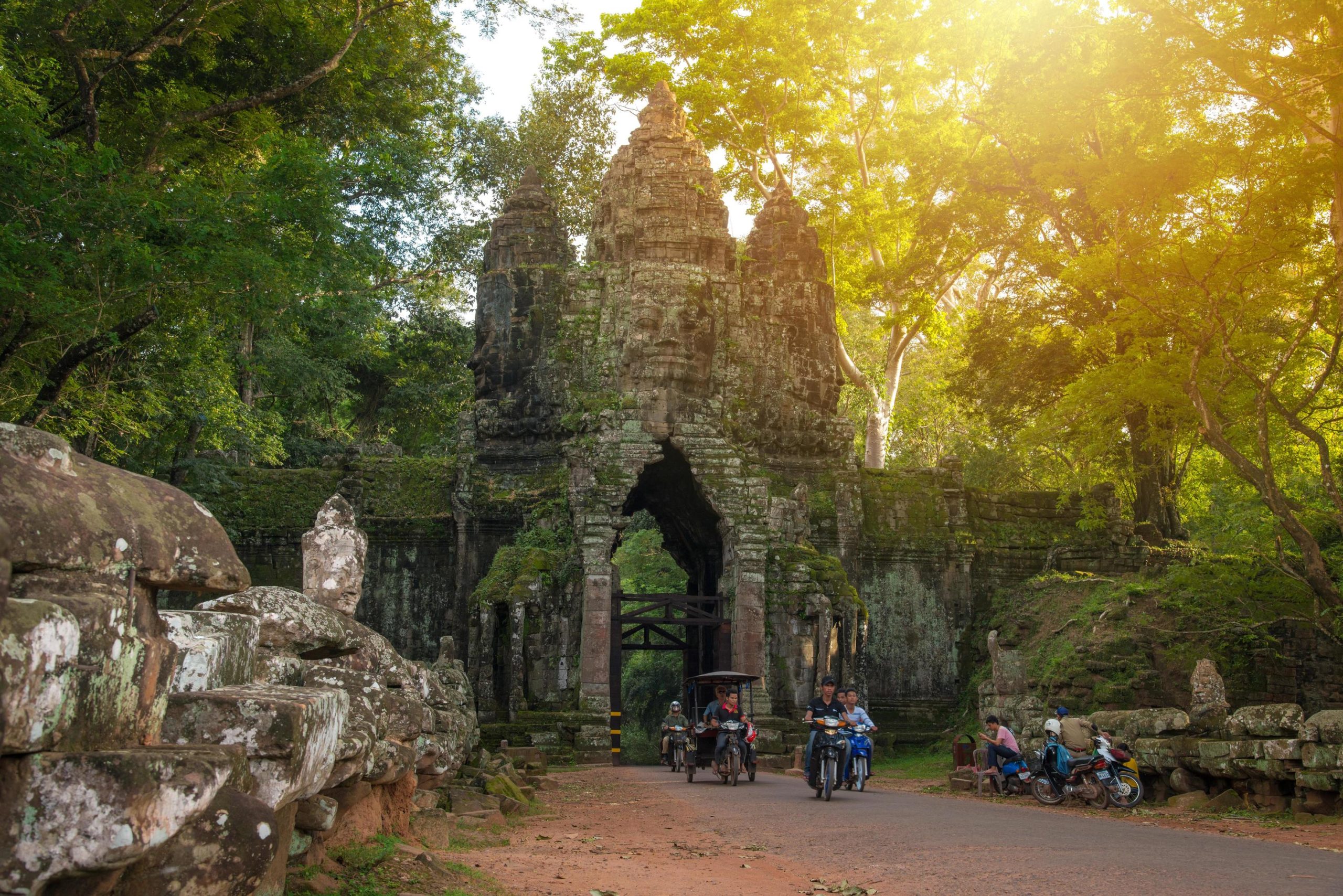
The same weekend, a Cambodian local guide posted on Facebook asking why official tourism communication kept pushing crowd images at Angkor when foreign visitors said they came for atmosphere, slowness, peace. Comments accumulated through the weekend. Resident Cambodians and resident foreigners replied. The Visit Cambodia account answered that Cambodia’s voice on international platforms remained limited and that any form of promotion was still better than none.
Both events sit inside the same 48-hour window, name the same atmospheric vocabulary, and are not opposed.
Cambodia’s TourismTech Roadmap 2025 names smart experience, ecotourism, integrated transport, safety and security, and digital marketing as priority categories. The Roadmap predates the local debate. The Green Season Campaign launched with precisely the atmospheric vocabulary the local guide’s post asked for. The Cambodia Tourism Board’s 500 Agents FAM Trip programme, announced in March, is structurally trade-conversion infrastructure for showing global travel agents Cambodia beyond Angkor: coastal retreats, cultural heritage, city, nature, adventure, culinary, community-based tourism. The architecture exists. The implementation question is whether the execution layer is moving at the speed of the policy.
The visible measurement is asymmetric. Angkor Enterprise Q1 2026 figures show 270,911 international visitors, down 32.02% year-on-year, and ticket revenue of $13.1 million, down 30%. The January-to-April expansion came in at 322,004 visitors and $15.5 million in revenue, holding the same correction trajectory. At the Green Season launch, the minister stated Cambodia received over one million international and more than six million domestic tourists in Q1 2026, an increase he put at over 58 percent year-on-year on the combined total. The combined-arrivals figure and the Angkor figure are not the same measurement. Both are state-attributed; both are true. The domestic engine is climbing while the international flagship at Angkor is still in correction. That asymmetry is the working budget under which the next twelve months of tourism communication will operate.
The names making the analytical points the local debate raised are already public. Kim Minea, CEO of the Cambodia Tourism Board, told a January industry briefing that showing the reality on the ground generated credible, first-hand storytelling and closed the gap between perception and the real experience of travelling in Cambodia. The perception-experience gap in Minea’s vocabulary and the atmosphere-vs-crowds distinction in the local guide’s vocabulary are the same observation in different registers. Chhay Sivlin, president of the Cambodia Association of Travel Agents, said restoring traveller confidence required confronting negative perceptions head-on, particularly online scams, and called for visa exemption expansion and e-visa simplification. Kes Nai, an English-speaking Siem Reap guide, said tour packages needed more activities and events to encourage week-long stays rather than a few-day stop. Khiev Thy, president of the Khmer Angkor Tour Guide Association, attributed the Q1 decline primarily to Middle East conflict, incursions by Thai forces into Cambodian territory, and air ticket price increases. Yang Peou, Secretary-General of the Royal Academy of Cambodia, said Cambodia had an opportunity to position itself as a new regional destination as Thailand’s tourism reputation faced challenges.
Five Cambodian industry voices, on record between January and May, articulating five facets of the same execution conversation. The local guide’s post was a thread in a fabric already being woven.
Foreign commentary on the same Facebook thread, and the upstream synthesis circulating in adjacent industry spaces, advanced a different reading: that Cambodia, structurally, does not see itself, that the country’s tourism content is built around what Cambodians like rather than what foreigners want, that the visible feed amounts to comprehension deficit at the institutional level. The reading carries intuitive appeal. It also requires the documentary record not to exist.
Cambodia legislated the Law on Combating Online Scams in April 2026 by Royal Kram NS/RKM/0426/006. Sovereign legislation moved through parliament inside four months of the most aggressive international scrutiny cycle on Southeast Asian scam compounds. Justice Minister Koeut Rith stated in the parliamentary record that the scam crime had seriously affected public security and order, and badly damaged Cambodia’s reputation and image on the international stage. The reputational naming, in the parliamentary record, was direct. The Tourism Ministry and the Information Ministry held a joint coordination meeting on 31 March 2026 framed around sharing positive stories and fighting disinformation across four named tourism regions: Phnom Penh and surroundings, cultural and historical zones, coastal areas, ecotourism zones. Sovereign narrative coordination, dated, with a documented inter-ministry footprint. The country that legislates its own reputational repair, runs its own narrative coordination, publishes its own forward-priority Roadmap, and launches a new campaign with the precise vocabulary stakeholder voices have been requesting is not a country that fails to see itself. It is a country in mid-build.
What the local debate names, and what the named industry voices name in different vocabularies, is not a comprehension gap. It is an execution coordination gap. Stephen Higgins of Mekong Strategic Capital, presenting at the IBC 2026 economic outlook briefing in January, put it in financial language: if Cambodia’s tourism numbers had matched Vietnam’s growth rate since 2018, the country would now be hosting approximately 82% more international tourists, and that level of difference would fill a lot of hotel rooms and restaurants and feed directly into employment, small business revenues, and domestic demand. Higgins’s observation that Angkor ticket sales remained well below pre-pandemic levels for much of the year is the financial articulation of what the local guide articulated in cultural terms.
The Visit Cambodia account’s reply on the Facebook thread sits inside that constraint. The framing the account used, that Cambodia’s voice on international platforms remained limited and that any form of promotion was still better than none, names the resource and capacity ceiling state communications work under. Mid-band creative output, the layer between policy documents and feed-level images that converts vision into desire, requires investment Cambodia is still allocating across competing priorities. Crowd imagery functions as cheap reassurance proof when the operating budget is reputational repair under active perception ceiling.
For tourism business operators, including hotels, tour companies, transport, food and beverage, and guide associations, the working condition is segmentation. Domestic tourism is the volume engine and is moving. Western and Japanese boutique segments, the high-margin slice, require atmospheric content the policy architecture now has the vocabulary for and the campaign now has the launching surface for. The work for operators is converting that vocabulary into bookable product faster than the policy cycle alone would.
For the State, the next measurement is whether the inter-ministry coordination of 31 March, the Roadmap categories, and the Green Season launch translate into mid-band creative output at feed level: Khmer-sound design, multilingual writing, segmented campaigns differentiated by audience. The instruments are named. The execution rhythm is what becomes visible next.
For Cambodia’s local creative class, including the guides, content creators, and operators whose Facebook posts and comment threads accumulated supportive replies over the weekend, the working position is constructive. The local debate is not external critique. It is Cambodian private-sector creative work being performed by Cambodians who live inside the country’s atmospheric register. The execution question is whether the state communication apparatus picks it up and amplifies it.
The 32% Q1 decline at Angkor and the 58% Q1 increase in combined arrivals are the same quarter, measuring different things, both true. The Green Season Campaign and the local guide’s Facebook post are the same weekend, naming the same atmospheric framing, both Cambodian.