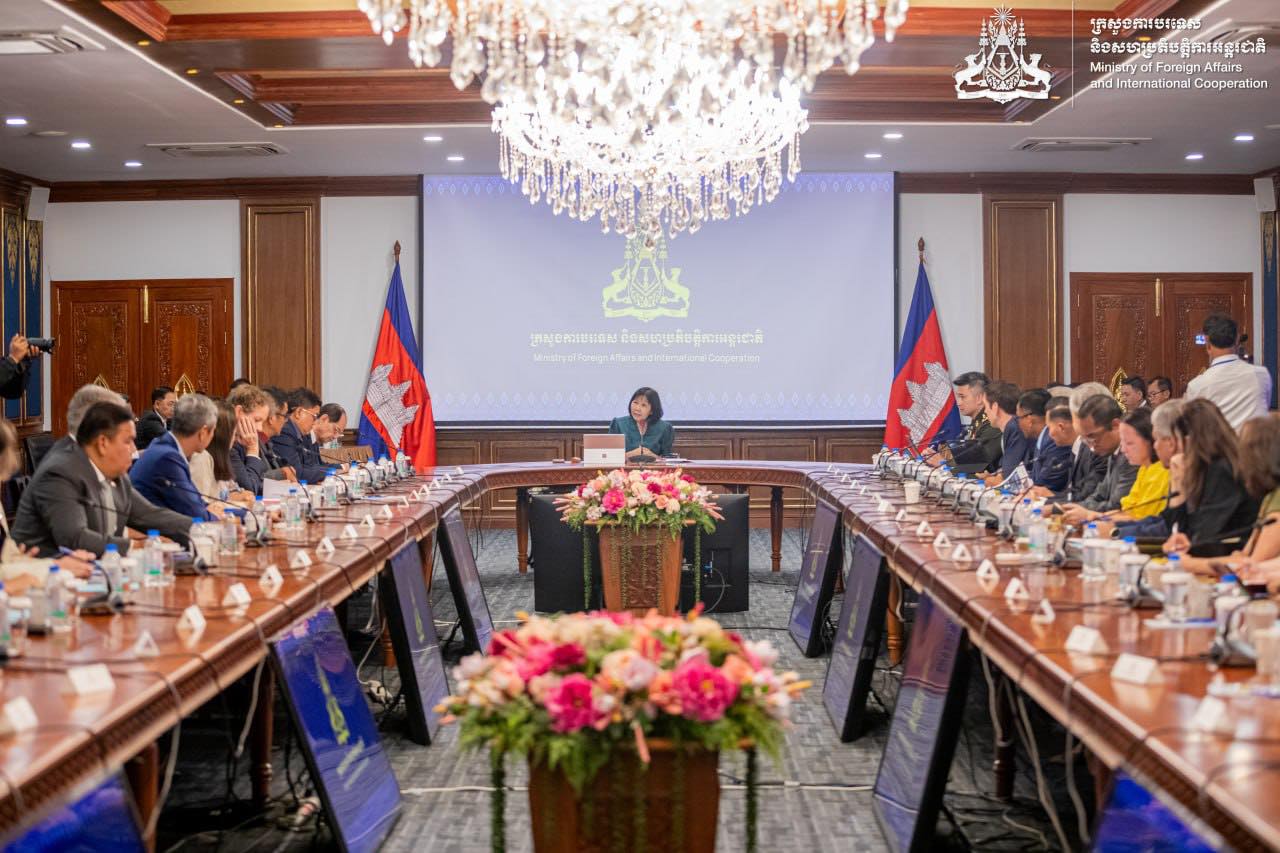
Cambodia’s Acting Foreign Minister, Eat Sophea, told 43 members of diplomatic missions and international organizations gathered in Phnom Penh on 6 May that Cambodia had formally notified Thailand of its decision to seek resolution of the overlapping maritime claims through compulsory conciliation under the United Nations Convention on the Law of the Sea.
The notification activates a pathway that the Convention’s Part XV preserves even where both parties to a maritime dispute have, as Cambodia and Thailand both have, declared full exclusion of binding adjudication on maritime delimitation. The pathway turns on a proviso embedded in Article 298(1)(a)(i) of UNCLOS: a state having made such a declaration must, on request from the other party to a dispute arising after 16 November 1994, accept submission of the matter to conciliation under Annex V, Section 2.
The architecture became live on 5 May, when the Thai cabinet’s decision to cancel the 2001 maritime memorandum took effect, removing the bilateral framework that had governed the overlapping claims area for twenty-five years and, with it, the procedural shields the framework had given Thailand under UNCLOS.
Cambodia’s notification followed within twenty-four hours. The diplomatic briefing on 6 May placed the move on the international record in front of the assembled missions.
Cambodia ratified UNCLOS on 6 February 2026; the ratification entered into force on 8 March. Thailand has been a party since 15 May 2011. Both states filed full Article 298 exclusion declarations covering all three categories of disputes referred to in subparagraphs 1(a), (b), and (c) of that article. The declarations are mirror images. Three months passed between Cambodia’s ratification and the notification.
Thailand’s own foreign ministry had assessed the bilateral framework that has now fallen. Vice Foreign Minister Russ Jalichandra told a 13 November 2024 PRD briefing that the 2001 memorandum was “Thailand’s most effective tool” on the maritime boundary, that cancellation was futile, and that no parliamentary approval was required to keep it in force. The Thai cabinet’s 2009 attempted cancellation had been reversed in 2014 after a review reached the same conclusion. The 2026 cabinet decision broke from both.
The institutional pathway to termination ran through the Thai government’s own machinery in compressed form. Prime Minister Anutin Charnvirakul announced on 9 April 2026 that the cabinet would expedite a study on terminating the 2001 memorandum. Foreign Minister Sihasak Phuangketkeow on 11 April outlined the procedural sequence: the Foreign Ministry would prepare the proposal, the National Security Council would review it, and the cabinet would consider it. The cabinet decision arrived on 5 May. Cambodia’s filing reached Thailand the next day.
The 2001 memorandum carries no termination clause. Its operative text runs forward across five articles without provision for withdrawal, denunciation, or expiry. The Vienna Convention on the Law of Treaties Article 56 controls any unilateral termination of a treaty silent on the question, and requires evidence that the parties intended to admit denunciation or that such a right is implied by the treaty’s nature. Thailand is not a party to the Vienna Convention; both states treat the relevant provisions as customary international law.
The notification clears two procedural shields under UNCLOS. Article 281 provides that where the parties have agreed to seek settlement through a peaceful means of their own choice, the Convention’s compulsory procedures apply only where no settlement has been reached and the agreement does not exclude further procedure. The 2001 memorandum was the Article 281 agreement Thailand could point to. Article 298(1)(a)(iii) of UNCLOS carves out from the conciliation requirement any sea boundary dispute finally settled by an arrangement between the parties, or any such dispute to be settled in accordance with a bilateral or multilateral agreement binding on those parties; the 2001 memorandum was the arrangement Thailand could invoke under that subparagraph. Termination removes both shields. The Article 298(1)(a)(i) proviso applies regardless of either state’s declaration because it is part of the article they both invoked.
Three gates condition the conciliation, each a question the commission addresses rather than a pre-judgment by either state. The temporal gate requires the dispute to arise after UNCLOS’s 16 November 1994 entry into force; Cambodia’s strongest answer is that the 2001 memorandum and the present termination are both post-1994 instruments structuring the dispute. The Timor-Leste and Australia conciliation commission read the proviso’s temporal reference, in its 2016 Decision on Competence, as the Convention’s entry into force generally rather than the date the underlying claims originated. The land-territory exclusion bars conciliation on disputes that necessarily involve unsettled sovereignty over land or insular territory; Thailand has held since the 1907 Treaty that Koh Kut is recognized Thai territory and that no negotiations are underway involving the island, and Cambodia has not claimed sovereignty over Koh Kut. The negotiation-failure gate requires absence of agreement after a reasonable period; the framework that structured those negotiations was unilaterally terminated. Each is a procedural test of competence, distinct from the maritime boundary itself, which both states’ Article 298 declarations remove from any binding adjudicative track.
Annex V Section 2 conciliation produces a non-binding report. The Timor-Leste and Australia conciliation under the same Article 298(1)(a)(i) proviso (PCA Case 2016-10) issued such a report; it culminated in the binding Maritime Boundary Treaty signed on 6 March 2018 and entered into force on 30 August 2019.
The economic stakes underneath the procedural architecture run substantial. Resource estimates for the overlapping claims area cluster around $138 billion, drawn from PTTEP and RFA records on the gas and condensate potential of the contested zone. The 2001 memorandum bound delimitation and joint development together as an indivisible package; Thailand’s termination dismantled both tracks at once.
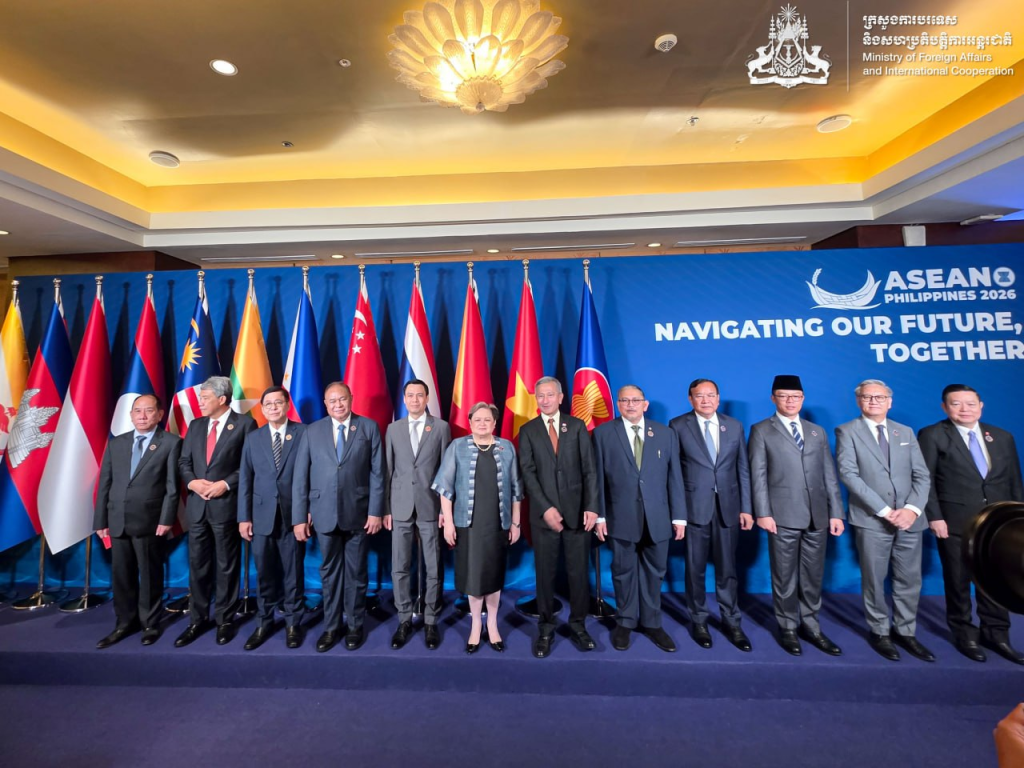
At the ASEAN Foreign Ministers’ Meeting in Cebu on 7 May, per Cambodia’s MFAIC Press Release No. 70/2026, Foreign Minister Prak Sokhonn placed in the meeting record the Treaty of Amity and Cooperation in Southeast Asia’s principles in full: “peaceful coexistence, mutual respect, peaceful settlement of disputes, and the renunciation of the threat or use of force.” The Treaty’s 50th anniversary, Sokhonn told the meeting, “serves as a timely reminder of its enduring relevance as a cornerstone of regional stability.” On the Cebu sidelines that evening, Prime Minister Hun Manet joined Philippine President Ferdinand Marcos Jr. and Anutin in the trilateral the Philippines hosted as ASEAN Chair.
Eat Sophea reaffirmed Cambodia’s commitment to peaceful resolution under international law and existing bilateral agreements, and the principled position that borders must not be changed by force.