
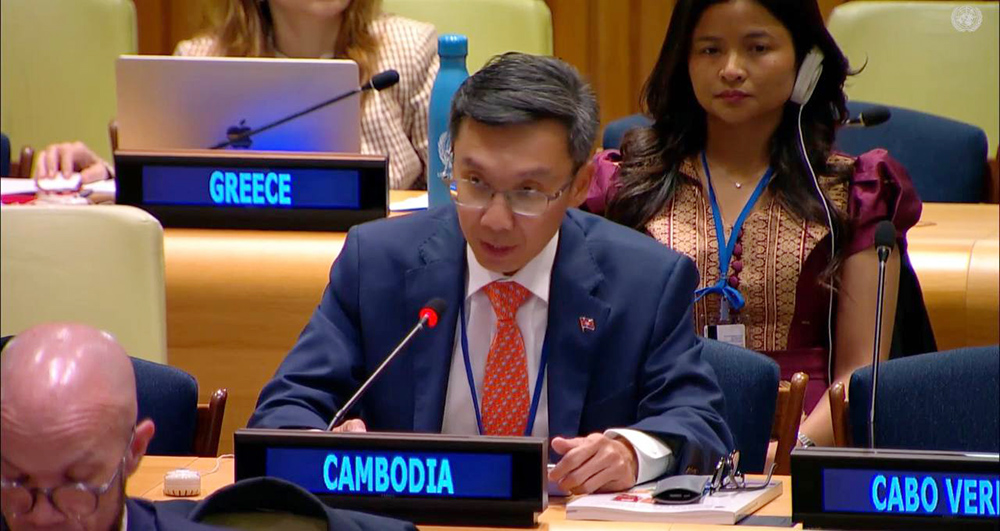
Cambodia told a UN development-financing forum on April 22 that its border conflict with Thailand has set back the country’s Sustainable Development Goals, and called for “concessional financing and debt relief for countries recovering from external aggression.” The statement drew a same-day right of reply from Thailand.
The statement was delivered by H.E. Chou Heng, Deputy Secretary General of Cambodia’s Council for the Development of Cambodia, at the ECOSOC Forum on Financing for Development Follow-Up, held at UN Headquarters in New York from 20 to 24 April. The forum is the principal institutional setting where member states and development agencies track implementation of the Sevilla Commitment, the global financing-for-development framework adopted in Sevilla, Spain, in June 2025. The forum convenes annually under the UN Economic and Social Council.
Cambodia’s intervention was its third at a distinct UN forum in four months on the 2025 border fighting. On 5 January, Permanent Representative Chhea Keo filed identical letters at the Security Council and General Assembly documenting “continued aggressive acts by Thai armed forces” after the 27 December ceasefire. In February, Foreign Minister Prak Sokhonn raised the conflict at the 61st session of the UN Human Rights Council in Geneva. Wednesday’s statement was the first to fold the conflict into the Sevilla Commitment’s financing architecture.
Thailand replied the same day. Cherdchai Chaivaivid, Ambassador and Permanent Representative of Thailand to the United Nations, exercised Thailand’s right of reply at the forum, telling the council that cross-border attacks from Cambodia in 2025 killed 19 Thai civilians, injured 51 others and displaced more than 400,000 residents. He alleged that scam networks operating from Cambodian territory generate up to $19 billion a year, and raised concerns over Cambodian landmine use. Cherdchai had signed Thailand’s January UN filing accusing Cambodia of “unprovoked and indiscriminate armed attacks.”
Cambodia rebutted within hours. In a statement reported by Khmer Times, Cambodian officials dismissed Thailand’s framing as “a deliberate distortion of facts and a dangerous politicisation” of a complex transnational crime challenge, saying it was being used as a pretext to deflect from Thai incursions into Cambodian sovereign territory. Cambodia did not deny the existence of transnational cybercrime networks, the paper reported, but rejected singling out Cambodia while ignoring the regional scope of the problem. The officials were not named in the Khmer Times report.
According to Cambodia’s statement, the conflict has resulted in more than 100 deaths and the displacement of over 650,000 civilians. The figure is slightly above the 640,000 cumulative displacement Cambodia’s Interior Ministry reported in January after the December 2025 fighting. As of February 2026, Cambodia said, more than 80,000 people remained displaced, including 50,000 women and 30,000 children. Dozens of schools and health facilities in affected provinces remain closed. The statement described disruptions to border trade, tourism and economic activity slowing recovery. Scarce public funds had been redirected toward humanitarian assistance, reconstruction and defence spending, resources that would otherwise support health, education, social protection and Sustainable Development Goal implementation.
Cambodia asked the international community to ensure that conflict-related fiscal shocks are factored into development-financing policies. It was the first time Cambodia had placed that specific ask inside the Sevilla Commitment follow-up process.
The two casualty counts do not map to the same population. Cambodia’s figures track the cumulative conflict toll, per the AKP wire reporting of Chou Heng’s statement. Thailand’s figures are Thai-side civilians specifically, per Cherdchai’s right of reply. Britannica’s coverage of the conflict records more than 100 killed and over half a million civilians displaced during the fighting.
Cambodia’s rebuttal treated the scam and landmine framings as a single instrumentalisation move. The Khmer Times reporting framed both accusations as serving the same function for Cambodia’s critics, providing cover for cross-border military actions. Cambodia did not engage the substance of the landmine concerns at the forum.
Thailand’s scam framing had precedent at a UN venue. At the Human Rights Council’s 61st session in February, Cambodian Foreign Minister Prak Sokhonn told delegates in Geneva that the fight against online scam syndicates required cooperation, not foreign unilateral police or military actions that serve only to mask acts of aggression and occupation. Thai Foreign Minister Sihasak Phuangketkeow answered by shifting discussion toward online scam operations in Cambodia and accusing the Cambodian side of years of encroachment and repeated provocations. The ECOSOC right of reply placed that framing on a financing-architecture record two months later.
Sevilla is the first intergovernmentally agreed global financing-for-development framework since the 2015 Addis Ababa Action Agenda, adopted on 30 June 2025 at the Fourth International Conference on Financing for Development in Spain. Also known as the Compromiso de Sevilla, it cites a $4 trillion annual financing gap for the Sustainable Development Goals. Debt relief is one of its core pillars, along with domestic resource mobilisation, international tax cooperation and reform of multilateral financial institutions.
Cambodia is scheduled to graduate from the UN’s Least Developed Country classification in 2029. ECOSOC itself endorsed that recommendation in May 2024. Graduation will reduce access to certain concessional trade preferences and external concessional financing, according to IMF analysis. Folding conflict-related fiscal shocks into the Sevilla Commitment keeps Cambodia inside an active global conversation about conflict-affected debt relief at a moment when its overall development-finance position is set to tighten.
Statements delivered at the ECOSOC forum enter the UN record and are available for citation in future intergovernmental negotiations. Cambodia placed its external-aggression framing and its debt-relief request into the Sevilla Commitment implementation stream. Thailand placed its casualty figures and the scam-network framing into the same stream.
Three UN forums in four months mark Cambodia’s most sustained multilateral legal-diplomatic campaign since 2013, when the International Court of Justice confirmed Cambodian sovereignty over the Temple of Preah Vihear and its immediate vicinity.
Whether the three interventions represent a coordinated sequence or three separate responses to three distinct institutional triggers is not disclosed in the statements themselves. The record shows Cambodia active on three distinct UN tracks. Those tracks are security, human rights, and development financing, each with its own review cycle.
The ECOSOC Forum on Financing for Development Follow-Up closes in New York on 24 April. Cambodia’s January Security Council filing remains on the Council’s agenda under agenda item 31, Prevention of armed conflict.