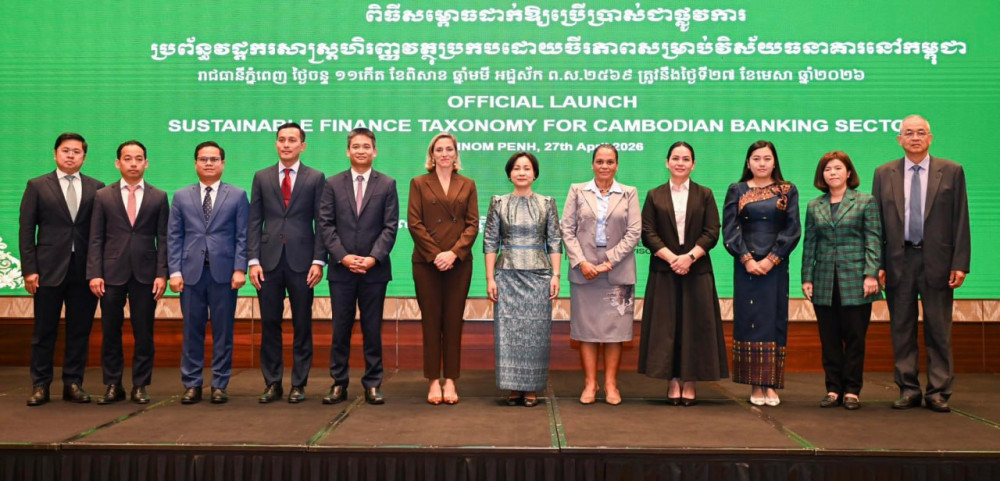
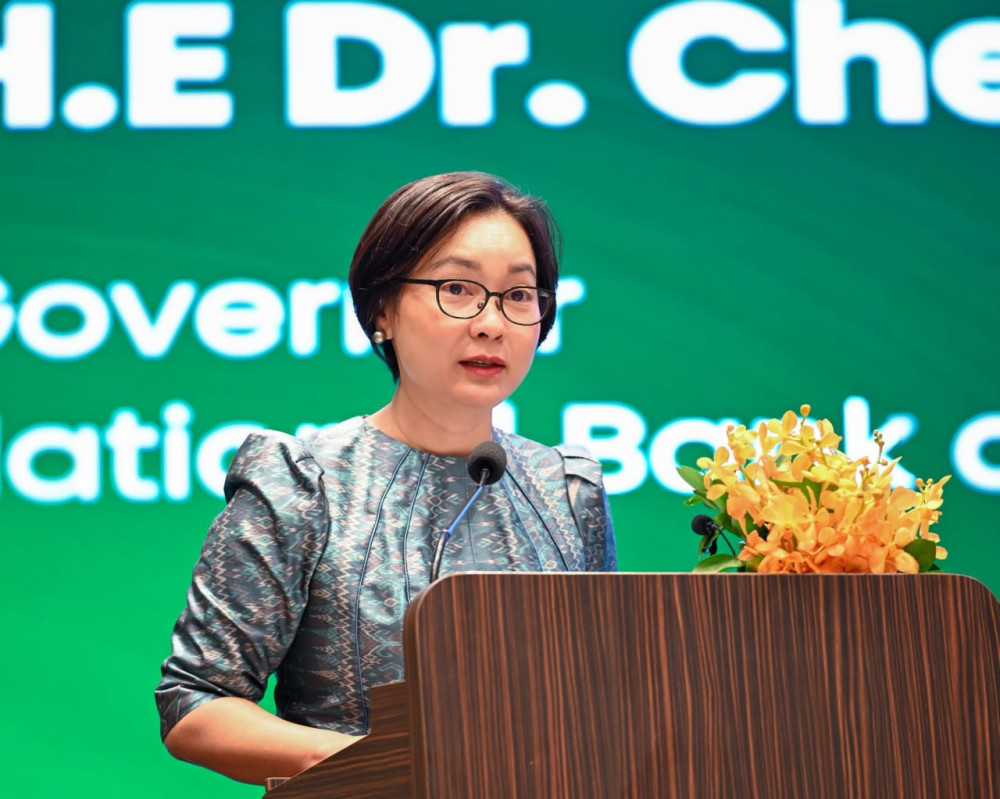
On 19 September 2016, the Association of Banks in Cambodia officially launched the Cambodian Sustainable Finance Initiative under partnership with the International Finance Corporation’s Sustainable Banking Network. Phase 1 of the country’s sustainable finance taxonomy launched at the National Bank of Cambodia on 27 April 2026, under three prioritised sectors: energy, transport, construction.
Governor Chea Serey presided over the launch alongside Elvira Morella, the International Finance Corporation’s Director of Advisory and Economic Research for East Asia and the Pacific. The two institutions have worked together since the 2016 launch, when Chea Serey was a witness to the CSFI signing as Director General of Central Banking.
What launched on 27 April was the country’s first national sustainable finance taxonomy, the classification system that gives Cambodian banks criteria to identify which economic activities qualify as sustainable. The launch arrived six months before Cambodia hosts the Francophonie Summit for the third time and roughly thirty-three months before LDC graduation in 2029, an exit point that carries environmental and climate considerations alongside human and labour rights as structural conditions on EU and US preferential market access. Two readings of the 27 April launch are open: event, or the documented close of a multi-year build. The dates settle that question; the sequence is in the public documentary record.
In March 2019, Cambodia’s Sustainable Finance Principles launched formally at NBC, with Chea Serey delivering the opening remarks. The Principles were the architecture under which Phase 1 sat as the operational instrument. In July 2022, NBC ran ESG Risk Management Training inside the banking system, working through internal capacity before formal taxonomy work began. On 8 December 2023, NBC and UNESCAP signed a Memorandum of Understanding on a sustainable finance roadmap. On 19 December 2023, NBC and IFC signed a Cooperation Agreement on the Development of the Cambodia Green Finance Taxonomy and Market, the bilateral instrument that anchored taxonomy development. The 2024 NBC Annual Report committed to finalising Phase 1 in 2025 and named the three sectors that arrived at the 27 April launch. On 8 April 2025, NBC and IFC jointly convened a consultation workshop on the draft taxonomy in Phnom Penh, chaired by NBC Deputy Governor Yim Leat.
The 2024 Annual Report also recorded ADB Subprogram 1, fifty million US dollars of policy-based financing on climate risk regulatory reform, financial stability, market development and consumer protection, scheduled for implementation in 2025. NBC and ERIA signed a Green Digital Finance Memorandum of Understanding on 26 April 2024. The Governor travelled to Brussels the same year as an invited speaker at the Francophone Climate Conference. NBC moved its reserves into green and ESG bonds.
The instruments accumulated inside Cambodia before the international record arrived to read them accumulating. The stakes for the country were already in the record. A joint MEF and UNDP study from 2020 placed potential GDP loss from climate impact at 9.8 percent by 2050, with $1.5 billion in climate disaster losses recorded between 1993 and 2020. At COP26 in November 2021, Cambodia pledged a 40 percent reduction in greenhouse gas emissions by 2030 and carbon neutrality by 2050. The taxonomy is the regulatory instrument that translates those positions into bankable definitions.
The taxonomy lands inside a banking system the NBC’s own 2024 Financial Stability Review documents under structural pressure. Non-performing loans climbed from 5.4 percent in 2023 to 7.3 percent in 2024, real estate market activity has weakened, and credit quality across the system has declined. The taxonomy supplies the regulatory clarity that lets banks finance green projects without the greenwashing risk that lives where the definitions are absent. NBC’s regulatory floor was already in place. Banks and financial institutions (BFIs) financing green projects carry a relatively low risk weightage of 80 percent, set in advance of the taxonomy’s formal arrival. The risk weightage is one element of the regulatory floor; the taxonomy supplies the criteria that activate it. Cambodia’s national taxonomy operates inside the ASEAN Taxonomy for Sustainable Finance Version 3 framework, the regional reference released by the ASEAN Taxonomy Board on 27 March 2024 with technical screening criteria covering the same three sectors that arrived in Cambodia’s Phase 1: energy, transportation, construction. The launch makes Cambodia the sixth ASEAN Member State with a national sustainable finance taxonomy, after Indonesia, Malaysia, the Philippines, Singapore, and Thailand.
NBC has been entrusted with hosting the Francophone Summit for the third time in 2026, after 2002 and 2011. The hosting carries the country’s environmental positioning into the room with documentation behind it. The Brussels 2024 invitation placed the Governor inside Francophonie’s climate space as a participant before the hosting. The taxonomy arrives as the substantive instrument the participation set up.
The pattern admits a sceptical reading. A taxonomy that arrives six months before a multilateral hosting could be performative, timed for visibility rather than capacity. The reading collapses on the dates. The 2016 CSFI launch predates Francophonie hosting planning visibility by almost a decade. The 2019 Principles launch predates it by seven years. The December 2023 UNESCAP MoU, the December 2023 NBC-IFC Cooperation Agreement on Taxonomy Development, and the April 2024 ERIA Green Digital Finance MoU sit across distinct multilateral architectures with distinct calendars and distinct partner counterparties. Performance does not compound across that timeframe with that many partners on that many parallel tracks.
The reading also reverses on agency. The 2016 CSFI launch was an Association of Banks in Cambodia decision with IFC partnership through SBN. The 2019 Principles launched under domestic remarks at NBC. The December 2023 UNESCAP MoU, the December 2023 NBC-IFC bilateral on taxonomy development, and the April 2024 ERIA MoU were instruments NBC entered as counterparty. Phase 1 is the Cambodian taxonomy. IFC’s role across the decade was advisory and partner; the instrument that launched on 27 April is what NBC built. The framing that reads such instruments as Cambodia “aligning with” international sustainable finance standards mistakes a builder for an adopter.
ECOSOC endorsed Cambodia’s 2029 LDC graduation in May 2024. UNDP’s policy brief on Cambodia’s preparedness named environmental and climate considerations alongside human and labour rights as the structural conditions on EU and US preferential market access post-graduation. The brief documents the tariff arithmetic underneath: garment, footwear, and travel goods exports to the EU facing rates rising from zero under the Everything but Arms preference to 8.8 percent under standard GSP and 11.5 percent under Most-Favoured-Nation rates, with rules of origin tightening from 30 percent to 60 percent local value-added. The taxonomy is an instrument the financial system holds before the conditionality lands.
What launched on 27 April closed one phase of a build. Phase 1 covers energy, transport, and construction. Phase 2 has been in development since 2024, scheduled to add sectors and deepen climate change adaptation provisions; the agriculture, garment, and tourism sectors central to the Cambodian economy enter in subsequent phases. The Phase 1 launch is the moment the international record can read what Cambodia’s institutional record already showed.