
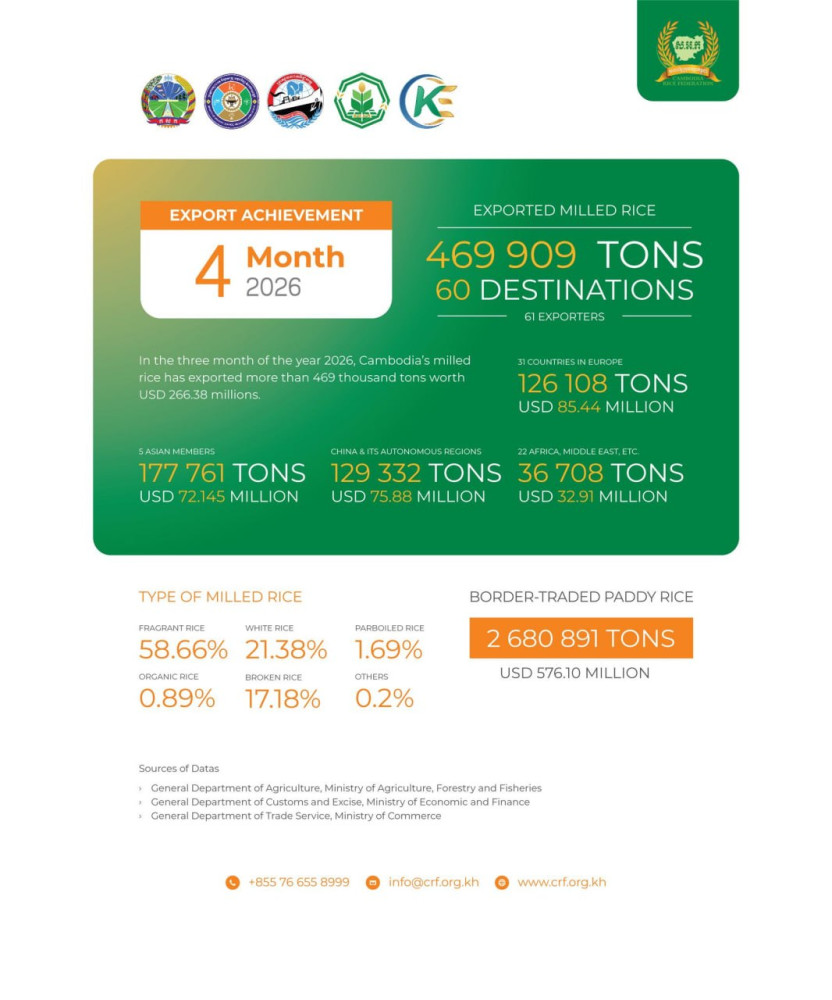
Cambodia’s first-four-month 2026 milled rice exports came in at $266.38 million from 469,909 tonnes, 27 percent above the $209.22 million the Cambodia Rice Federation booked over the same months of 2025 and 66 percent above the 282,313-tonne volume. In the same window, paddy rice exports fell to $576.10 million from $723.05 million. Cambodia’s total rice export revenue across both lines came in roughly $90 million below the 2025 figure.
The European Union shipped 126,108 tonnes of Cambodian milled rice for $85.44 million, against 134,212 tonnes for $106.19 million a year earlier: 6 percent fewer tonnes, 19.5 percent less revenue.
Average price per tonne across all of Cambodia’s milled exports fell to $567 in 2026 from $741 in 2025, computed from the CRF figures both periods. EU buyers paid $677 per tonne. China paid $587. The five-state ASEAN volume that drove the 38 percent regional share arrived at $406. A residual 36,708 tonnes shipped to 22 other markets, including in Africa and the Middle East, sold at $897 per tonne, the highest unit price across any destination band. Cambodian rice is selling more tonnes at a lower mean price, and the mean is dragged by where the marginal volume went.
Cambodia shipped 177,761 tonnes of milled rice to five ASEAN countries in the first four months of 2026, against 40,291 tonnes over the same period of 2025. Volume rose 341 percent. Revenue rose 149.6 percent. Price per tonne fell 43 percent, from $717 to $406.
The Philippines opened the largest ASEAN window. Executive Order 105, signed on November 7, 2025, set a quarterly price-indexed tariff system effective January 2026, with the rate held at the 15 percent floor through March 2026 because the trigger price was not breached. Philippine Department of Agriculture Secretary Francisco Tiu Laurel told importers in December 2025 to consider Cambodia, Myanmar, and other non-traditional suppliers beyond Vietnam. The first-quarter 2026 Philippine rice import composition by country of origin has not been released; that breakdown sits as the direct test of which suppliers captured the Vietnam-vacated share.
CRF did not break down variety mix by destination market in the May 11 report. Fragrant rice held 58.66 percent of the all-export average, down from the 77.9 percent fragrant share reported in the same federation’s first-four-months 2025 release, with broken rice now disclosed separately at 17.18 percent. How much of the per-tonne differential is variety composition and how much is market discount on equivalent grades, the May 11 release does not address; the destination-level variety breakdown is a refresh target.
The Kingdom of Cambodia and the Cambodia Rice Federation filed Case T-246/19 at the EU General Court against Commission Implementing Regulation 2019/67, which had reimposed three years of safeguard duties on Cambodian and Myanmar Indica rice imports that were otherwise duty-free under the Everything But Arms scheme. The Court annulled the regulation on 9 November 2022, finding the Commission had committed manifest errors of assessment by defining the Union industry as rice millers and excluding rice growers from the injury investigation. The Agricultural and Rural Development Bank met COFCO Grains at the Chinese state company’s Beijing headquarters on 9 March 2026 and agreed to facilitate cross-border settlement arrangements for Cambodian rice exports to China. The government released $40 million through ARDB in November 2025 to stabilise rice prices through the 2025-2026 harvest season. Malys Angkor, the Phka Rumduol variety, won the World’s Best Rice title for the seventh time at the November 2025 World Rice Conference in Phnom Penh, sharing the honour with Vietnam’s ST25. As of 2024, around 80 medium and large-scale Cambodian rice mills met international food safety standards with combined wet-paddy drying capacity of 50,000 tonnes per day.
Cambodia exported 2.68 million tonnes of paddy rice over the first four months of 2026 against 3.03 million tonnes over the same months of 2025. Volume fell 11.6 percent. Revenue fell 20.3 percent, from $723.05 million to $576.10 million. U.S. Department of Agriculture reporting from December 2025 records paddy as the bulk of Cambodia’s rice export volume, crossing mainly to Vietnam where Vietnamese mills capture the processing margin. Vietnam’s own grain reporting recorded paddy rice, primarily sourced from Cambodia, at 83 percent of Vietnam’s total rice imports through the first half of 2025, with 1.7 million tonnes from Cambodia alone, and added that trade contacts believe the actual volume is higher than the official figure because of unrecorded cross-border transactions.
The Philippines window that opened for Cambodia’s milled exports also closed for Vietnam’s, through the same four-month import ban that ended on December 31, 2025. The paddy that did not cross to Vietnamese mills during the ban period for re-export to Philippine buyers is the same paddy that did not earn $215 per tonne crossing the Cambodia-Vietnam border. How much of the 11.6 percent paddy volume decline is the ban-cycle effect, how much is a longer Vietnamese mill demand contraction, and how much is a Cambodia-side redirect into domestic milling, the released figures do not disaggregate.
Cambodian milled rice sold to EU and China buyers at $677 and $587 per tonne in the first four months of 2026. Cambodian paddy crossed to Vietnamese mills at $215. Domestic milling capacity is the line that separates them.