
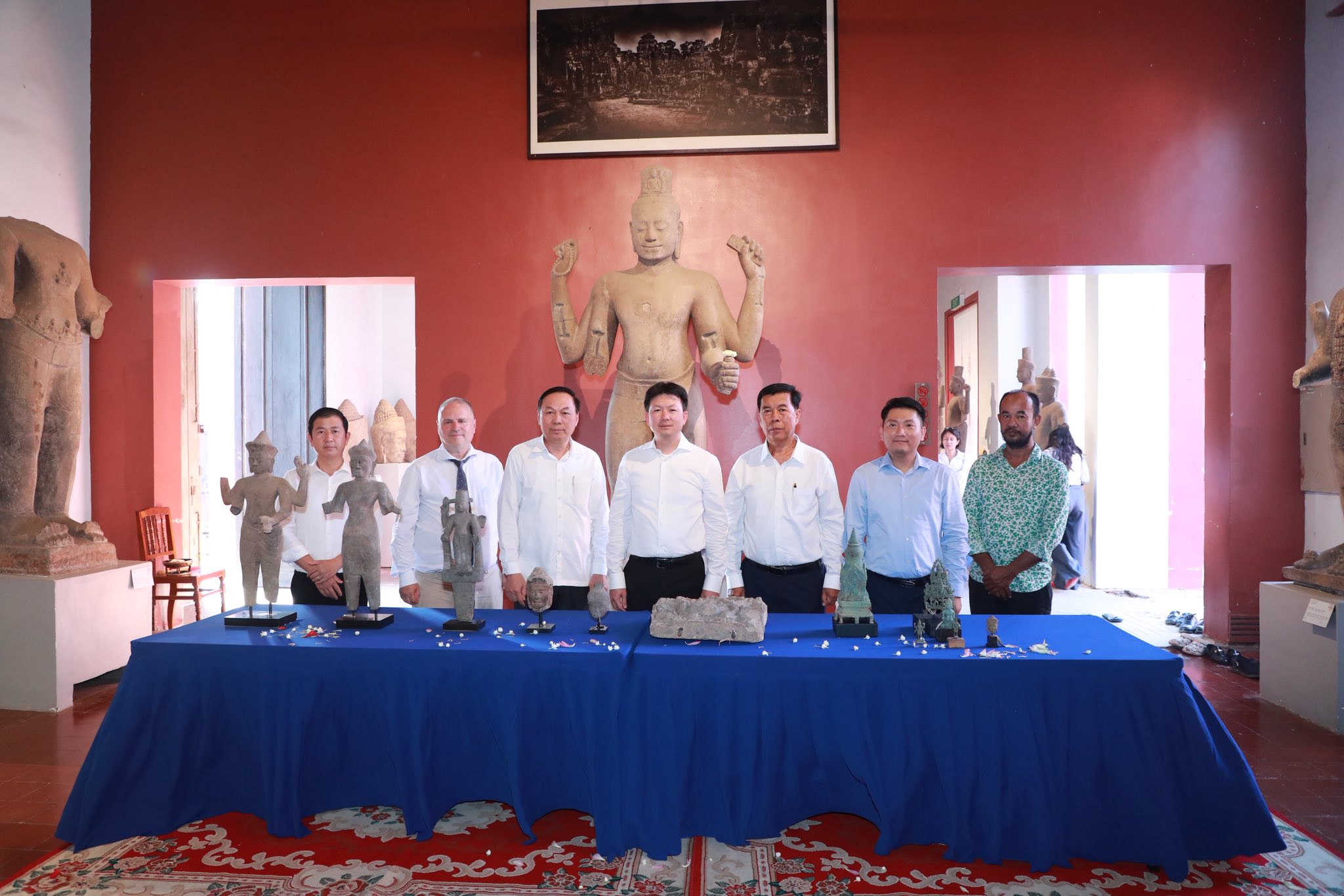
Cambodia’s Constitution begins with a preamble declaring its people “the heirs of a great civilization, a prosperous, powerful, large and glorious nation whose prestige radiated like a diamond.” For decades, the physical evidence of that civilization sat in foreign museums and private collections, removed during French colonial administration, looted before, during, and after decades of civil war and genocide, and trafficked through networks that stretched from temple sites in Koh Ker and Angkor to auction houses in New York and London. On 6 April 2026, the Ministry of Culture and Fine Arts announced the return of 20 Khmer cultural objects from a private collection in Asia: sandstone sculptures and bronze works including statues from the Bayon period, the late twelfth and early thirteenth century apex of Buddhist kingship under Jayavarman VII, whose monumental face towers and sculptural programs at Angkor Thom remain among the defining artistic achievements of Southeast Asian history.
The objects came from a private collection in Asia. The Ministry did not name the collector, identify the country, cite a legal instrument, or credit any law enforcement agency. In a restitution program that has produced increasingly detailed public announcements with each milestone, the April press release was among the most restrained in the program’s recent record. That restraint is the development worth examining.
The Architecture
Cambodia’s restitution team published an account of its approach in the Fordham Law Review in February 2026. The essay, authored by Bradley J. Gordon of Edenbridge Asia, Melina Antoniadis of NOSTOS Strategies, and Edenbridge researcher Sokunthyda Long, describes what they call a “collaborative model of restitution” built through four stages: assembling a specialized team, investigation and evidence collection including testimony from former looters, public engagement through media, and negotiations conducted as cultural diplomacy rather than litigation. The authors state that Cambodia has prioritized negotiation over litigation while remaining prepared to pursue legal action, and that some holders of Khmer objects “have shown great sensitivity and a desire to do the ‘right thing.’” They position the approach as a “replicable model that combines local knowledge, legal innovation, and cultural diplomacy.”
The April return named Gordon and Antoniadis alongside a new figure: Imran Hamid Khwaja, a partner at Tan Rajah & Cheah, one of Singapore’s oldest law firms. Khwaja’s public profile is commercial dispute resolution, family law, and international sports governance; he has served as Deputy Chairman of the International Cricket Council since 2017. No prior involvement in cultural heritage appears in his public record. His presence points to access, mediation capacity, or jurisdictional reach that the existing team did not previously have. The Ministry’s press release named him first, ahead of Gordon and Antoniadis, a departure from the ordering in previous restitution announcements.
Precedent and Distinction
Cambodia has recovered objects from Asian private collectors before. In July 2019, Fumiko Takakuwa, the widow of a Japanese collector, returned 85 artifacts to the National Museum in Phnom Penh. She told reporters her husband had wished them returned before his death. The Ministry described the objects as believed stolen from Cambodian temples during the war. That return was described as voluntary, and no external advisory team was publicly involved.

The April 2026 return is structurally different. It involved a professional advisory architecture spanning Singapore, Phnom Penh, and London. It is the first documented case in Cambodia’s restitution record where the collector’s identity is withheld from the official announcement. Previous private-collector returns named the holder: Takakuwa (Japan, 2019), the Lindemann family (United States, 2023), István Zelnik (Hungary, 2025), the Latchford estate (United Kingdom, 2021-2026). The April 2026 announcement breaks that pattern.
The Ministry’s language also shifted. The Zelnik return described objects “looted from Cambodia during the decades of civil war.” The Fordham article uses the term “blood antiquities.” The April press release described the objects as “cultural properties displaced during times of conflict,” the softest formulation in Cambodia’s recent restitution press releases.
Whether the anonymity and softer language reflect a negotiated confidentiality condition, a deliberate policy to lower barriers for future voluntary returns, or other factors is not stated in the public record.
Cambodia’s Institutional Position
Cambodia’s domestic legal architecture for cultural property protection is codified, not aspirational. Civil Code article 141(1) establishes state ownership of cultural heritage. The 1996 Law on the Protection of Cultural Heritage prohibits unauthorized removal. A 2002 subdecree provides implementing regulations. Cambodia ratified the UNESCO 1970 Convention on illicit trafficking of cultural property in September 1972. In 2003, Cambodia signed a bilateral cultural property agreement with the United States, the only agreement of its kind with a Southeast Asian country, most recently renewed in 2023. That agreement provides the legal framework under which prosecutorial recoveries through the Southern District of New York have operated, and according to US Embassy figures, has facilitated the return of over 100 antiquities across two decades.
None of these instruments were cited in the April announcement. Singapore has not ratified the UNESCO 1970 Convention. If the collection was held in Singapore, there was no treaty-based obligation on the holder to return the objects and no Convention-derived enforcement mechanism available to Cambodia. The return, under that reading, was facilitated entirely through private channels.

Cambodia’s program now operates across at least three simultaneous tracks: formal bilateral (the US cultural property agreement), multilateral treaty (UNESCO 1970), and informal negotiated recovery in jurisdictions where the conventional instruments do not apply. Few source countries manage even one of these tracks effectively. Italy’s Carabinieri Tutela Patrimonio Culturale, the standard reference for cultural recovery programs, is law-enforcement-heavy with dedicated police units. Greece’s Parthenon campaign is adversarial and sovereign-to-sovereign. Nigeria’s Benin Bronzes recovery has relied on institutional and moral-reputational pressure. Cambodia built a negotiation-driven, investigation-backed recovery program without dedicated law-enforcement infrastructure, without the diplomatic weight of a major power, and with a Ministry working alongside a small team of private-sector lawyers and consultants. The program’s output, over 1,098 objects from 15 countries by August 2024, with roughly half from private collections and at least 406 more documented since, is notable precisely because of the institutional architecture that produced it.
The Trajectory
Between November 2025 and April 2026, five separate returns were publicly announced: Zelnik (296 objects), Smithsonian (3), Asian Art Museum of San Francisco (13), Latchford (74), and the unnamed Asian collector (20). The clustering reflects long-running processes converging rather than a sudden acceleration: the Latchford return operated under a 2020 agreement, the Zelnik return followed years of negotiations, and the Smithsonian’s provenance assessment began in 2022. But the clustering demonstrates something the numbers alone do not: the program’s capacity to manage multiple recovery tracks across different jurisdictions, legal frameworks, and holder categories simultaneously.
What the Record Does Not Yet Show
The April announcement is sourced exclusively from the Ministry of Culture and Fine Arts and its media relays, including Agence Kampuchea Presse and Kampuchea Thmey. No wire service, independent outlet, or international reporting organization has independently covered the return as of publication. No object-by-object inventory has been released. No provenance chain has been disclosed for any of the 20 pieces. No acquisition history, export documentation, or site-specific archaeological confirmation is available.
The collector’s anonymity creates a tension inherent in any confidential voluntary return model. Shielding the holder’s identity lowers the barriers for future returns and may unlock objects that adversarial approaches never would. But it also means the acquisition chain, the network through which the objects left Cambodia, and the conduct of intermediaries remain unexamined in the permanent record. For a program whose published framework emphasizes “shared responsibility, transparency, and repair,” the transparency dimension of this particular return is, by design or necessity, incomplete.
The Ministry’s press release concluded with a call on “museums and private collectors holding Khmer artifacts to reach out and engage in professional dialogue regarding their potential return.” Paired with a return where the collector was shielded from identification, the signal is concrete: a path exists, a professional team operates it, and discretion is possible.
The Permanent Record
What Cambodia has built over the past decade is, in the landscape of global cultural restitution, structurally unusual. A country whose Constitution describes its people as heirs to a civilization “whose prestige radiated like a diamond,” and which lost a quarter of its population to genocide while its temples were stripped and its gods sold, assembled a recovery program that has produced results from the Metropolitan Museum of Art to unnamed private collections in Asia, and published its methodology as a model for other source countries to follow.

The 20 objects are home. Their provenance documentation, when published, will determine whether they enter Cambodia’s permanent heritage record as recovered cultural property with a documented chain of removal, or as returned objects whose full journey remains, for now, only partially told.