
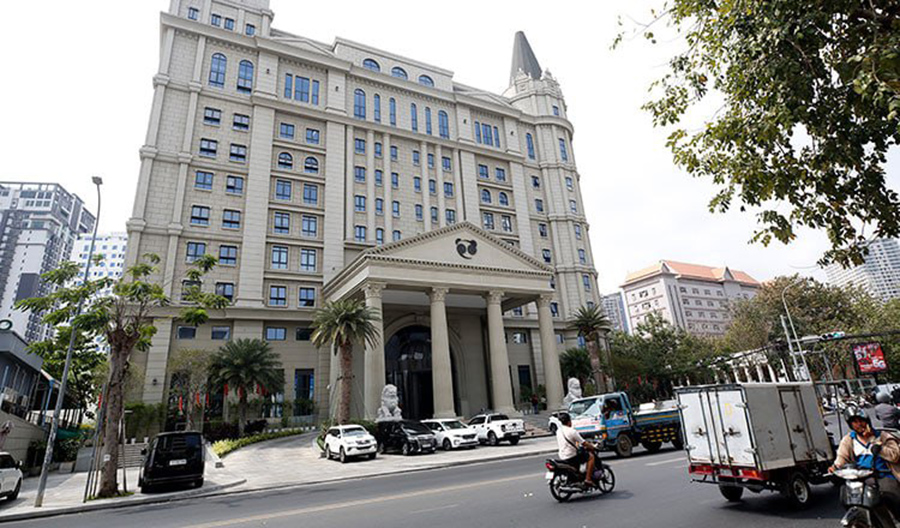
Cambodian authorities arrested and deported Li Xiong, chairman of Panda Commercial Bank, to China on April 1, 2026, the Ministry of Interior said. Li’s Cambodian citizenship had been revoked by Royal Decree on March 31, according to the Agence Kampuchea Presse and Kiripost, the second such revocation in the enforcement sequence that began with Prince Group chairman Chen Zhi’s deportation in January.
The event followed a longer construction. Between June 2025 and April 2026, Cambodia assembled a legal framework, an institutional enforcement body, a legislative instrument, and a financial regulatory action into a sequence that removed two figures identified by Chinese law enforcement as core members of the Chen Zhi criminal syndicate. The architecture, rather than any single deportation, is the structural story.
The legal mechanism
Cambodia’s MFAIC said in January 2026 that Chen Zhi’s citizenship revocation was carried out under Article 29(4) of the Law on the Amendment to the Law on Nationality, dated September 5, 2025, and Article 52(4) of the implementing sub-decree dated December 1, 2025, AKP reported. The cited provisions allow revocation of nationality acquired through forgery or false information during the application process, according to the MFAIC spokesperson’s statement.
The September 5, 2025 amendment predates the October 14, 2025 OFAC sanctions against Chen Zhi and the Prince Group by five weeks. The implementing sub-decree followed in December, and the first deportation under these instruments occurred in January 2026.
Whether Li Xiong’s March 31 revocation used the same legal basis has not been independently confirmed. The Royal Decree has not been published in an accessed English-language source. Human Rights Watch, in a January 23, 2026 statement, described the implementing sub-decree as outlining different criteria, including treason, collusion with foreign countries, and undermining national sovereignty. The primary text of both provisions has not been independently retrieved, and the discrepancy between the MFAIC and HRW characterizations remains unresolved.
The institutional sequence
AKP reported that the inaugural meeting of the Ad Hoc Commission for Combating Online Scams took place on June 27, 2025, followed by a nationwide sweep directive from Prime Minister Hun Manet on July 14. The enforcement statistics expanded through successive official reports: AKP said 1,362 suspects were arrested at 20 locations by mid-July; 3,455 across 92 locations by mid-October; and 4,983 suspects, 35 major cases, and 168 convictions by January 10, 2026. Reuters reported by February that approximately 190 scam locations had been sealed and 173 prominent crime figures arrested. AP reported on March 11 that 250 locations had been targeted, with about 200 shut down.
On March 30, 2026, all 112 members of the National Assembly present voted to pass Cambodia’s first law specifically targeting online scam operations, AP reported. The legislation introduces penalties of five to ten years for directing a technology-fraud site, with higher penalties up to life imprisonment when death occurs, according to AP. The law awaits Senate review and royal assent.
The financial trajectory
Panda Commercial Bank’s audited 2023 annual report lists total assets of $221,815,925. NBC’s published comparison tables show Panda’s total assets at approximately 2,238 billion KHR by end-2024, equivalent to roughly $556 million at the table’s stated exchange rate, a year-over-year increase of approximately 151 percent. By end-2025, Xinhua, citing an NBC public notice, reported Panda held approximately $776 million in assets and $502 million in deposits, representing 0.77 percent of the Cambodian banking system.
The NBC halted Panda’s operations on February 23, 2026, citing worsening financial condition, Xinhua reported. Li Xiong appeared as chairman in the bank’s 2023 annual report. CamboJA reported in November 2025 that Li and Hun To, a cousin of Prime Minister Hun Manet, were on Panda’s board until October 2025, and that corporate records showed overlap between Huione-linked entities and the bank’s senior leadership.
The NBC’s stated rationale for the Panda intervention was prudential. The primary NBC notice has not been independently retrieved, and whether the regulatory action cited the bank’s links to the Chen Zhi network, or financial deterioration alone, remains unconfirmed.
The jurisdictional routing
Both Chen Zhi and Li Xiong were transferred to China, not the United States, despite active US enforcement against the same network. The US Treasury sanctioned 146 targets within the Prince Group on October 14, 2025. FinCEN’s final rule severed Huione Group from the US financial system the same day. Reuters reported on January 7, 2026, that Cambodia’s Interior Ministry said Chen’s extradition was carried out “within the scope of cooperation in combating transnational crime and pursuant to a request” from Beijing.
Thailand extradited gambling figure She Zhijiang to China in November 2025, Reuters reported, providing a direct Southeast Asian precedent for routing a suspected syndicate figure to Beijing at China’s request. No US official statement on the Cambodia-to-China routing of either Chen or Li was located in the materials reviewed.
Global Initiative Against Transnational Organized Crime published an analysis on January 29, 2026, arguing that China’s pressure and broader international pressure shaped the enforcement sequence, and that Cambodian agencies appeared largely absent during the initial exodus from Prince-linked compounds. Cambodian Foreign Minister Prak Sokhonn told Reuters on January 14 that the arrests reflected Cambodia’s “firm commitment” to combat the crime and that full cooperation with Beijing had started months earlier.
The FATF timeline
Cambodia does not appear on the FATF list of jurisdictions under increased monitoring published February 13, 2026. The Asia-Pacific Group on Money Laundering has scheduled Cambodia’s next mutual evaluation for 2029, with the technical compliance submission due March 31, 2028.
H.R. 5490, the Dismantle Foreign Scam Syndicates Act introduced in the US Congress, advocates FATF greylisting of Cambodia. The bill describes scam operations as “joint ventures between Chinese criminal organizations and autocratic governments” in countries where “transparency is absent and rule of law is anemic.” The bill has been referred to committee. It is a legislative proposal, not a current FATF action.
The enforcement sequence Cambodia built between June 2025 and April 2026 arrives three years before the assessment that could carry economic consequences. Whether that sequence represents pre-positioning for the 2029 evaluation, a response to sanctions pressure, or domestically initiated institutional reform cannot be determined from the public record alone. The legal instruments, the enforcement statistics, and the regulatory actions are documented. The question of what drove them remains open.