
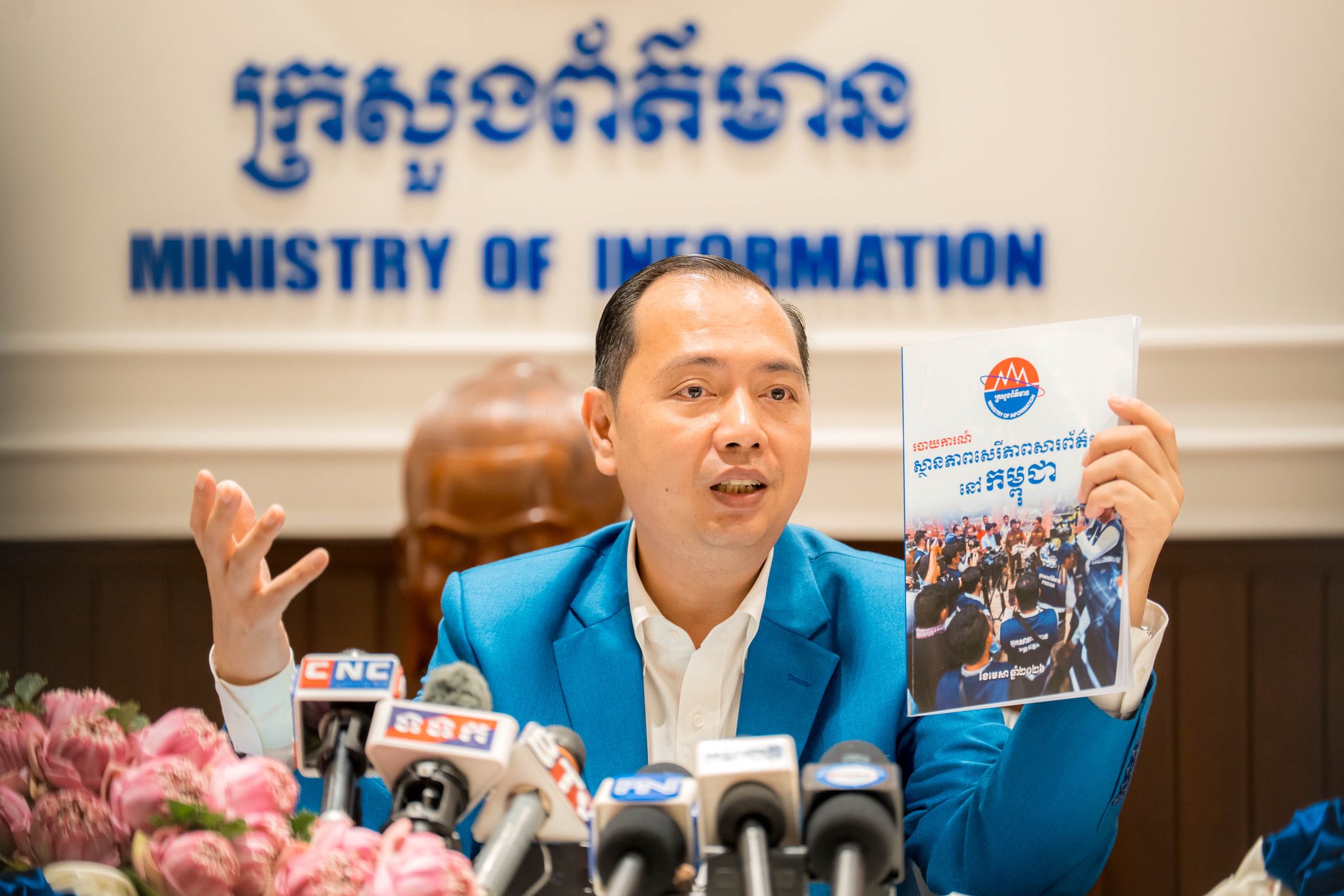
The Ministry of Information released its third annual report on the state of press freedom in Cambodia at a press conference in Phnom Penh on 29 April 2026 presided over by Minister Neth Pheaktra. The release lands four days before the UNESCO World Press Freedom Day Global Conference opens in Lusaka and roughly a week ahead of the typical release window of the RSF World Press Freedom Index. The two events anchor the international press freedom calendar each May. The Ministry has now produced this measurement instrument annually since 2024.
The 2026 sample drew 570 respondents, up from 467 in the 2025 study and 341 in the 2024 inaugural baseline. The 2024 study covered journalists across twenty-five capitals and provinces and recorded a 6.5 percent share of women respondents. The Ministry’s posted 2024 PDF carried a formal Study Methodology section identifying mixed qualitative and quantitative approaches. The 2025 release coverage described the 86-page second study as using scientific research methods based on the 2024 baseline data, with a coverage period of April 2024 through April 2025. The 2025 report’s full PDF was not retrieved through accessible search as of publication.
The 2026 figures put press freedom in Cambodia at 80.8 percent good. The 2025 release reported 81.4 percent very good, with 72.2 percent good and 9.2 percent excellent inside the very-good top line. Whether the categories map cleanly across the two iterations is not resolved on the release coverage retrieved through 29 April.
Inside the 2026 headline, 85.8 percent of respondents reported full freedom to gather information and disseminate news. 70.4 percent reported never experiencing threats, harassment, or violence in the past year. 84.6 percent reported never having been sued by citizens or authorities over their reporting. Pheaktra told the conference that the report’s purpose is to assess the state of freedom and measure the health of the media sector, particularly its progress, challenges, and areas for improvement, and to ensure the development of the information and broadcasting sector has a clear direction, a favorable environment, and safety for professional practice. He framed the release as covering institutional modernization, regulatory frameworks, and maintaining press order across the period from 2025 through the first quarter of 2026.
The press order rating, sandab thnab sar porthaman, came in at 75.26 percent good, up from 71.8 percent the prior year. The Ministry release uses ambiguous percent notation (“approximately 3.46%”); the AKP English translation reads the change as 3.46 percentage points. The arithmetic is exactly 3.46 percentage points or 4.82 percent in relative terms. Sandab thnab sar porthaman renders into English variously as press order, media order, or order of the press, and the term is established Ministry of Information institutional terminology pre-dating the 2026 release. The 1995 Law on the Press in its WTO-hosted English text does not use the formulation as a defined statutory category. The term operates as Ministry working terminology rather than a statute-defined classification on the documentary record retrieved.
The Ministry’s press release contains a paragraph fusing the press freedom rating frame to the Cambodia-Thailand border conflict that opened in July 2025 and remained on the political record across the survey’s 2025-through-Q1-2026 coverage period. The release reads: “Although journalistic duties have been taken place amid Thai military’s illegal armed incursions on Cambodia’s sovereignty and territorial integrity, the space for freedom and the environment for professional journalism in Cambodia have been ensured.”
Pheaktra, appointed Minister of Information on 22 August 2023 after prior service as spokesperson at the Environment Ministry and at the Extraordinary Chambers in the Courts of Cambodia, said at the conference: “In the digital era, press freedom involves contributing to the strengthening of information security, which must go hand in hand with respect for the law, ethical standards, and social responsibility, in order to help maintain public order and national security.” The press release closes with the Ministry’s stated forward direction that the survey provides a core foundation for leadership, management, and direction in Cambodia’s media sector, and that the Ministry will continue to promote information security, enhance the quality of journalism, and ensure Cambodia’s information sovereignty within the legal and regulatory framework.
The Ministry’s documented mediation function runs alongside the survey instrument. A Ministry release on 28 October 2025 recorded 23 journalist disputes resolved through the third quarter of 2025. A Cambodianess account on 27 March 2026 set the running figure at 34 cases plus eleven new media settled out of court, with lawyers provided in seven cases involving twelve outlets, between 2025 and February 2026.
The 2026 release coverage retrieved across AKP, Fresh News, TVK Cambodia, Phnom Penh Post Khmer, Khmer Times, and the Ministry’s own press release does not anchor sample frame, fieldwork dates, instrument wording, response rate, weighting, anonymity protocol, or administrator. The 2024 inaugural report carried a formal methodology section accessible through the Ministry’s posted PDF. The 2025 second study was described in coverage as scientifically methodologized; the underlying instrument was not retrieved.
What the QR code on the press release directs to was not retrieved through accessible search as of publication.
CPJ reported on 20 February 2026 that journalists Pheap Phara and Phon Sopheap were sentenced to fourteen years for treason; the organization recorded their arrest on 31 July 2025 after they returned from reporting on the Cambodia-Thailand border dispute in Oddar Meanchey. AP reported on the appeal of the convictions over a photograph from a Thai border clash; the Battambang Court of Appeal upheld the 14-year sentence on 26 March 2026, denying the request to reclassify the charge to a lesser provision. CPJ documented Hem Vanna’s arrest on 3 February 2026 over a 30 January video on the alleged physical assault of Chinese nationals at a suspected scam compound in Poipet roughly 100 metres behind a local military police station; he was charged under Articles 301 and 495 of the Criminal Code. CPJ recorded Luot Sophal’s arrest on 13 February 2026 in Oddar Meanchey over a military water-shortage report, charged under Articles 472, 494, and 495 of the Criminal Code. CPJ separately recorded the brief detention on 11 February 2026 of Mech Dara, an investigative reporter known for his work on Cambodian online scam compounds, in Koh Kong over photographs taken at a suspected scam compound raid, with police forcing deletion of the images. The five actions sit inside the survey’s 2025-through-Q1-2026 coverage period.
The 2026 World Press Freedom Day theme as carried in UNESCO’s documentary record is “Shaping a Future at Peace: Promoting Press Freedom for Human Rights, Development, and Security,” with the global conference scheduled in Lusaka on 4 and 5 May 2026. The Ministry of Information press release renders the theme as “Shaping a Peaceful Future: Strengthening Press Freedom for Human Rights, Development, and Security.” Whether the divergence on Future at Peace versus Peaceful Future and on Promoting versus Strengthening reflects translation range or framing choice is not resolved on the documentary record.
The Reporters Without Borders Index 2025 ranks Cambodia 161st of 180 countries with a score of 28.18, placing the country among the states the index categorizes as “very serious.” The 2026 RSF Index was not on the RSF Cambodia country page as of 29 April 2026; RSF typically releases the annual index on or around 3 May. Freedom House’s Cambodia entry for 2026 records a Global Freedom Score of 22 out of 100, status Not Free, down one point from the prior year’s 23, with Political Rights at 4 of 40 and Civil Liberties at 18 of 60.
CamboJA’s announcement on 27 April 2026 marked the observance with civil society partners convening approximately 150 participants for engagement around media legal frameworks, crisis reporting, the role of artificial intelligence, and an overview of the RSF Index 2026.
Article 41 of the Cambodian Constitution codes freedom of expression, freedom of information, freedom of publication, and freedom of assembly. The text qualifies that “no one shall exercise these rights to infringe upon the honor of others, or to affect the good customs of society, public order and national security.” The same article reserves the regime of the media to determination by law. Article 12 of the 1995 Law on the Press prohibits the press from publishing or reproducing information that may affect national security and political stability and assigns the Ministries of Information and Interior the right of immediate confiscation. Article 11 of the same law prohibits the press from publishing material that may affect public order by inciting violence.
The Ministry’s third measurement instrument enters a calendar where the international comparator data lands within the next week. The Reporters Without Borders 2026 Index releases on or around 3 May. The UNESCO Global Conference convenes in Lusaka on 4 May. The press release is dated 29 April. The 2026 methodology section was not on the public record as of 29 April.