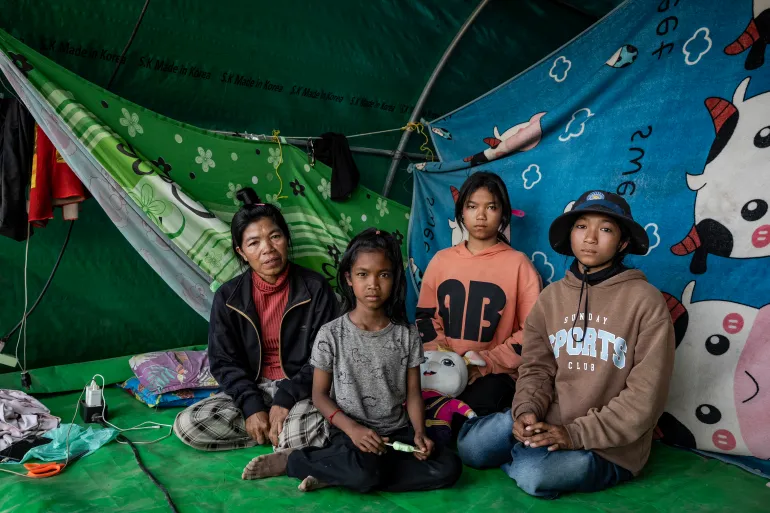
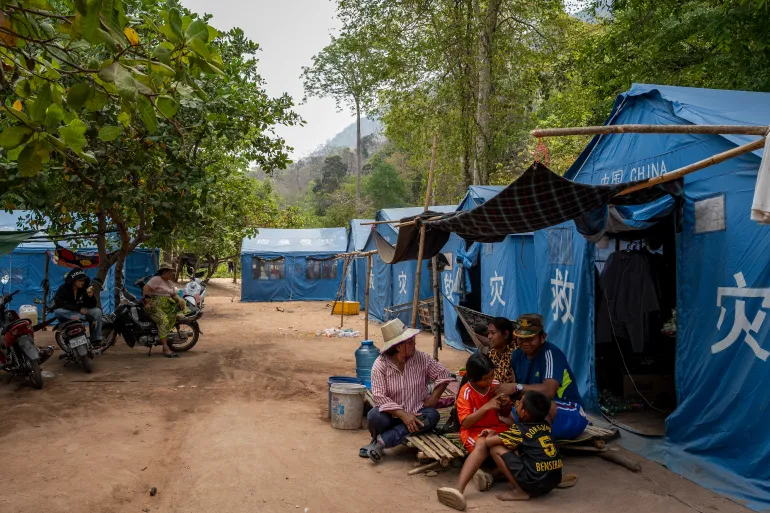
Cambodia filed photographic enclosures of Chouk Chey Village and Prey Chan Village at the UN Security Council on 2 January 2026. Al Jazeera reporters described shipping containers and barbed wire blocking access to the same two villages on 9 May 2026.
Cambodia’s UN filing of 2 January and Thailand’s response of 19 January name the same villages and the same conduct in opposite legal terms. International press coverage of post-ceasefire conditions has not engaged the documented architecture either side produced.
Cambodia’s Ministry of Interior reports more than 34,440 displaced persons remain in camps as of this month, including 11,355 children. Cambodia’s UN Security Council filing of 2 January names 14 locations across four provinces under what the filing characterises as Thai armed forces’ “effective control.” Thailand’s response filing of 19 January characterises the same troop positions as compliance with Paragraph 2 of the 27 December ceasefire. The 134 days between ceasefire signature and the May displacement figure followed a December round of fighting that ran from 7 to 27 December 2025 and is documented at the UN level on both sides.
Cambodia’s filing identifies the locations by name. In Banteay Meanchey: Prey Chan Village, Chouk Chey Village, Boeung Trakuon area. In Pursat: Phluk Domrei area, Thmor Da International Point of Entry. In Preah Vihear: An Ses, Ta Thav, Phnom Trap. In Oddar Meanchey: O Smach, K’nar Temple, Ta Krabei Temple, Tamone Thom Temple, Chob Angkunh, Chok Krous. The filing attaches four photographic enclosures: Chouk Chey, Prey Chan, Boeung Trakuon, Thmor Da.
The legal characterisation in Cambodia’s filing names Articles 2(3) and 2(4) of the UN Charter, which prohibit the use of force against the territorial integrity of another state, and Article 53 of the Fourth Geneva Convention of 1949, which prohibits the destruction of property “given the operative ceasefire.” The filing further states that the conduct constitutes “an unlawful and continuing occupation, wholly lacking any legal basis under international law.” The filing names the 1904 Franco-Siamese Convention and 1907 Treaty as the established basis for the international land border.
Thailand’s response filing frames the same conduct differently. Paragraph 7 reads: “The maintenance of Thailand’s current troop positions following the ceasefire constitutes direct compliance with the agreed de-escalation measures, as reflected in Paragraph 2 of the Joint Statement.” The filing further states that all measures are “conducted within Thai territory at the time of the ceasefire.” Royal Thai Army Spokesperson Maj Gen Winthai Suvaree told Nation Thailand on 19 February, responding to Cambodian Prime Minister Hun Manet’s accusations, that the placement of shipping containers and barbed wire was “a temporary measure to secure the area.” The same spokesperson characterised the displaced Cambodians as illegal encroachers on Thai soil rather than displaced persons, citing Cambodian non-return after past conflicts.
Both filings sit on the UN record.
Paragraph 2 of the 27 December Joint Statement reads: “Both sides agree to maintain current troop deployments without further movement. There shall be no troop movements, including patrol towards the other side’s position.” Paragraph 4 reads: “Both sides agree to allow civilians residing in the affected border areas to return at the earliest, without obstruction and in safety and dignity, to their homes and normal livelihoods in areas within their own side.” The phrase “within their own side” carries the asymmetry. Each government applies the phrase to a different territorial line.
Cambodia’s Ministry of Interior released sequential figures across the 134 days. On 3 January, AKP reported 393,640 cumulative returnees alongside provincial school and health-centre closures. The figures that follow measure those still unable to return rather than cumulative returns. By 16 January, 144,000 remained displaced, with 14 areas named under “unlawful control.” On 17 February, the ministry reported 74,139 still unable to return, including 25,372 children, citing “three weeks of aggressive Thai military attacks on Cambodia’s territory.” The May figure of more than 34,440 is the latest ministry count routed through Al Jazeera. The still-displaced count descended sequentially. The 14-site figure did not move.
Hun Manet told Reuters on 17 February that Thai forces were occupying Cambodian territory “deep into Cambodian territory in many areas” and “further beyond even Thailand’s own unilateral claim.” The Prime Minister said Thai troops had placed shipping containers and barbed wire inside areas that Thailand had previously recognised as Cambodian territory, and residents were unable to return home. The statement was filed at presidential level, in international media, three months before Al Jazeera’s reporters described the same containers in the same villages.
Al Jazeera’s own 18 February reporting carried Hun Manet’s statement and named the container blockade. The 9 May feature describes the containers as “a sort of new frontier between the two countries.” Across three months in the same outlet, framing moved from named Thai conduct (“deep into Cambodian territory in many areas”) to bilateral border condition (“a sort of new frontier between the two countries”).
The International Court of Justice’s 2013 Interpretation of its 1962 Temple of Preah Vihear judgment determined that Cambodia had sovereignty over the whole territory of the promontory of Preah Vihear “and that, in consequence, Thailand was under an obligation to withdraw from that territory the Thai military or police forces, or other guards or keepers, that were stationed there.” UNESCO’s statement of 10 December 2025 reminded all parties of obligations under the 1954 Hague Convention for the Protection of Cultural Property in the Event of Armed Conflict. Three of the locations Cambodia names in its UN filing are temples: K’nar, Ta Krabei, Tamone Thom.
Al Jazeera’s 9 May feature reports that the Cambodian military has also prevented some civilians, including a 67-year-old farmer named Sun Reth, from returning to homes in front-line areas the article describes as “still highly militarised zones.” That restriction is operating on the Cambodian side of the line, attributed to active militarisation of zones still under contestation. Cambodia’s UN filing describes a different category of conduct: Thai armed forces’ physical occupation and demolition of structures inside locations Cambodia identifies as its sovereign territory.
The 22 December ASEAN Chair Statement called on both parties to ensure civilians “are able to return, without obstruction and in safety and dignity, to their homes and normal livelihoods as they existed prior to the outbreak of hostilities.” The 27 December Joint Statement, signed five days later, narrowed that obligation to “areas within their own side.”
The Joint Boundary Commission, the bilateral demarcation mechanism established under the 2000 Memorandum of Understanding and named in Cambodia’s filing and endorsed in Thailand’s, has not convened since the ceasefire. Thailand’s January filing stated the JBC would resume after the 8 February Thai general election. Three months past that election, no public JBC schedule has been announced.
The 14 locations named in Cambodia’s January filing remain identified by name in the UN record. The more than 34,440 displaced persons remain identified by count in the Cambodian government record. The shipping containers in Chouk Chey and Prey Chan remain in place at 134 days, as the photographic enclosures of January’s filing and the May reporting both attest.