
The Thai cabinet cancelled the 2001 maritime Memorandum of Understanding with Cambodia on Tuesday 5 May 2026. The same afternoon, Cambodia’s Deputy Prime Minister and Foreign Minister Prak Sokhonn announced the Kingdom would initiate compulsory conciliation under the United Nations Convention on the Law of the Sea.
By Wednesday morning, Prime Minister Anutin Charnvirakul told reporters that “at least both countries will now be operating under the same set of rules” and that “Thailand no longer has the MOU 44, so whatever discussions take place from now on, new rules and frameworks must be agreed upon together.” Asked the day before whether a successor instrument would replace MOU 44, he proposed “MOU70.” Asked whether the Tuesday cancellation took legal effect immediately, he said: “Not yet. We have to notify our MOU partner. A letter will be sent.” Foreign Minister Sihasak Phuangketkeow told Reuters the move was designed “so that our negotiations can go forward.”
The instrument that made Cambodia’s pursuit operative had been in force for fifty-eight days.
Cambodia’s National Assembly ratified UNCLOS on 16 January 2026. The instrument of accession was deposited on 6 February. Entry into force followed on 8 March under depositary notification C.N.85.2026.TREATIES-XXI.6. Forty-eight hours before Thailand’s cabinet act, Kung Phoak, Secretary of State at the Ministry of Foreign Affairs and International Cooperation, named Annex V Section 2 by article number.
What unfolded across the next four days, at official channels and at a Cebu trilateral hosted by Philippine President Ferdinand Marcos Jr., was the live question of procedural availability under treaty law, not the question of fresh political consent.
Anutin, speaking after the cabinet decision, said the move was “not related to the border conflict with Cambodia, but part of my policy. It has been 25 years and there has been no progress.” Ratchada Thanadirek, spokesperson for the prime minister’s office, described the revocation as a “realignment of the cooperative framework rather than a suspension of bilateral relations or dialogue” and confirmed Thailand had “unofficially notified Cambodia of its decision and will proceed with formal notification while establishing technical and legal committees.” Sihasak told Reuters: “We’re telling our Cambodian colleagues, this is not to abandon negotiation.”
Prak Sokhonn’s statement at MFAIC said the 2001 Memorandum had long served as the only bilateral framework for addressing maritime claims and that Cambodia had “no option but to turn to UNCLOS mechanisms.” He said Thailand’s withdrawal “does not affect Cambodia’s legitimate rights over its maritime territory.” In a statement released that evening, Hun Manet said Cambodia “would be left with no choice but to rely upon international law and the United Nations Convention on the Law of the Sea (UNCLOS), particularly the mechanism of Compulsory Conciliation under this Convention.”
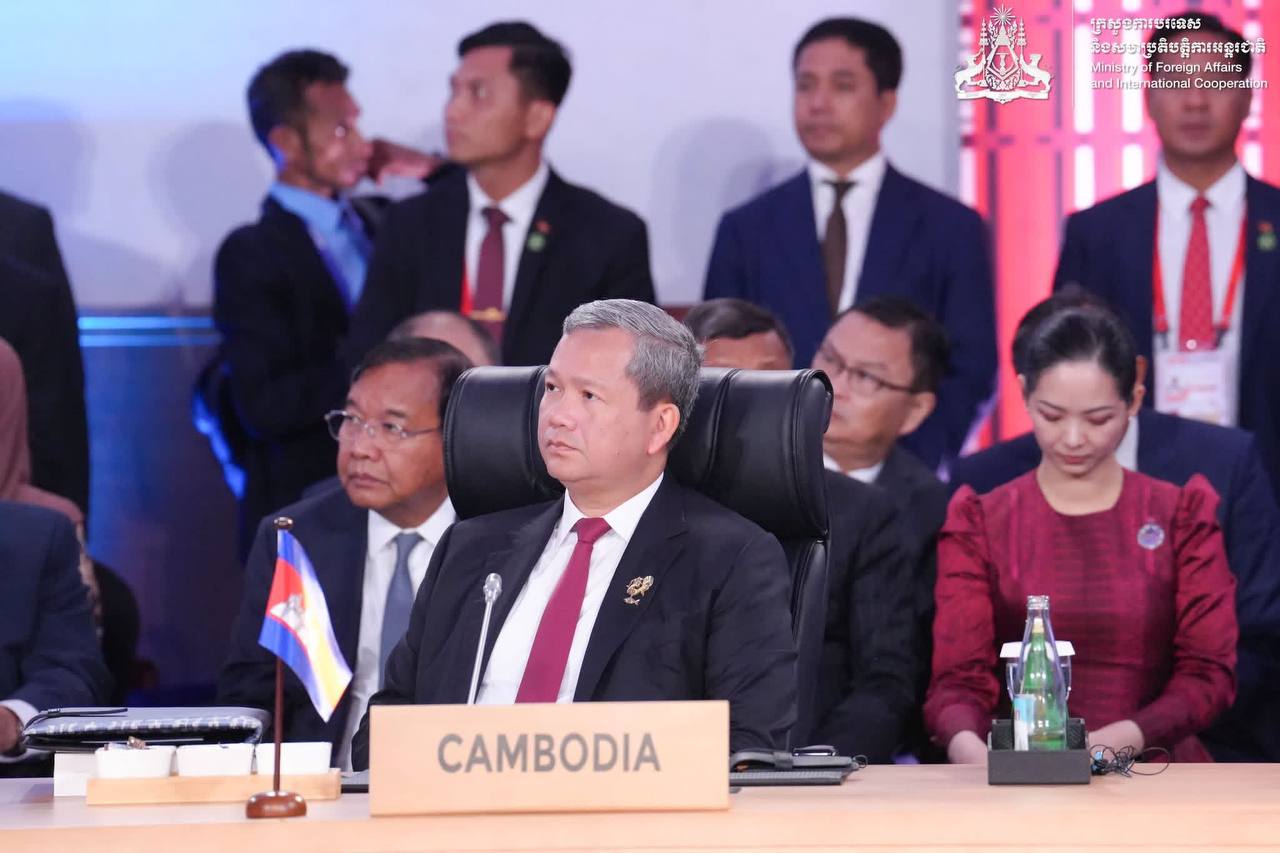
Two days later, Anutin and Hun Manet met for the first time since October 2025 in a trilateral hosted by Marcos on the sidelines of the 48th ASEAN Summit. By Anutin’s own Facebook account, posted from Cebu and carried by Nation Thailand, Cambodia “formally acknowledged the decision during the meeting” and both governments agreed future discussions would proceed under UNCLOS as the common framework. The Cambodian readout issued by AKP recorded Anutin emphasising “the importance of more direct communication between the two countries at all levels” and saying that on maritime issues he “had proposed constructive ways forward during the discussion in the spirit of good neighbourliness.” Anutin said the face-to-face meeting “helped speed up communication between the two governments” and without it Thailand “might otherwise have needed to send formal written notification through diplomatic channels, a process he said could have taken several months.” At his own press conference in Cebu that evening, Hun Manet said “Cambodia reiterates that border cannot be changed or determined by force or through fait accompli” and reaffirmed Cambodia’s compulsory conciliation pursuit, calling it “a peaceful path toward a fair solution for both parties.”
The Article 298 declarations Thailand filed in 2011 and Cambodia filed in 2026 are mirror images. Both states excluded all three categories of disputes from Section 2 procedures: sea boundary delimitation, military activities, and Security Council matters. Neither state filed an Article 287 forum-choice declaration. The Article 298(1)(a)(i) proviso, in the verbatim UN-published text, requires a state having made the delimitation exclusion to “accept submission of the matter to conciliation under Annex V, section 2” when a dispute “arises subsequent to the entry into force of this Convention” and “no agreement within a reasonable period of time is reached in negotiations between the parties.” A further proviso excludes any dispute that “necessarily involves the concurrent consideration of any unsettled dispute concerning sovereignty or other rights over continental or insular land territory.” The proviso is not in either state’s declaration. It is in the article both declarations cite.
The Memorandum signed in Phnom Penh on 18 June 2001 by Thai Foreign Minister Surakiart Sathirathai and Cambodian Senior Minister Sok An contains no termination clause and no dispute resolution clause. Article 5 makes all actions under the Memorandum “without prejudice to the maritime claims of either party” pending delimitation. Thailand attempted cancellation once before, in 2009 under Abhisit Vejjajiva’s cabinet, and the 2014 cabinet reversed the 2009 decision after a review. In November 2024, Thai Vice Minister for Foreign Affairs Russ Jalichandra said on the Government Public Relations Department record that “subsequent studies highlighted [the MOU’s] strategic advantages. Consequently, the Cabinet opted in 2014 to uphold the MOU.” Jalichandra called MOU 44 “Thailand’s most effective tool.”
The underlying maritime claims predate UNCLOS entry into force on 16 November 1994. Cambodia’s claim line dates to Lon Nol’s 1972 presidential decrees; Thailand’s counterclaim followed in 1973. Whether the dispute “arises subsequent to the entry into force of this Convention” is the contested gate. The Timor-Leste compulsory conciliation (PCA Case No. 2016-10) ruled on this question in its Decision on Competence of 19 September 2016. The commission found that the ordinary meaning of the unqualified phrase “favours the former interpretation regarding entry into force of the Convention as a whole,” not entry into force as between the parties. The conciliation culminated in a binding Maritime Boundary Treaty between Australia and Timor-Leste signed on 6 March 2018. The precedent does not mechanically erase Thailand’s timing objection. It does establish that an Article 298 delimitation exclusion does not foreclose Annex V Section 2 access.
The Diplomat reported that Thai government spokespeople “say that it is also willing to rely on UNCLOS to resolve the overlapping claims, albeit on a bilateral basis.” Anutin’s 6 May statement named two conditions for that bilateralism: a common set of rules and frameworks “agreed upon together.” On 5 May, he told Nation Thailand: “There are no negotiations at the moment.” Asked the same day about a successor, he proposed “MOU70.” The instrument the cabinet had voted to remove was the bilateral framework that had supported bilateral primacy for 25 years.
Cambodia’s UNCLOS accession entered into force on 8 March 2026, fifty-eight days before the Thai cabinet acted. The Thai National Security Council chaired by Anutin agreed in principle to cancel on 23 April and forwarded the matter to cabinet. Cambodia’s Ministry of Foreign Affairs and International Cooperation issued its baseline statement on 24 April. On 2 May, Cambodianess carried Cambodia’s reiteration of compulsory conciliation pursuit. On 3 May, Kung Phoak named Annex V Section 2 directly. On 5 May, Prak Sokhonn and Hun Manet activated the announcement. On 7 May, Hun Manet held the position publicly at Cebu.
The procedural step that follows the announcement is a written notification under Annex V Section 2. The notified party “shall be obliged to submit” and failure to reply or submit “shall not constitute a bar to the proceedings.” As of publication, Cambodia’s filing status at the Permanent Court of Arbitration was not on the public record.