
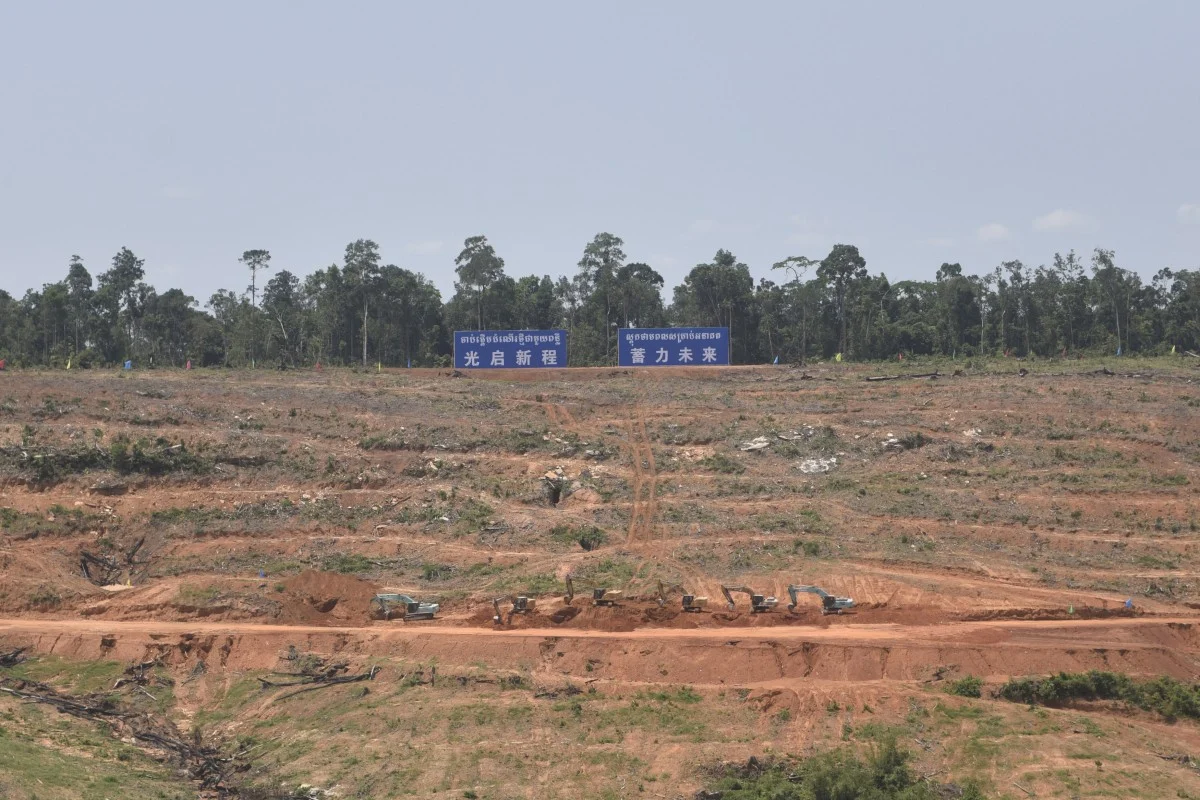
Cambodia broke ground on a gigawatt-scale pumped-storage hydropower station on 10 April 2026. Pumped-storage is established technology for grid-stability targets of this scale. The target this project advances is Cambodia’s own. The terms on which it was procured are not public.
The developer is China National Heavy Machinery Corporation (CHMC), a subsidiary of the state-owned Sinomach group. Under a corporate disclosure filed in February 2025, the $996 million Upper Tatay project in Koh Kong province is structured as a build-operate-transfer arrangement, with $299 million in sponsor equity and $697 million in bank financing. The installed capacity is 1,000 megawatts across four 250 MW reversible pump-turbine units. Completion is targeted for 2029. Minister of Mines and Energy Keo Ratanak described it at the groundbreaking ceremony as the first pumped-storage hydropower project Cambodia has authorized.
Three conditions surrounding this procurement are unresolved in the public record. The lending bank behind the $697 million is not identified in any publicly available filing. No environmental impact assessment has been released. No competitive tender or non-Chinese rival bid has been located on record. The outcome advances a legitimate national target through appropriate technology. The terms on which the outcome was arranged are not documented. That gap is the analytical subject.
This analysis reviewed English- and Chinese-language corporate disclosures from Sinomach and CHMC, international institutional reporting from CSIS, the IMF, and the World Bank, Cambodian state coverage via Agence Kampuchea Presse, and on-record statements from Cambodian officials. Cambodian ministerial registries for environmental impact assessments and procurement, Electricité du Cambodge announcement archives, Khmer-language press beyond the English-translated state wire, and dedicated Chinese policy-bank project trackers (AidData, China Exim Bank, and China Development Bank project disclosures) were not systematically reviewed. CHMC, Sinomach, Electricité du Cambodge, and Cambodia’s Ministries of Environment and of Mines and Energy were not approached for comment for this piece. The analysis does not establish whether the three documented absences are specific to this procurement or reflect broader patterns in Cambodia’s infrastructure procurement generally. That question is out of scope here. What is in scope and already in hand: Cambodia’s 70 percent renewable target predates both this project and the fuel crisis invoked in its coverage, and the disclosed financing architecture is not sovereign-to-sovereign concessional lending. The conditions of procurement, not its legitimacy, are what the public record leaves open.
In a speech on 21 December 2023, Prime Minister Hun Manet committed Cambodia to raising renewable energy to at least 70 percent of installed capacity by 2030, from a 62 percent baseline. In September 2024, the Council of Ministers approved 23 power projects including two energy storage stations, per the US International Trade Administration’s November 2025 country commercial guide. Cambodia currently operates 5,932 MW of installed capacity at 63.23 percent renewable, with 96 percent of households and 99.1 percent of villages connected, according to Electricity Authority of Cambodia data reported by Agence Kampuchea Presse. The 1 GW project fits a pre-existing energy architecture. It was not imposed on one.
Concessional bilateral lending from a foreign government adds to Cambodia’s sovereign debt. A BOT project financed through sponsor equity and bank lending, with the asset transferred to Electricité du Cambodge after a defined operating period, does not. Cambodia’s Chinese bilateral debt stock stood at $4.068 billion at end-2024, equivalent to 8.8 percent of GDP and 34.1 percent of external debt, per the IMF-World Bank Debt Sustainability Analysis accompanying the 2025 Article IV consultation. The “debt trap” framing that accompanies Chinese-financed infrastructure in Southeast Asia runs on the assumption that the financing is sovereign-to-sovereign concessional lending. Sri Lanka’s Hambantota port is the canonical case the framing was built around, and Deborah Brautigam and Meg Rithmire’s empirical rebuttal is the most-cited pushback. The Upper Tatay procurement, as disclosed in the Sinomach filing, is not sovereign-to-sovereign concessional lending. The framing misses what the disclosed financing architecture actually shows.
The sharper question is what the $697 million bank financing actually is. The Sinomach filing records the equity-and-debt split without naming the lender. If the lending institutions are the Export-Import Bank of China or China Development Bank, the structure partially reintroduces the quasi-bilateral exposure that the BOT form was meant to avoid. If they are commercial banks, the dependency characterization weakens substantially. The public record does not close that question. The opacity is the first structural condition.
CHMC already operates the original 246 MW Tatay hydropower station, commissioned in 2015, which according to a 2025 Sinomach parent-group disclosure has generated more than 10 billion kilowatt-hours and received EDC’s “Outstanding Contribution in Power Generation” award. A 150 MW conventional hydropower project on the same river is under construction. The new 1 GW pumped-storage facility sits on top of that cascade. CHMC has also contracted a 500 kV transmission line and a battery storage facility in Takeo province, per the company’s January 2025 Cambodia footprint disclosure. CSIS documented the cascade structure in December 2025. One Chinese state-owned enterprise now holds or is constructing the dominant generation, storage, and transmission footprint in a single river basin. That fact alone is not illegitimate. It is a concentration pattern made visible by the public record without any competitive benchmark against which to test its terms.
No public environmental impact assessment for the 1 GW project has been located. For the adjacent 150 MW Upper Tatay conventional project, Cambodian civil society called for EIA transparency as early as January 2022. The Lower Sesan 2 hydropower dam, also developed by a Chinese state-owned enterprise, displaced thousands and produced documented ecological harm, according to a 2021 Human Rights Watch report. Upper Tatay shares the developer class. The precedent does not predict outcomes at Upper Tatay. It establishes that EIA absence is not an academic concern in Cambodia’s hydropower record.
The South China Morning Post on 19 April positioned the project as a response to Cambodia’s energy vulnerability during the Iran war and the fuel price disruption that followed, echoing Xinhua’s framing. The documented sequence predates the crisis. CHMC signed the project memorandum of understanding in October 2023 at the Third Belt and Road Forum, per the company’s own corporate record. Financing agreements were concluded in February 2025. The Sinomach board approved the investment in March 2025. Cambodia’s Council of Ministers had approved the broader 23-project slate in September 2024. Every consequential decision on this project predated the current fuel crisis. The crisis narrative is retroactive.
Xinhua also reported that Chinese-built power plants raised Cambodia’s national electricity access rate from “about 50 percent” to “nearly 96 percent.” The World Bank’s own energy access diagnostic records Cambodia’s grid electrification at 32.5 percent in 2010, not 50 percent, and 58.2 percent in 2014. Growth to the current level was multi-source. The Asian Development Bank has separately recorded household access rising from 17 percent in 2008 to almost 90 percent in 2021, alongside its own solar park contributions. Cambodian state grid expansion, mini-grid installations, and Chinese hydropower made parallel contributions. Attributing a multi-actor achievement to a single provider compresses the historical record in one direction.
Chinese foreign direct investment reached 65.5 percent of Cambodia’s total FDI inflows in 2024, up from 41.3 percent in 2019, according to the World Bank’s Cambodia Economic Update of June 2025. Cambodia’s electricity costs remain nearly double those in Vietnam, the IMF found in its 2025 Article IV consultation, and the fund identified current tariffs and charges on self-generated solar power as barriers to private green investment. The Upper Tatay project addresses grid flexibility. It does not address the tariff constraint. That distinction matters for how this procurement fits into the broader reform picture Cambodia has committed to.
BOT financing is not sovereign debt. Cambodia conceived and approved the project through its own institutions before any external crisis. The 70 percent renewable target is Cambodia’s stated national goal. CHMC’s operational record at the original Tatay station spans a decade of EDC-recognized generation. Cambodia imports 672 megawatts of electricity from Thailand, Vietnam, and Laos combined, roughly a quarter of total supply, according to the ASEAN+3 Macroeconomic Research Office’s November 2025 analytical note, and most of that Thai import channel has been structurally disrupted since mid-2025 by the Cambodia-Thailand border conflict that began on 28 May 2025, per the same AMRO document. A developing economy facing an urgent grid-stability requirement, limited domestic capital for gigawatt-scale infrastructure, and a partner with a decade of local operational history is not, by those facts alone, structurally captured. The reasonable reading is that Cambodia executed a standard infrastructure procurement with the most available partner at the required scale.
What separates a standard procurement from a structurally concerning one is the conditions that surround it. Competitive tendering establishes market pricing. Public environmental review establishes accountability to affected communities. Financing disclosure clarifies the actual debt architecture. When those three are absent from the public record, the outcome remains legitimate while the terms remain unexamined. Cambodia chose the right technology for the right target at the right moment. Whether the structural capacity to choose among providers, or to impose the transparency conditions that would protect its own long-term position, was available to it is a question the public record cannot currently answer.
Jayant Menon, a visiting senior fellow at the ISEAS-Yusof Ishak Institute, framed the project’s promise conditionally to the South China Morning Post. The benefits hold, he said, only if due diligence is undertaken faithfully. The diligence belongs to Cambodia. It belongs to the Ministry of Mines and Energy that approves, the Ministry of Environment that reviews, the Ministry of Economy and Finance that governs the contingent fiscal exposure, and Electricité du Cambodge that will receive the asset at BOT transfer. That condition, held by them, is the analysis.