
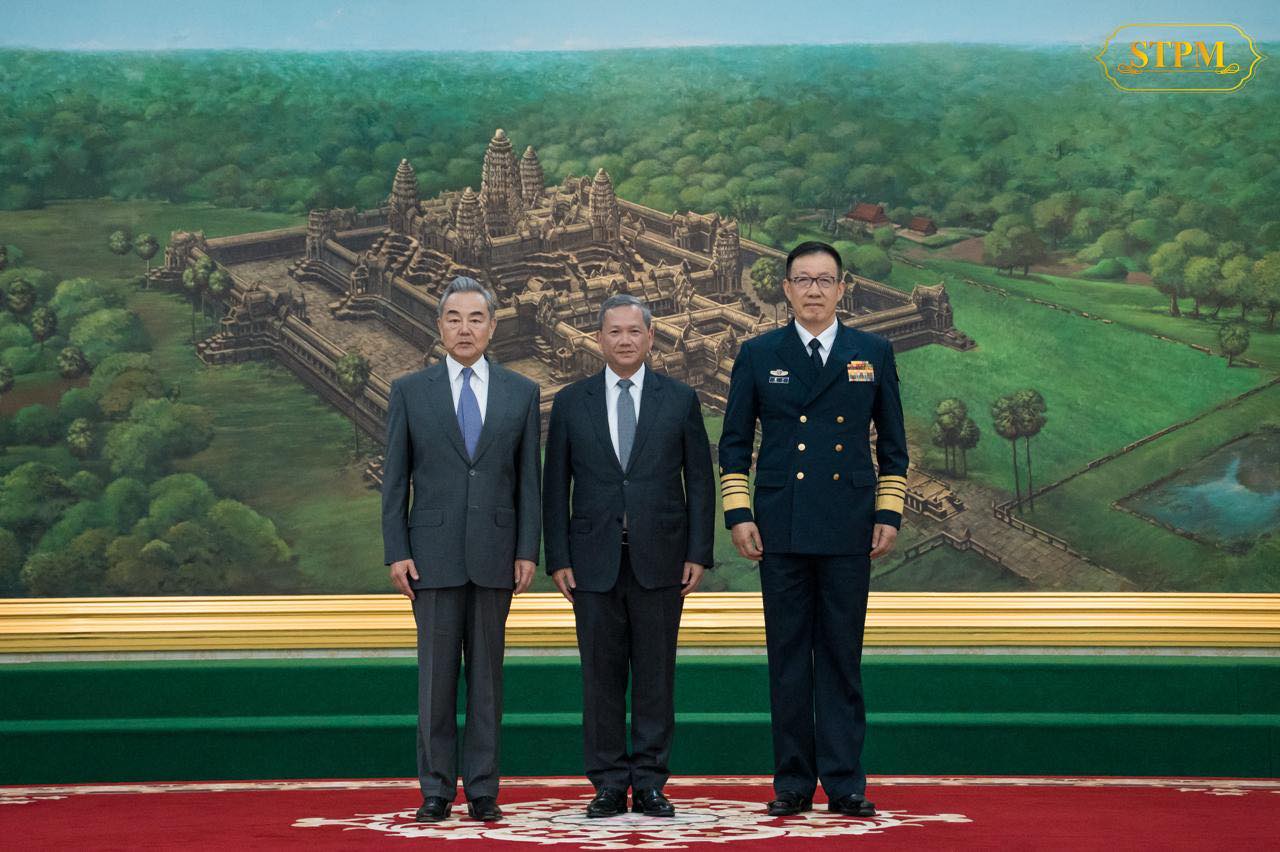
Cambodia and China held the first meeting of their 2+2 strategic dialogue mechanism in Phnom Penh on 22 April 2026. Cambodia’s Agence Kampuchea Press reported the inaugural session also produced an agreement to elevate the format to a 3+3 framework with the inclusion of Cambodia’s Ministry of Interior and China’s Ministry of Public Security. Xinhua’s own meeting readout, published the following day, described the session throughout as a “2+2” mechanism and did not use the “3+3” formulation. The same event is named differently in the two primary records. That divergence sits at the centre of what the inaugural meeting accomplished.
Foreign Minister Prak Sokhonn and Defence Minister Tea Seiha co-chaired for Cambodia. Wang Yi and Dong Jun led for China. The mechanism had been proposed during Xi Jinping’s state visit to Cambodia in April 2025 and reaffirmed at head-of-government, parliamentary and ambassadorial levels over eleven months without a first meeting being scheduled. AKP describes the elevation as expanding the dialogue into a channel covering “political, security, economic, regional, and international issues” and frames the Interior-ministry addition as reflecting “growing bilateral cooperation and the changing regional and international environment”. Xinhua’s readout records Wang Yi expressing China’s willingness to develop the mechanism into “a strategic platform for enhancing political and defense security cooperation” and does not mention public-security ministerial inclusion.
The asymmetry is not a translation artefact. The Cambodian Ministry of Information also reported the 3+3 upgrade, and the Phnom Penh Post’s coverage of Hun Manet’s courtesy meeting with the Chinese delegation described the mechanism as a “2+2” consistent with both governments’ pre-meeting framing. Phnom Penh announced the elevation. Beijing acknowledged the meeting. The record as of 23 April holds both framings simultaneously, with the scope of the institutional expansion confirmed on the Cambodian side and unconfirmed on the Chinese side. Which framing will control the record is testable, not settled; the piece returns to the test conditions below.
The timing matters. Cambodia and Thailand have been in post-ceasefire institutional work on a border conflict that produced kinetic clashes in July and August 2025, with a ceasefire taking hold in late July and a 27 December 2025 Special General Border Committee joint statement establishing the working track that has run since. April has been the most active month in that track since the ceasefire. Chinese Foreign Ministry spokesperson Guo Jiakun announced on 21 April that Wang Yi would visit Cambodia, Thailand and Myanmar from 22 to 26 April, with the Cambodia stop scheduled as the first leg. The meeting with Prak Sokhonn and Tea Seiha was also the ministerial culmination of a seventeen-day sequence of Cambodian diplomatic instruments on the country’s two most active files. On 5 April, the Ministry of Foreign Affairs and International Cooperation issued a formal protest over Thai troop activities near Preah Vihear, including land-clearing, the deployment of approximately 100 metres of barbed wire, and armoured-vehicle positioning, citing the 1904 Franco-Siamese Convention and the 1907 Treaty as the governing instruments. A second protest followed on 19 April over continued consolidation across Preah Vihear, Oddar Meanchey and Pursat provinces. The MFAIC notified the public on 21 April that the 2+2 meeting would proceed the next day. The Interior-ministry inclusion, announced the day after the meeting, closed the sequence.
Vietnam is the structural comparator, not Indonesia. The first ministerial meeting of the China-Vietnam 3+3 strategic dialogue on diplomacy, defence and public security was held in Hanoi on 16 March 2026, five weeks before Phnom Penh’s session. At that meeting, Wang Yi described the China-Vietnam 3+3 as “the first strategic communication platform of its kind globally”. Indonesia’s 2+2, launched in April 2025 and still China’s only other operational foreign-plus-defence ministerial mechanism in ASEAN, has not held its second meeting. Across the region’s ten states, China’s comparable mechanisms sit at senior-official or exercise level, with Singapore and the Philippines operating defence-policy dialogues without ministerial foreign-affairs coupling. The 3+3 architecture as Cambodia has reported it would place Cambodia alongside Vietnam at the top of China’s ASEAN dialogue tier, bypassing the middle level Cambodia previously occupied through the recurring Golden Dragon and Peace Angel bilateral military exercises and mine-action training frameworks.
Hun Manet’s separate meeting with Wang Yi and Dong Jun on 22 April is where the Thailand file entered the Chinese strategic forum. The two readouts diverge here as well. AKP records Hun Manet briefing the Chinese side on “recent developments along the Cambodia-Thailand border” and reaffirming Cambodia’s position “that border issues should be resolved peacefully, based on international law and in accordance with existing bilateral treaties, conventions, and agreements between the two countries”. The Phnom Penh Post’s account, drawn from Hun Manet’s own social-media statement, carries the same language. Xinhua’s parallel readout reports Hun Manet “briefed on the situation regarding the Cambodia-Thailand border conflict and expressed his hope that China would play a greater role in advancing peace talks”. People’s Daily carries identical indirect reported speech. The Cambodian rendering foregrounds the legal architecture. The Chinese rendering foregrounds an invitation to mediate. The same exchange appears in two structurally different framings on the two governments’ primary channels.
The Cambodian framing is structurally consequential because Thailand’s political apparatus is moving in the opposite direction. Prime Minister Anutin Charnvirakul’s 9 April policy statement to parliament pledged to “expedite studying how to terminate MoU 44,” the 2001 memorandum that establishes the bilateral joint-negotiation framework over the overlapping maritime claims area in the Gulf of Thailand without delimiting boundaries. Thailand’s own Vice Minister for Foreign Affairs Russ Jalichandra clarified in November 2024 that the agreement “remains Thailand’s most effective tool” for protecting maritime interests, noting that a 2009 Cabinet resolution proposing cancellation was reversed in 2014 after subsequent studies highlighted the MoU’s strategic advantages, and that cancellation “would not eliminate Cambodia’s territorial claims”. Hun Manet’s reaffirmation of “existing bilateral treaties, conventions, and agreements” in the Chinese strategic forum on 22 April landed in the direct runway before Wang Yi’s Bangkok stop, with the architecture Thailand’s current government is moving to dismantle named as the Cambodian position.
Wang Yi’s response kept China’s mediator posture continuous with its December 2025 shuttle role. The Fuxian Meeting, held on 28-29 December 2025 at Yunnan Province, brought the three foreign ministers together in the trilateral format that produced a joint statement supporting the Joint Boundary Commission mechanism and ASEAN Observer Team operations after the post-clash ceasefire. The Xinhua meeting readout of 22 April records China “supports Cambodia and Thailand in implementing the consensus reached at the China-Cambodia-Thailand Fuxian Meeting, making good use of existing bilateral mechanisms, strengthening dialogue, rebuilding mutual trust, and improving relations”. China did not adopt Cambodia’s legal framing of the Thai troop activity at Preah Vihear as a sovereignty violation under the 1904 Convention and 1907 Treaty architecture that Cambodia’s April protests named. It also did not endorse Thailand’s cancellation trajectory. The Fuxian reference preserves the format through which China engaged the bilateral in December. The humanitarian-support language for “Cambodian border residents’ resettlement” carries forward the concrete economic-humanitarian channel China opened during the 2025 conflict.
The operational content was placed on the Chinese-side primary readout for the first time. Public-security ministerial inclusion, as reflected on the Cambodian-side record, would bring cross-border criminal-policing jurisdiction, intelligence sharing, and scam-compound enforcement into the formal ministerial channel, areas that fall outside FM/DM remit in both bureaucracies. Xinhua records both sides agreeing to “deepen law enforcement and defense cooperation, jointly combat online gambling and telecom fraud, and safeguard their respective cybersecurity”. The anti-scam language is not new to the bilateral frame. Xi Jinping’s 17 April 2025 talks with Hun Manet called on both countries to “resolutely crack down on online gambling and telecom fraud” in the conversation where the 2+2 was proposed. What the 22 April session added is a ministerial mandate scoped to cross-border criminal networks and cybersecurity. Cambodia’s own anti-scam statute, Royal Kram NS/RKM/0426/006, was promulgated earlier in April 2026 and provides the domestic legal architecture within which any Interior-ministry cooperation with China’s Ministry of Public Security would operate.
A rebranding-only reading is defensible. AKP’s own readout describes a broad mixed platform covering “digital transformation, green development, blue economy, connectivity, resilient supply chains, financial cooperation, and people-to-people exchanges” alongside the security language. The “Industrial Development Corridor” and “Fish and Rice Corridor,” both launched at Xi Jinping’s April 2025 state visit and reaffirmed by Wang Yi at the 22 April meeting, are branding frameworks without published operational substance. Indonesia’s 2+2, launched in April 2025, has not held its second meeting, and China’s overall ministerial-mechanism rollout tempo in ASEAN has consistently trailed the announcement cycle. The institutional elevation Cambodia has reported will be testable against two concrete conditions: whether a second 3+3 ministerial meeting is scheduled within twelve months, and whether the law-enforcement and cybersecurity mandate produces verifiable bilateral working-group outputs within six months. Until then, the elevation carries the weight Cambodia has assigned it in the Cambodian record and the narrower weight China has accepted in the Chinese record.
That gap is the finding. Cambodia has placed a documentary claim on the table that the Chinese side has not contradicted and has not adopted. The claim will either be operationalised through a second meeting and traceable enforcement output, or it will remain a Cambodian-side characterisation of an inaugural session the Chinese side recorded in narrower terms. In either case, the record Cambodia published on 23 April becomes the reference point against which the next twelve months will be measured.