
The Law on Compulsory Military Service has been on Cambodia’s books since 22 December 2006, six chapters and eighteen articles. Article 2 of that text set the obligation at ages 18 to 30, with eighteen months of service, women voluntary, and exemption for monks and the physically unfit. “We made this law in 2006, but we did not implement it,” Prime Minister Hun Manet said at the Royal Gendarmerie’s 32nd anniversary in Kampong Chhnang last July, announcing implementation from 2026. The draft now under National Assembly review does not extend the 2006 law’s reach. It narrows the age cohort to men aged 18 through 25, retains women’s voluntary participation, lengthens service from eighteen to twenty-four months, and builds exemption and benefits architecture into the obligation that the 2006 text did not contain.
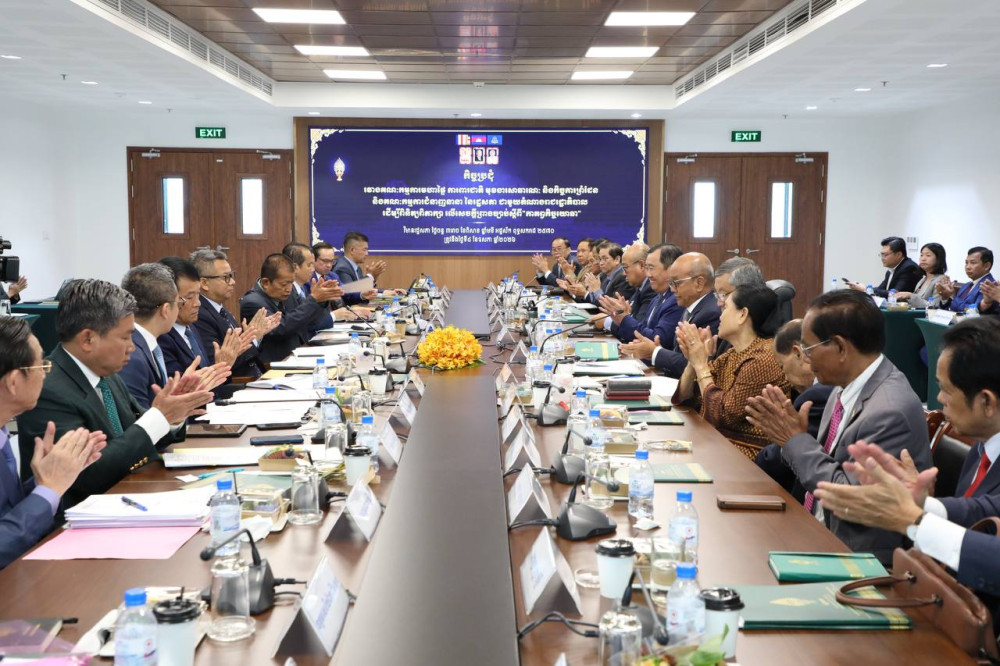
On May 4 the National Assembly’s Fourth Commission opened review of the draft, with commission chair Kep Chuktema presiding and Deputy Prime Minister and Minister of National Defence Tea Seiha leading the government delegation, eleven days after Cabinet approval on April 23 and ten days after the Associated Press wire opened the international cycle.
A calibration of an existing instrument to a documented demand sits before the assembly. Tea Seiha said the 2006 framework no longer matched Cambodia’s present situation. The age range narrows by five years at the upper bound and the duration extends by six months. Hun Manet placed the cohort the new range will draw from at around three hundred thousand each year, against an armed forces baseline the CIA Factbook estimates at roughly two hundred thousand including military police. The instrument the draft replaces was filed in 2006, nineteen years before the 2025 fighting on the Thai border that left around a hundred Cambodian soldiers and civilians dead and displaced more than five hundred thousand people on both sides before the December ceasefire.
Government spokesperson Pen Bona told the Associated Press the draft runs to eight chapters and twenty articles. The exemption architecture covers officially recognised monks, persons with disabilities, and citizens with certified expertise in science, technology, and innovation. Specialists who contribute to the Royal Cambodian Armed Forces through research or public-benefit missions may receive exemptions equivalent to the service period. Those who have completed military service under contract are considered to have fulfilled the obligation. Khmer Times reported the draft routes physical-fitness assessment through a health committee. The Agence Kampuchea Presse account, single-sourced for these details, adds that the draft makes dual citizens residing in Cambodia subject to the obligation. The same source describes a six-month service extension in exceptional circumstances and prison terms running from six months to five years for evasion. The benefits package, also single-sourced to AKP, covers priority public and private employment, job security and salary protection during service, resumption of education, and allowances.
The cohort math fixes the form. Three hundred thousand turning eighteen each year, twenty-four months of service, and a force baseline of roughly two hundred thousand including military police rule out universal call-up by arithmetic. The drafting question is who serves and on what terms, not whether all who turn eighteen appear.
In late April the international wire cycle led with the 2025 conflict. The Associated Press placed the legislation under the headline “After last year’s fighting with Thailand, Cambodia readies new conscription law for men aged 18-25”. The Defense Post carried the wire under “Cambodia Pushes Ahead With Military Conscription Law.” The institutional record carries a different sequence. The Law on Compulsory Military Service was filed in 2006, nineteen years before the conflict the wire put first. Hun Manet announced implementation in July 2025, six weeks after the May 28 incident at the border in which Cambodian soldier Suon Raun was killed and three months before the deeper fighting that followed. The 2026 draft narrows the age range its 2006 predecessor set and extends the service the predecessor wrote.
The implementation tests are already in Cambodia’s own civic record. Kin Phea, Director-General of the Institute of International Relations at the Royal Academy of Cambodia, told Khmer Times the draft’s exemption criteria were broadly acceptable but unclear in places, with risk of misinterpretation absent detailed sub-decrees and risk of corruption and favouritism without clear implementing rules. Royal Academy policy analyst Seun Sam, reported in Khmer Times on the Hun Manet announcement last July, said fairness required treating citizens identically regardless of social or economic status. CamboJA carried college student Phong Arn proposing the law take account of teenagers carrying household economic responsibilities, and political analyst Meas Nee saying the law was necessary in view of border-country considerations involving Vietnam and Thailand.
The draft now moves to the National Assembly plenary, then the Senate, then King Norodom Sihamoni’s signature, with implementation set for 2026 by Hun Manet’s announcement last July.