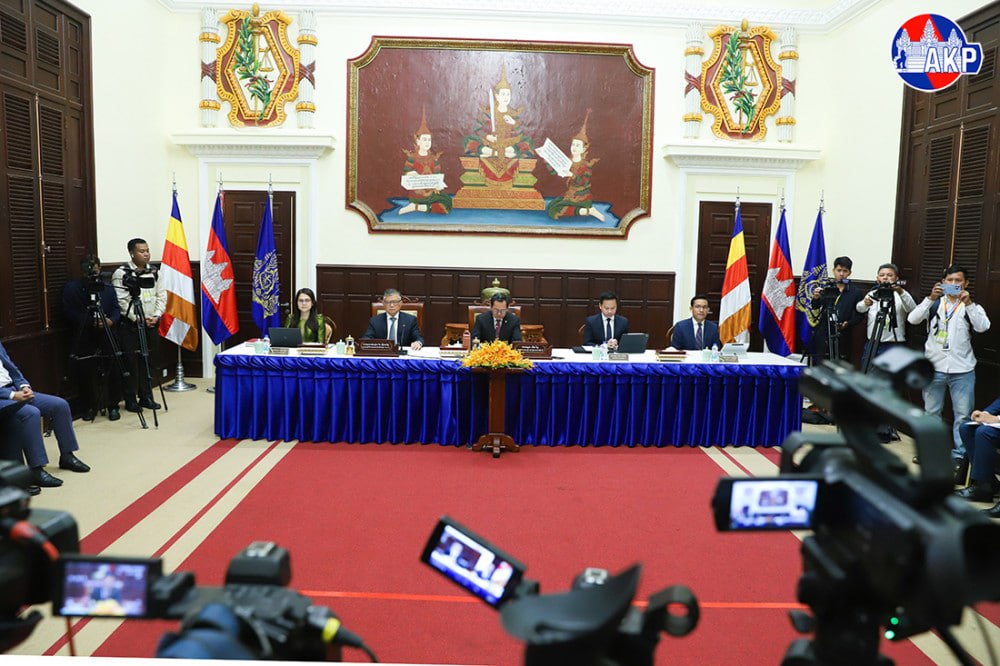
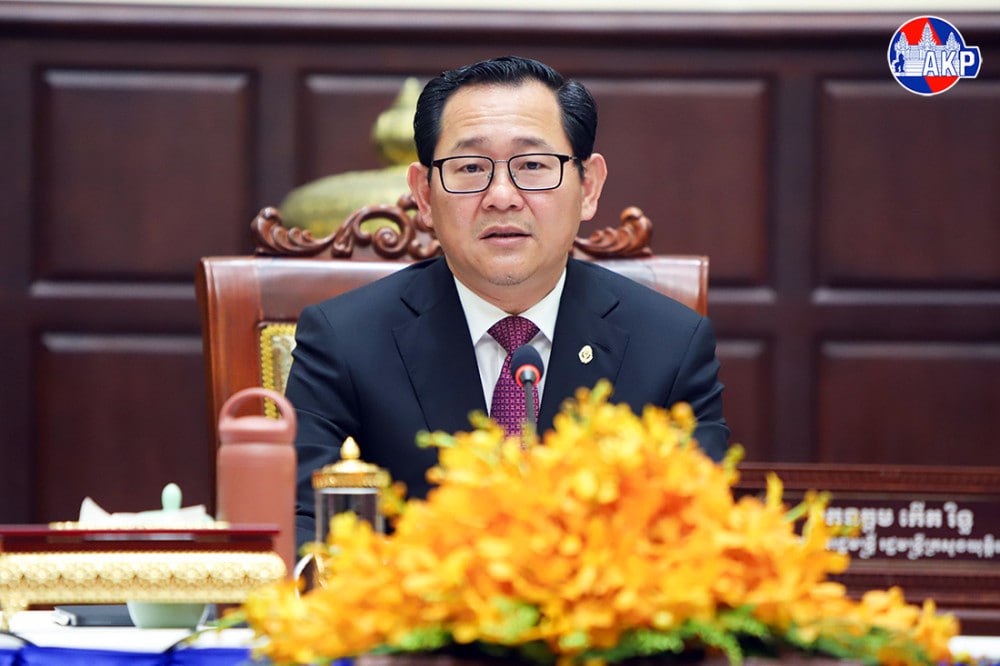
Cambodia’s justice minister designated online scam operations a “comprehensive national security issue” on April 3, 2026, announcing the passage of the country’s first law targeting the industry. The declaration came ten months after the prime minister began chairing an anti-scam commission that had been documented in official Cambodian government media since June 2025.
The gap between those two dates frames a question the law alone cannot answer: whether Cambodia’s most aggressive institutional response to its scam economy represents structural reform or the product of external pressure that arrived faster than the institutions it targeted could absorb.
The law, formally titled the Law on Combating Cyber-Fraud, passed the National Assembly unanimously on March 30 with 112 votes and cleared the Senate on April 3. It creates five new criminal offenses, extends pre-charge detention from the standard 72 hours to a maximum of ten days, and introduces a reverse burden of proof on asset owners: those who cannot demonstrate the legal origin of assets suspected of being scam proceeds face money laundering charges without a prior conviction for the predicate offense. Organizers of scam centers involving trafficking, forced labor, or violence face ten to twenty years in prison. Operations that cause death carry sentences of up to life imprisonment. Property used to house scam operations is subject to confiscation unless the owner can prove non-complicity.
The provisions are not cosmetic. The stand-alone money laundering offense, modeled on Singapore’s framework and aligned with Financial Action Task Force standards, addresses a documented enforcement gap: under Cambodia’s existing anti-money laundering law, asset confiscation required a prior criminal conviction for the underlying offense. The law’s extraterritorial jurisdiction covers offenses committed outside Cambodia when Cambodian citizens are involved or when Cambodian financial systems are used. A separate mechanism, to be established by executive instrument, receives judicial police powers through an order of the justice minister, creating a parallel enforcement track outside the traditional police chain.
That mechanism already exists. The Commission for Combating Online Scams, documented in official Agence Kampuchea Presse reporting as early as June 27, 2025, has operated under Prime Minister Hun Manet’s chairmanship through a secretariat led by Senior Minister Chhay Sinarith. Between June 2025 and April 2026, Cambodian authorities raided approximately 2,500 sites, dismantled 200 scam centers, initiated 79 legal cases against nearly 700 ringleaders and associates, and repatriated close to 10,000 workers from 23 countries, according to figures from the commission and the Associated Press.
The institutional response accelerated after October 2025, when the U.S. Treasury’s Office of Foreign Assets Control designated the Prince Group, one of Cambodia’s largest conglomerates, a Transnational Criminal Organization and sanctioned 146 affiliated targets. The U.S. Department of Justice indicted the group’s founder, Chen Zhi, for operating forced-labor scam compounds, and prosecutors seized approximately $15 billion in cryptocurrency linked to the network. The United Kingdom imposed concurrent sanctions. Chen Zhi was arrested in Cambodia and extradited to China on January 6, 2026. Two days before the April 3 national security designation, Li Xiong, former chairman of the Huione Group and an alleged core member of Chen Zhi’s network, was similarly arrested and extradited.
Chen Zhi had served as a personal advisor to both Hun Manet and his father, former Prime Minister Hun Sen, and held the title of Neak Oknha, Cambodia’s highest honorific. Hun Manet told AFP in February 2026 that his government “did not know that he was the kingpin.”
The law and the enforcement campaign it accompanies land in a documented institutional landscape. The U.S. State Department’s 2025 Trafficking in Persons Report, issued in October 2025, maintained Cambodia at Tier 3, the lowest ranking, for a fourth consecutive year. The report found a “government pattern of human trafficking in online scam operations.” It stated that the government had never arrested or prosecuted a scam compound operator or owner and that senior officials had financially benefited from and intimidated witnesses to forced labor in scam operations. Compounds shut down by authorities, the report stated, were often reopened within days after payments to officials. Cambodia was newly designated a state sponsor of trafficking.
A June 2025 Amnesty International investigation, based on eighteen months of research, described evidence suggesting coordination between Chinese compound operators and Cambodian police. Cambodian journalist Mech Dara, who investigated scam-center networks, was arrested in 2024 and charged with incitement.
The compound pressure that preceded the law was not limited to U.S. enforcement action. China demanded Chen Zhi’s extradition and announced that individuals linked to the Prince Group had until February 15, 2026, to surrender. The United Kingdom sanctioned additional scam-center actors on March 26. South Korea imposed its most severe travel warning tier on parts of Cambodia in October 2025 after a Korean student died in a scam compound. Tourism arrivals from the Asia-Pacific region fell 20 percent year-on-year in 2025, with Thai visitors declining more than 50 percent. The ASEAN+3 Macroeconomic Research Office documented in November 2025 that Cambodia’s tourism industry had not fully recovered from “lingering reputation concerns related to online-scam operations” even before the border conflict with Thailand reduced arrivals further.
France, a permanent member of the UN Security Council, expressed “our shared desire to combat online-scam centres” during a bilateral meeting between Foreign Ministers Jean-Noel Barrot and Prak Sokhonn on February 25, 2026. The United States and Cambodia agreed during a leaders-level meeting to “expand cooperation on combating transnational crime organizations, including narcotics traffickers and online scam centers.”
Whether the new legal architecture produces outcomes the enforcement campaign alone has not is the question the law’s own provisions frame. The law exempts persons forced to commit cyber-fraud from criminal liability, addressing findings that authorities had penalized trafficking victims for crimes committed under coercion. It creates incentives for cooperating witnesses who disclose offenses before prosecution. It targets networked and distributed operations, not only physical compounds, responding to the documented pattern of operations reconstituting after raids.
Jacob Sims, a visiting fellow at Harvard University’s Asia Center, noted that past crackdowns failed because they left financial and protection networks intact. Hun Manet has pledged to close all scam centers by the end of April. Whether the law’s provisions reach the networks that sustained the industry through a decade of documented institutional tolerance will determine whether the national security designation announced on April 3 marks a structural shift or the point at which external pressure produced its most visible institutional response.