
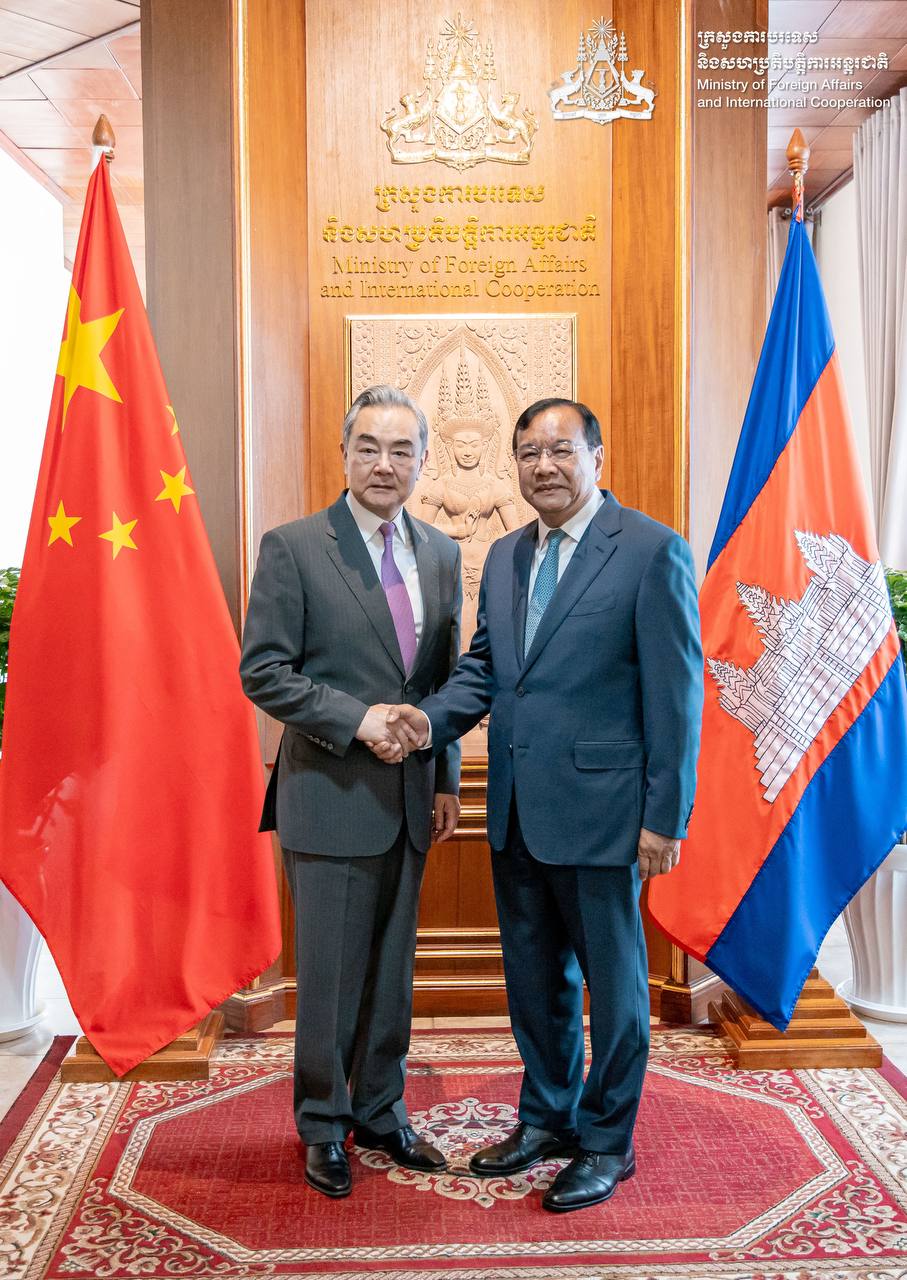
Wang Yi opened a four-day Southeast Asia tour in Phnom Penh on 22 April 2026, not in Bangkok. The first stop ran longer than the second and delivered the inaugural meeting of a new China-Cambodia “2+2” Strategic Dialogue between foreign and defence ministers. Cambodia’s co-chairs were both Deputy Prime Ministers, Prak Sokhonn for foreign affairs and Tea Seiha for defence, matching the institutional weight of Wang Yi and Defence Minister Dong Jun.
Hun Manet had returned from a 6 to 9 April state visit to France two weeks earlier. On 22 April, Cambodia’s permanent mission opened a third UN forum binding the Cambodia-Thailand border conflict to financing architecture, an ECOSOC intervention that joined UN Security Council filings A/80/587-S/2026/7 and A/80/593-S/2026/37 already on the record. The 2+2 with Beijing was one channel inside a broader operating month.
Cambodia’s foreign ministry distributed Press Release No. PR 63/2026 on 25 April, naming the Diamond Cooperation Framework, the Industrial and Technological Corridor, the Fish and Rice Corridor, the Funan Techo Integrated Water Resources Management Project, and defence and security cooperation. None of it was new in April 2026. All of it predated Wang Yi’s plane by at least two years. What was new was the institutional vehicle now running it: a defence-and-foreign-ministry mechanism Cambodia hosted on its own soil, with both co-chairs at deputy-prime-minister rank, and a press release Cambodia issued on its own letterhead naming what the bilateral now contains.
The Diamond Cooperation Framework first appeared in joint Cambodia-China text on 13 February 2023, in the joint statement on building a “Community with a Shared Future in the New Era”, with six priority areas covering political cooperation, production capacity, agriculture, energy, security, and people-to-people exchanges. The corridor language followed the same trajectory: “Industrial Development Corridor” in February 2023, evolving to “Industrial and Technological Corridor” by the September 2023 joint communique, with a master plan formulated by April 2024. The Fish and Rice Corridor entered joint grammar in the same February 2023 statement, centred on north-western Cambodia and the Tonle Sap Lake area, with operational content covering aquaculture, agro-processing, ecological agriculture, modern machinery, new agricultural technology, and human resources.
Cambodia’s 25 April press release used “Industrial and Technological Corridor.” The PRC MFA readout of the same 23 April bilateral used “Industrial Development Corridor.” Either side may have institutional reasons. The drift is on the record.
While the corridor architecture moved across 2023 and 2024, the rest of Cambodia’s external map also moved. The U.S. Department of Commerce removed Cambodia from the Bureau of Industry and Security’s D:5 arms-embargoed country list, effective 3 February 2026, after a White House announcement on 26 October 2025. Ream Naval Base, the subject of years of US-China contestation over alleged Chinese military access, hosted the first U.S. Navy port call in January 2026 and the first Japanese naval visit in April 2025. France hosted Hun Manet from 6 to 9 April 2026, against a January 2024 Élysée framework that committed EUR 215 million across three conventions.
Inside the 23 April Sokhonn-Wang Yi bilateral, Cambodia briefed China on the Cambodia-Thailand border file. The Cambodia MFA press release recorded that Cambodia “expressed deep appreciation” for China’s “active and constructive role in promoting dialogue and direct communication between the two countries, which helped de-escalate the situation, and in providing humanitarian assistance to the displaced people.” The same briefing pattern ran on 22 April with Hun Manet, per the PRC MFA readout. The recognition entered the record on Cambodia’s letterhead and on Beijing’s.
China reaffirmed “firm support for Cambodia to independently pursue a development path suitable for its national context” and characterised Cambodia’s regional and international role as “increasingly active and constructive,” per the same press release. Cambodia reaffirmed the One-China policy and Taiwan’s status as “an inalienable part of China’s territory.” The exchange ran in two directions.
Cambodia’s 25 April press release on the 23 April bilateral did not name online gambling or telecom fraud. The PRC MFA readout of the same meeting did, recording Wang Yi’s framing that “combating online gambling and telecom fraud is vital to the safety of people’s lives and property,” that the cooperation must be sustained, and that the criminal economy must be “resolutely and thoroughly” removed. The PRC readout records Sokhonn reciprocating in the same meeting. Hun Manet committed to the same in his 22 April meeting with Wang Yi, per the PRC readout. Senate President and Acting Head of State Samdech Techo Hun Sen committed to the same in his 23 April meeting, per the PRC readout. The six-point consensus from the 2+2 inaugural, briefed by Wang Yi after the meeting, included intensifying cooperation to combat online gambling and telecom fraud. Cambodia’s public bilateral text on the 23 April Sokhonn meeting omitted scam content. The commitments, as recorded by Beijing, are on the bilateral record.
Two days later, in Bangkok and at a meeting venue in Krabi province, Wang Yi co-chaired the third meeting of the existing China-Thailand Foreign Ministers’ Consultation Mechanism with Thai DPM/FM Sihasak Phuangketkeow. The bilateral grammar Thailand confirmed differed from the architecture Cambodia named: Comprehensive Strategic Cooperative Partnership; a Community with a Shared Future for Enhanced Stability, Prosperity and Sustainability; a forthcoming Joint Action Plan; technology, innovation, electric vehicles, green transition, renewable energy; transboundary challenges including water management, air pollution, and transnational crimes. Thailand’s MFA readout, like Cambodia’s, did not name online gambling or telecom fraud specifically. The PRC MFA readout of Wang Yi’s parallel 24 April meeting with Prime Minister Anutin Charnvirakul did, with both sides committing to crack down on the criminal economy.
Cambodia hosted the inaugural meeting of a new mechanism, with defence ministers at the table. Thailand hosted the third meeting of an existing FM-only mechanism. The two legs of Wang Yi’s tour were not equivalents.
A reading is available in which Cambodia is operating inside Chinese diplomatic grammar with multi-vector activity as secondary cover. The grammar Cambodia is reaffirming, “Community with a Shared Future,” “Diamond Cooperation,” the named corridors, originated in Chinese diplomatic systems and recurs across Chinese bilateral relationships. The 2+2 mechanism was agreed at Xi Jinping’s April 2025 state visit to Cambodia. Beijing inserts scam-economy discipline into the bilateral record where Cambodia’s own public text softens it. On that reading, Cambodia is the recipient of Chinese architecture and the convertor of it, and the recipient role precedes the convertor role.
What that reading does not fully account for is the documented sequence on Cambodia’s terms. Cambodia closed the near-year preparation trail of the 2+2 mechanism by hosting the inaugural on its own soil. Cambodia briefed China on the border file. Cambodia distributed formal recognition of Chinese de-escalation through its own ministry’s letterhead. Cambodia ran the France visit, the ECOSOC deployment, the UN Security Council filings, and the ASEAN Observer Team facilitation in parallel, not in sequence after Beijing. The Funan Techo Integrated Water Resources Management Project broke ground on its main canal segment on 11 April 2026, before Wang Yi’s plane. The grammar is Chinese in origin. The deployment runs through Cambodian institutions. Both observations sit on the record.
Wang Yi departed Techo International Airport on 23 April 2026. The Bangkok leg ran on 24 April. The Myanmar leg ran from 24 to 26 April.