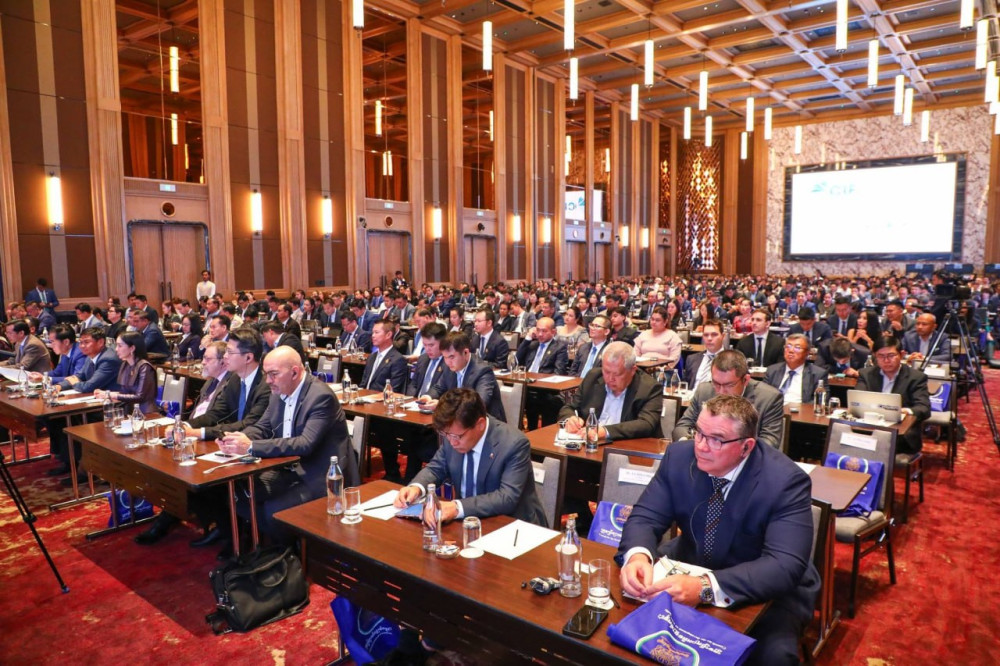
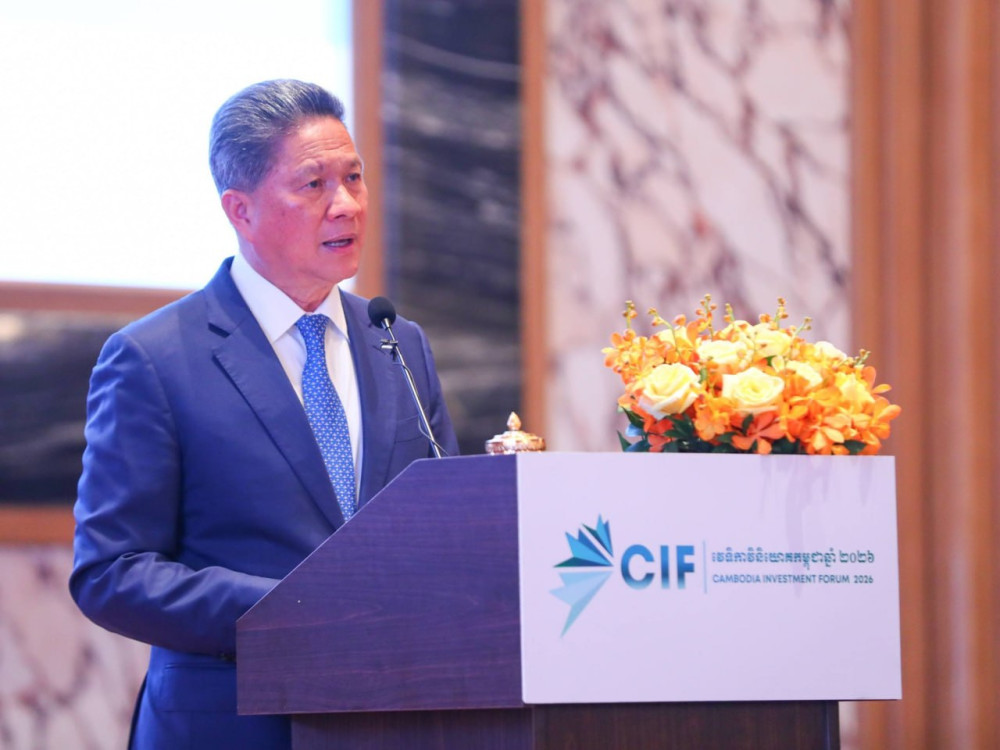
On the morning of May 7, Sun Chanthol opened Cambodia’s inaugural high-level investment forum in Phnom Penh. That evening, Hun Manet sat with Ferdinand Marcos Jr. and Anutin Charnvirakul in Cebu for trilateral talks on the Cambodia-Thailand border.
The Deputy Prime Minister and First Vice-Chairman of the Council for the Development of Cambodia presided over the opening under the theme “Beyond Investment: Strengthening Resilience through Proactive Aftercare and Strategic Partnership.” Hem Vanndy, Minister of Industry, Science, Technology and Innovation, and Heng Sour, Minister of Labour and Vocational Training, attended alongside the Cambodia Chamber of Commerce, the Oknha Association of Cambodia, international chambers, and private-sector investors. Sun Chanthol told the forum that the CDC was strengthening “the quality, efficiency, transparency, and accountability of public service delivery” through the Single Window mechanism, the Cambodia Investment Project Management system, and the National Single Window.
He announced a new Business Co-Creation working group and a project to provide investor-facing physical infrastructure at the CDC headquarters. He cited the Law on Combating Technology-Enabled Scams, promulgated by Royal Decree NS/RKM/0426/006 on 6 April 2026, as a priority instrument for cyber-fraud elimination and for the safety of investment and tourism.
The forum’s stated framing engaged what the Royal Government has built. The compound pressure stack those instruments operate within sat outside the address. The European Union’s partial withdrawal of Everything But Arms preferences took effect on 12 August 2020 and remains in place; European Commission GSP data records Cambodia as the EU’s second-largest EBA beneficiary, with €4.2 billion in preferential exports in 2024 and apparel accounting for 78 percent of preferential imports. Cambodia’s negotiating team brought the threatened US tariff down from 49 percent to 19 percent in 2025, and the 19 percent rate now applies. The October 2025 US Treasury sanctions on the Prince Group, a Cambodian real-estate-and-financial-services conglomerate designated by the US and UK for alleged cryptocurrency-scam operations, introduced a financial-stability risk that the ASEAN+3 Macroeconomic Research Office (AMRO) has on the record as separate from and compounding border-channel pressure. LDC graduation in 2029 will lift average preferential tariffs from zero under the EBA scheme to 8.8 percent under the standard GSP scheme and to 11.5 percent under MFN, with rules-of-origin local-content requirements rising from 30 to 60 percent.
The most current pressure is the one Hun Manet was managing in Cebu. AMRO’s November 2025 analytical note found that “sustained or worsening strains in Cambodia–Thailand relations may weigh on FDI in certain sectors,” with manufacturing firms that had adopted “Thailand+1” production strategies in Cambodia reliant on cross-border connectivity that the border closures disrupted. On 5 May the Thai cabinet approved the unilateral cancellation of MOU 2001, the 25-year-old bilateral framework on overlapping maritime claims and joint development of offshore energy resources. Cambodia responded by initiating UNCLOS compulsory conciliation, the non-binding five-member commission mechanism for disputes where bilateral negotiations have failed.
The figures Sun Chanthol cited as confidence indicators carry the same dual reading. CDC approved 184 fixed-asset investment projects worth $2.6 billion in the first four months of 2026, against the same-period 2025 figure of 231 projects worth $3.4 billion and the same-period 2024 figure of 128 projects worth approximately $2.5 billion. Against the 2025 baseline, project count fell about 20 percent and approved capital fell about 24 percent. Against the 2024 baseline, project count rose about 44 percent and capital rose about 2 percent. The 2025 surge to 630 projects worth $10 billion across the full year, a 45 percent increase over 2024 reported by CDC, is the trajectory peak the four-month 2026 figure sits against.
CDC approvals are forward-looking commitments. NBC inflow data is the disbursed reality. Total FDI inflow reached approximately $5.2 billion in 2025, an increase of 18.2 percent from $4.4 billion in 2024, with manufacturing rising about 50 percent year on year. Khmer Times, reading the same NBC report, records $5.1 billion and 16 percent growth, attributing $3.76 billion to China at 73.7 percent of total inflow, Singapore at $347 million, Canada at $230 million. The Chinese share of inflows was 41.3 percent in 2019 and 65.5 percent in 2024 per the World Bank, reaching 73 percent in 2025.
AMRO ranked Cambodia first in the 2025 Greenfield FDI Performance Index compiled by fDi Intelligence. The IMF’s 2025 Article IV consultation projected GDP growth at 4.8 percent in 2025 and 4.0 percent in 2026, both downward revisions from its 2024 Article IV projections. The IMF Executive Board’s November 2025 statement said that “governance reforms are essential to enhance business environment, bolster investor confidence, and ensure sustainable and inclusive development.”
Sun Chanthol’s address surfaced the architecture the Royal Government is building inward to retain investors who arrived. The compound pressure stack the architecture sits within is what Hun Manet is working in Cebu, what Cambodia is pursuing through UNCLOS conciliation, and what AMRO and the IMF have on the record.
The anti-scam law that Sun Chanthol cited is one place those two layers meet. The Royal Decree promulgating it on 6 April 2026 carries criminal penalties up to thirty billion riels in fines for legal entities, life imprisonment for scam-centre operators where deaths result, extraterritorial scope where Cambodian nationals or banking systems are involved, and a 48-hour Financial Intelligence Unit freeze authority on suspicious transactions. The law was passed by the National Assembly on 30 March 2026, reviewed by the Senate on 3 April 2026, and signed into law by Hun Sen as Acting Head of State three days later. On the same day the Royal Decree took effect, Cambodian authorities raided a Phnom Penh condominium and detained 218 foreign nationals on suspicion of operating a Japanese-targeting scam centre; AKP reported the operation the next day.
AKP’s coverage of the forum, the sole on-record source for the proceedings, recorded no investor questions, no challenges raised by attendees, and no sector-specific commitments.
Hun Manet’s joint press conference with Marcos and Anutin closed the same AKP front page that opened with the investment forum.