PHNOM PENH / NANNING, March 13, 2026 – Cambodia’s Ministry of Environment and a Chinese provincial state-owned planning firm have signed a memorandum of understanding aimed at modernizing Cambodia’s environmental monitoring systems through satellite imagery and data-management technology.
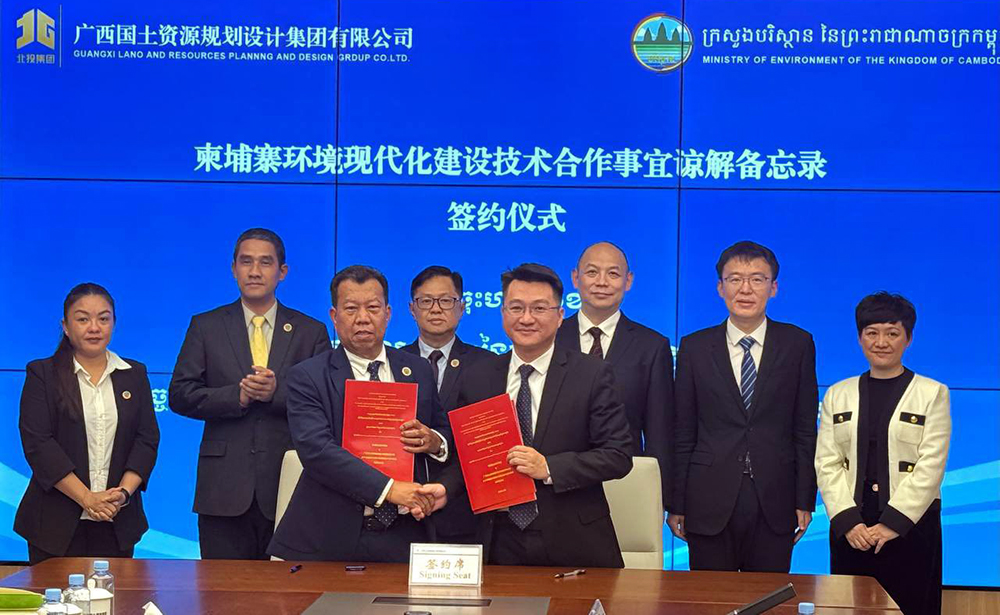
The agreement was signed on March 12 in Nanning, capital of China’s Guangxi Zhuang Autonomous Region, between the Cambodian Ministry of Environment and Guangxi Land and Resources Planning and Design Group Co., Ltd., according to institutional reporting cited by Khmer Times.
The MoU was signed by Khvay Atitya, undersecretary of state at Cambodia’s Ministry of Environment, and Chhit Dy, deputy director-general of the Guangxi firm.
According to reporting on the event, the cooperation will focus on the use of satellite imagery technology and satellite data-management systems to support modernization of Cambodia’s environmental monitoring capabilities.
Cambodian officials said the collaboration could strengthen the ministry’s ability to track environmental conditions and improve data management for policy planning.
Chinese-side context referenced the relevance of technologies linked to the BeiDou Navigation Satellite System, China’s global satellite navigation network, as part of the broader technological ecosystem associated with the cooperation.
However, the full text of the MoU has not been publicly released, and key implementation details remain undisclosed.
The currently visible public record does not identify:
- the financing structure of the cooperation
- whether the project involves grants or external funds
- the specific Cambodian departments responsible for implementation
- the technical architecture of the data systems
- the location of any data servers or cloud infrastructure.
Similarly, the legal role of the Guangxi firm in the project—whether as adviser, contractor, or system integrator—has not been publicly defined.
Without access to the full agreement or any technical annexes, analysts say it is not yet possible to determine whether the partnership represents a limited technical exchange or the beginning of a deeper operational integration of environmental monitoring systems.
For now, the available documentation supports classifying the agreement as substantive technical cooperation between Cambodia’s environment ministry and the Guangxi state-owned planning group.
Further clarity on the scope of the project may emerge if the Cambodian ministry or Chinese provincial authorities publish follow-up documentation such as implementation roadmaps, training programs, or procurement notices in the coming weeks.