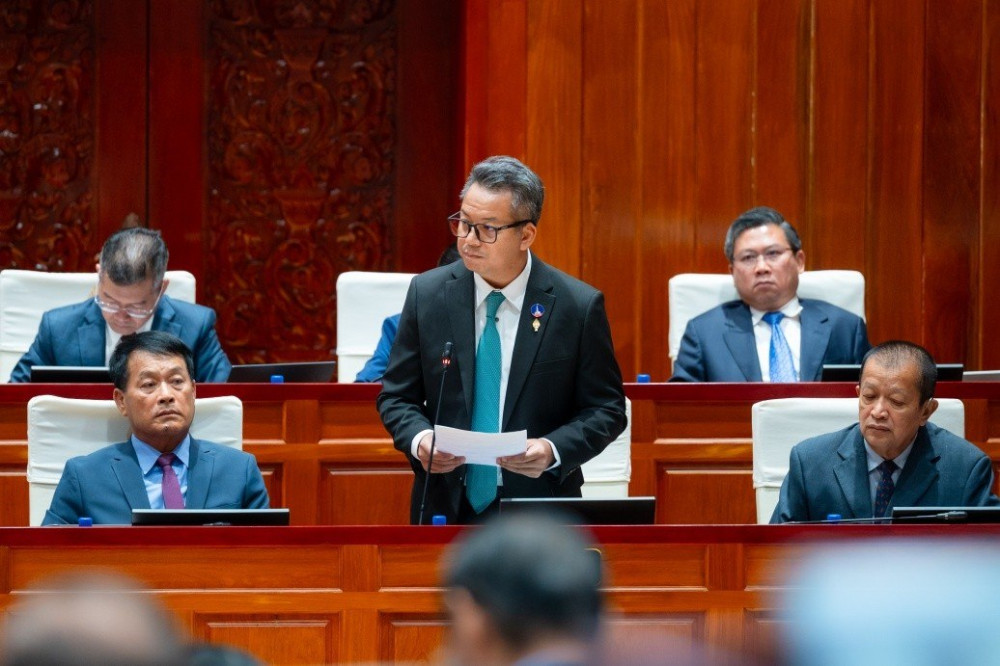
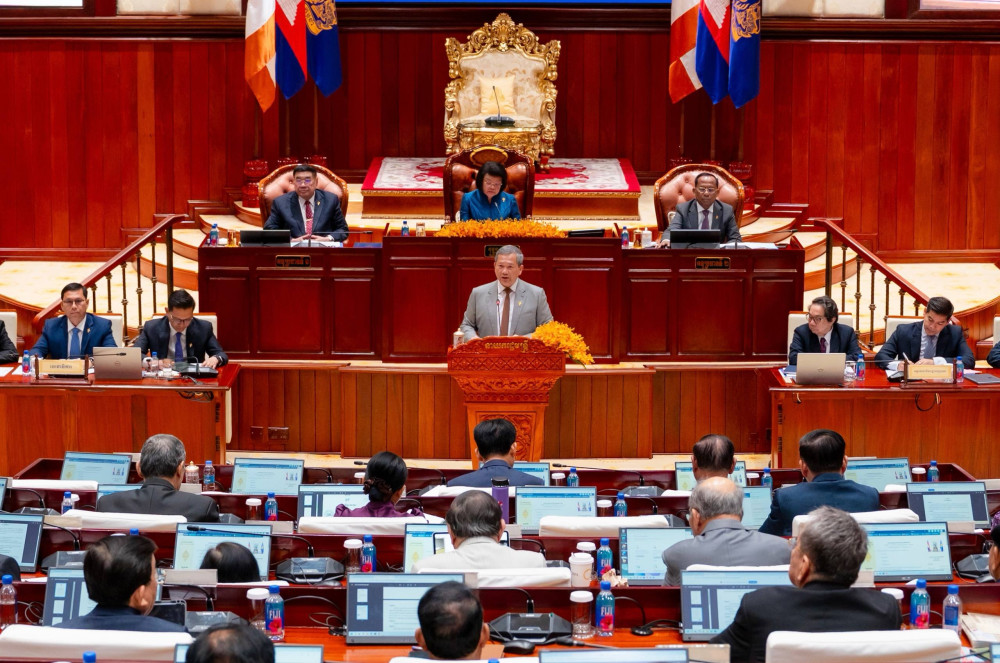
Cambodia’s National Assembly adopted a Draft Law on Military Conscription on 12 May at an extraordinary session of the 7th Legislature, with 114 of 114 lawmakers present voting in favour. The law contains 8 chapters and 20 articles, cites Article 49 (new) of the Constitution, and obliges male Cambodian citizens aged 18 to 25 to fulfil 24 months of military service. Women may participate voluntarily. Registration begins at age 17. Implementation begins in 2026.
The same session adopted a three-article law authorising the Royal Government’s payment guarantee for Electricité du Cambodge’s electricity purchases from Vietnam Electricity under an EDC-EVN agreement dated 30 January 2026.
The vote came inside a calendar week containing Thailand’s cabinet cancellation of the 2001 maritime memorandum of understanding on 5 May and Thaksin Shinawatra’s parole release from Klong Prem Central Prison on 11 May. Prime Minister Hun Manet first announced the 2026 conscription implementation on 14 July 2025 at the Royal Gendarmerie Training Centre in Kampong Chhnang Province, ten months before the 12 May session. The Cabinet reviewed the draft on 23 April. The session completes the National Assembly stage of the announced reform.
The new framework replaces a 2006 law that was passed but never enforced, which required male Cambodian citizens aged 18 to 30 to serve 18 months. Phnom Penh Post reported the operative selection mechanism applies through lottery from the 18 to 25 male cohort for two years of active duty. Reserve service runs until age 45. AFP reported the new law increases penalties for refusal to serve. Exemptions cover Buddhist monks, religious clergy, citizens with exceptional academic or professional qualifications, and persons with disabilities. Dual nationals residing in Cambodia are subject to the obligation.
Hun Manet told lawmakers Cambodia’s sovereignty was being threatened, AFP reported. “Peace cannot be achieved through begging from others. No one can fully protect us at all times except ourselves,” he said at the session, according to AKP. “Recent experiences have clearly shown that no one can help us completely at all times except ourselves.” The citizen-soldier framework, he said, “helps maintain balance between civilian life and national security responsibilities.” Hun Manet cited Singapore as a peer model in the AKP record; Phnom Penh Post reported the United States, Switzerland, and Israel as additional studied models.
He told the session that the world was entering “a new phase marked by border tensions, economic competition, and increasingly intense technological rivalry.” Cambodia, he said, “must continue reform and modernisation of the national defence sector, with emphasis on institutional reform, workforce modernisation, and equipment development at all levels.”
The 1993 Constitution sets out the substantive duty in Article 49: every Khmer citizen has a duty to take part in national reconstruction and to defend the motherland, and the duty to defend the motherland shall be exercised in accordance with law. The conscription bill cites “Article 49 (new)”. That notation denotes a subsequent constitutional amendment. The amendment’s specific provenance and text are not in the available primary record.
The 14 July 2025 announcement at Kampong Chhnang cited the 2006 law’s 18-month term as insufficient and committed to extending the active-duty period to 24 months, citing the dual purposes of increasing trained soldiers and improving recruitment effectiveness.
The 5 May Thai cabinet decision cancelled the maritime MOU at 12:30 at Government House. Prime Minister Anutin Charnvirakul, who took office after Bhumjaithai’s 192-seat win in the 8 February 2026 general election, told reporters the decision had no connection to the bilateral dispute. Cambodia announced the same day, through Deputy Prime Minister and Foreign Minister Prak Sokhonn, that it would initiate compulsory conciliation with Thailand under UNCLOS Annex V. Thaksin Shinawatra, the former prime minister whose daughter Paetongtarn led the previous Pheu Thai government, exited Klong Prem at 7:40 on 11 May after 243 days served, fitted with an electronic ankle monitor required until September.
Cambodia filed its bilateral position at the UN Security Council on 5 January 2026 (document A/80/587). The UNCLOS instrument of accession was deposited 6 February with declarations under Articles 287, 298, and 310; the Convention entered into force for Cambodia on 8 March. The June 2025 application to the International Court of Justice for interpretation of the Court’s 1962 judgment on the Temple of Preah Vihear predates both. A February 2026 statement at the UN Human Rights Council and a request to France for access to colonial-era boundary records held by the Archives Nationales d’Outre-Mer followed. On 5 May Cambodia activated compulsory conciliation under UNCLOS Annex V the same day Thailand removed the maritime framework.
The second law authorises state coverage for cross-border electricity imports under the 30 January EDC-EVN agreement; the agreement’s terms are not in the available public record. Cambodia’s imports from Thailand, Vietnam, and Laos run at roughly 672 megawatts, approximately 25 percent of total supply, against the 2024 baseline AMRO recorded in its November 2025 analytical note. Cambodia’s electricity costs run nearly double Vietnam’s, per the IMF Article IV consultation 2025.
Khuon Sudary, the National Assembly President, opened the session by saying the Royal Government remained “firmly committed to resolving disputes peacefully through existing mechanisms based on international law and mutual agreements,” and closed by calling on Cambodian citizens “both inside and outside the country, to remain united in support of the Royal Government’s peaceful and wise approach in safeguarding national interests.” The bill proceeds to the Senate.