
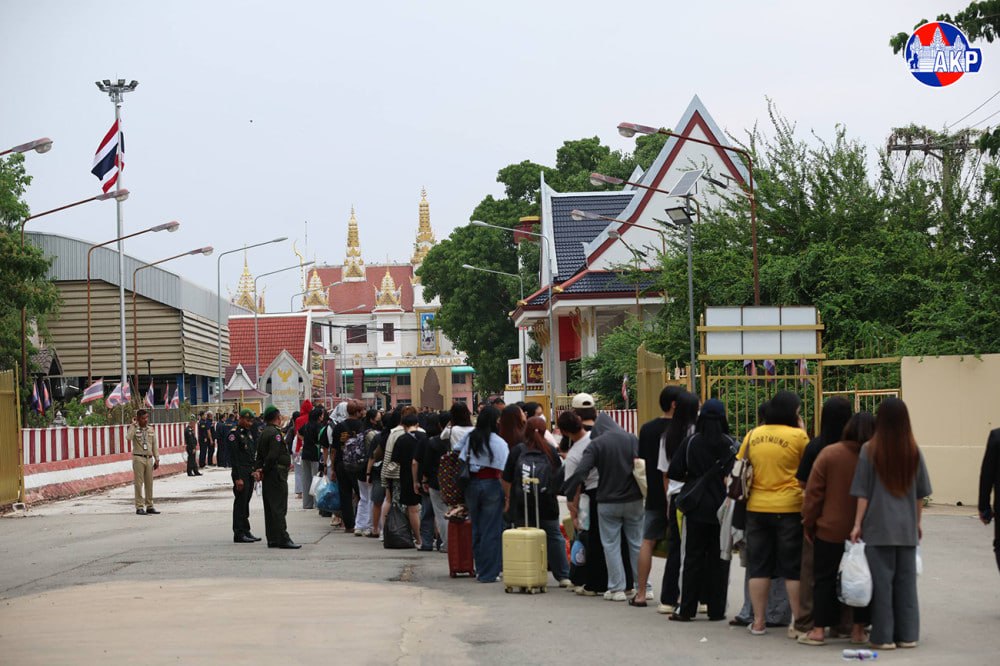
Thirty Thai nationals stayed behind. The other 635 walked back across the Poipet International Border Checkpoint on April 30, into Thai screening for involvement in transnational scam operations. Lieutenant General Som Vannvirak, Deputy Commissioner General of the National Police, said the thirty remained in Cambodian custody for offences committed inside the Kingdom.
The deportation followed a targeted raid five days earlier. On April 25, a joint task force inspected a high-rise condominium complex in Poipet, according to AKP. The site was identified as a hub for unauthorised online businesses, illegal gambling, and suspected cross-border criminal activity. Authorities seized 4,685 mobile phones and 416 computer monitors. Thai outlets reported the raid took place at Building F, a thirteen-storey twin tower opposite Rong Kluea Market in Aranyaprathet.
The handover did not pass cleanly.
Khaosod English, Thai Newsroom and Thairath English reported the transfer scheduled for the morning of April 30 stretched into the late afternoon. The Thai outlets framed the day as a Cambodian-side delay. The same reports cited Cambodian officials attributing the timeline to a shortage of buses after large-scale overnight arrests of scam suspects, with small vehicles making multiple round-trips between the detention site and the checkpoint. Cambodia’s Ministry of Interior issued a same-day evening statement calling the Thai reports fabricated, baseless, and misleading. The statement said all immigration formalities were expedited and the entire process from start to handover took less than twenty-four hours. The denial targeted framing rather than elapsed time.
Thai outlets timed the gap between scheduled morning handover and afternoon arrival in Thai custody. The MoI timed the gap between the start of formal immigration processing and the handover itself. Both intervals can be accurate. Resolving which interval each side measured requires the detention start time and the formal deportation order timestamp, neither of which surface in the available reporting.
The April 30 deportation sat inside a sequence the prior month had built. A Cambodian statute on technology-enabled scams entered force on April 6. The bilateral cooperation framework signed by Phnom Penh and Bangkok on 27 December 2025 contains a dedicated paragraph on cyber-scam suppression. On April 23, the US Treasury Department sanctioned Cambodian senator Kok An and 28 individuals and entities in his network. Treasury named his Crown Resorts hospitality company as the owner of casinos, resorts and other buildings in Poipet, Sihanoukville, Bavet and other Cambodian cities that have been converted into compounds. The Poipet raid two days later cleared one building. Whether that raid was coordinated with the OFAC action, sequenced after it, or independently timed does not surface in the publicly reported record.
Som Vannvirak said the thirty are held for legal proceedings tied to “specific offences committed within the Kingdom.” AKP did not state whether charges had been filed at the time of the deportation or specify under which articles of the new law the proceedings would run. The Law on Combating Online Scams promulgated on April 6 created the statutory category those proceedings will run through. Articles 5 through 7 cover technology-enabled scams, the organising or leading of scam centres, and the recruitment or training of others to commit such scams. Sentences range from two to thirty years, with life imprisonment available where the offence causes death.
The retention also sits inside a bilateral framework Cambodia and Thailand signed at the end of December. Paragraph 10 of the 3rd Special General Border Committee Joint Statement commits both sides to the Action Plan for Cooperation on the Prevention and Suppression of Transnational Crimes between the Cambodian National Police and the Royal Thai Police, with cyber scams and human trafficking named as priority subjects. The Poipet operation runs on that framework’s coordinating instruments.
The Cambodian government reported 250 raids and the closure of 91 casinos over the prior nine months, with 13,039 foreign nationals deported and 241,888 foreign nationals departing voluntarily between mid-January and April 19 as enforcement intensified. UNODC’s April 2025 regional report described cyber-fraud in the Mekong as having reached an inflection point, with operations industrialised, professionalised, and hedging beyond the region under enforcement pressure. The Poipet 635 enter a record now in five-figure territory. Whether the figures map to dismantled networks or to building turnover is a question those numbers do not answer on their own.
Amnesty International published findings in early April that the Commercial Gambling Management Commission recognised casino plans in December 2025 and January 2026 for operators with documented links to scam compounds, including three Crown casinos in Poipet, Bavet and Chrey Thum owned by Anco Brothers Co Ltd, the conglomerate Treasury later named as Kok An’s casino-licence holder for the same Poipet, Sihanoukville and Bavet properties OFAC sanctioned on April 23. The Amnesty findings predated the new law’s enforcement architecture by a fortnight. Whether the law’s provisions for confiscation of immovable property used as scam premises reach properties recognised by the gambling regulator is the second open question the April 30 operation does not resolve.
The strongest reading against the Poipet operation places its scale against what Cambodia did not name. Eight days before the deportation, the US Treasury identified Cambodian Senator Kok An’s Crown Resorts as the owner of casinos, resorts and other buildings in Poipet, Sihanoukville, Bavet and other Cambodian cities converted into compounds from which criminal organisations conduct digital asset investment fraud. Treasury named the layer above the operations: a sitting Cambodian senator, his Crown Resorts hospitality company, and Anco Brothers, his conglomerate that holds the casino licences. The Cambodian operation cleared one building. AKP coverage did not identify the building’s owner; the Thai outlets that described the tower did not either; and the Treasury sanctions, which named Crown Resorts and Anco Brothers properties in Poipet, did not specify which buildings the named entities own. Whether the cleared Building F belongs to the same architecture is unreported in the publicly available record, not contested.
The retained thirty are the test on the Cambodian side. Whether the charges filed under the new law reach the layer Treasury named eight days earlier, or stop at the operational layer the Poipet raid removed, is the open question. The 635 returnees are the test on the Thai side. Whether they enter Thai prosecution as participants in scam operations or pass through screening as trafficking victims is the parallel question. Both run on the framework signed in December. The April 30 deportation closed a building, the April 23 sanctions named a network, and the space between them has not been named in the publicly reported record on either side of the border.