
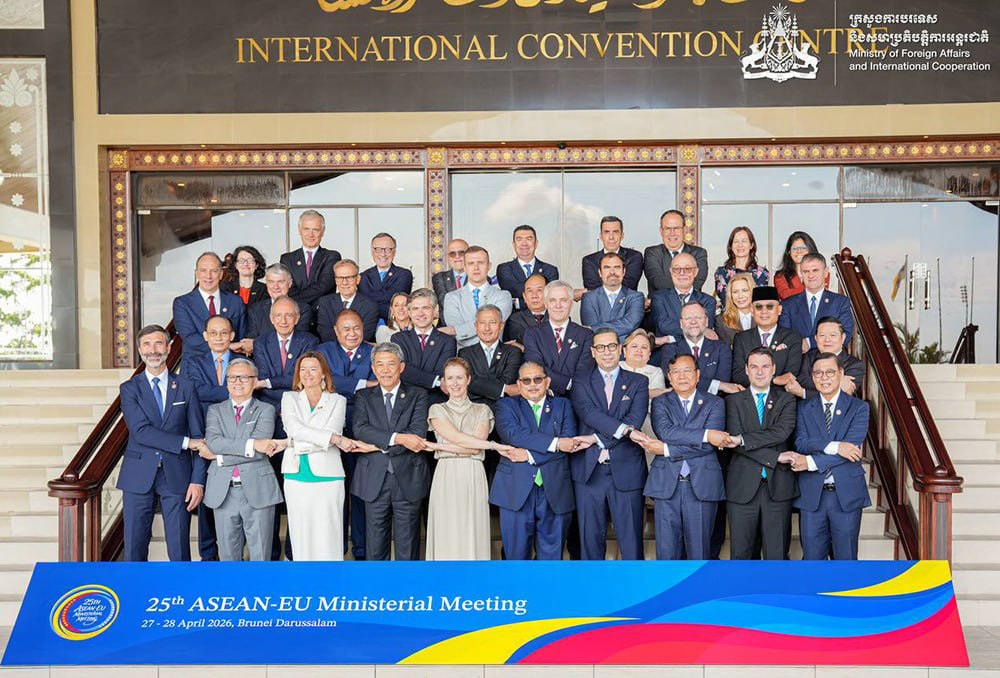
In Bandar Seri Begawan on April 27, Cambodia’s Deputy Prime Minister and Foreign Minister Prak Sokhonn met his Thai counterpart Sihasak Phuangketkeow on the margins of the 25th ASEAN-EU Ministerial Meeting. Cambodia’s foreign ministry posted the readout the same day in Khmer and English. The first-person record, carried verbatim by Xinhua, has Sokhonn telling Sihasak that lasting peace “requires genuine commitment and full respect for international law, the ASEAN Charter, as well as all existing treaties and agreements that bind us.” Sihasak told reporters after the meeting that he had used the bilateral to inform Cambodia that Thailand’s process to revoke MOU 44, the 2001 framework for managing overlapping maritime claims in the Gulf of Thailand, was moving toward Cabinet approval, with formal written notification to follow.
The two readouts cover one meeting and name two different treaties.
The bilateral arrived four months into a Thai institutional sequence pointing toward departure from the bilateral architecture both governments call the resolution mechanism. It also arrived one week ahead of the timing Sihasak had publicly indicated when, on April 11, he told reporters that Thailand was not ready to convene the Joint Boundary Commission within Cambodia’s proposed April 17 to 25 window and said he might meet his Cambodian counterpart on ASEAN summit sidelines in early May. Cambodia moved on the AEMM window. Thailand’s stated expected timing was the following week.
The AEMM press release Cambodia’s foreign ministry issued the next day did not name the bilateral. It recorded Sokhonn at the multilateral plenary stating “the importance of upholding international law and the principles of the United Nations Charter, in particular respect for sovereignty and territorial integrity, refraining from the threat or use of force, and the peaceful settlement of disputes in accordance with international law,” and saying that “these same principles equally guide Cambodia’s position with respect to the situation along its border with Thailand.” The release also recorded Cambodia’s appreciation to ASEAN Member States and the European Union “for their support for the ceasefire between Cambodia and Thailand, as well as for ongoing efforts toward the peaceful resolution of disputes in accordance with international law.”
Both ministers’ published commitments in the bilateral readout point to the same instrument. Sokhonn and Sihasak reaffirmed “full implementation of the Joint Statement of the 3rd Special GBC Meeting of 27 December 2025.” That document, which ended three weeks of armed conflict at the border and was signed by Cambodia’s Defence Minister Tea Seiha and Thailand’s Defence Minister Nattaphon Narkphanit at the international point of entry between Pailin and Chanthaburi provinces, was filed with the United Nations as A/80/593-S/2026/37. It names the Joint Boundary Commission as the survey and demarcation mechanism, requires troop deployments to remain in place without further movement, mandates ASEAN Observer Team verification, and incorporates the Ottawa Convention as the cooperation framework for humanitarian demining. Reaffirming that joint statement is reaffirming a treaty-anchored architecture that names existing instruments by category.
The four months between that signature and the Brunei bilateral show movement in the other direction on the Thai side. Thailand’s Council of State Secretary-General confirmed in February that the Anutin government had instructed its foreign ministry to study cancellation of MOU 44 and acknowledged the cancellation “involves a formal process,” explicitly deferring to the foreign ministry on international law. On March 24 Thailand’s Senate Special Committee voted unanimously to recommend cancellation of MOU 43, the 2000 land-boundary memorandum, citing Vienna Convention Article 60 as ground for unilateral withdrawal. The State Secretariat for Border Affairs in Phnom Penh rebutted on March 26, citing Vienna Convention Article 62(2), which excludes boundary-establishing treaties from the doctrine of fundamental change of circumstances, and the principle of uti possidetis juris, which preserves administrative lines drawn under prior sovereignty upon independence. Anutin’s policy statement to Parliament on April 9 included expedited study of MOU 44 termination. On April 11 Sihasak confirmed the procedural pathway for MOU 44: the Foreign Ministry will prepare the proposal, the National Security Council will review, the Cabinet will decide. He distinguished the maritime track from the land-boundary track, saying MOU 43 would be handled more carefully because some progress had already been made under that framework.
On April 23 Anutin announced that the National Security Council had confirmed the proposed MOU 44 abolition, with Cabinet review to follow. Cambodia’s foreign ministry responded on April 24 with a spokesperson statement referring to its earlier April 8 communication and saying it would be “deeply regrettable” if Thailand decided to unilaterally withdraw from MOU-2001, calling the agreement “more than a technical arrangement” and a reflection of “genuine will and common interest.” The Phnom Penh Post described the Cambodian framing as “a step away from the cooperative spirit” of the agreement.
Sihasak entered the Brunei bilateral with the cancellation pending Cabinet review and Cambodia’s regret already on the public record.
Sihasak’s stated rationale to Thai reporters after the meeting framed the move as a shift from bilateral memorandum to broader multilateral framework. He said Thailand was moving toward “a clearer and more internationally recognised framework under the United Nations Convention on the Law of the Sea.” Bangkok Post quoted him saying the cancellation was “a sovereign decision taken independently and not influenced by any third party, including China.” He said the move did not mean ending negotiations with Cambodia.
MOU-2001 was the second of two memoranda Cambodia and Thailand signed in 2000 and 2001 to manage their land and maritime border. The 2001 agreement covered roughly 26,000 square kilometres of overlapping claims in the energy-rich Gulf of Thailand, structured as an indivisible package that linked maritime boundary delimitation to joint development of offshore petroleum resources, with no termination clause and no dispute resolution clause. Withdrawal would be governed by Vienna Convention Article 56, which restricts unilateral denunciation to cases where the parties’ intent supports it or the nature of the agreement implies a right of denunciation. Cambodia’s April 24 statement said the agreement “remains in force until its objectives are fully achieved.” Cambodia ratified UNCLOS on February 6, 2026, with entry into force on March 8. Thailand ratified UNCLOS on May 15, 2011. Cambodia’s accession brought into force between the two parties UNCLOS Part XV, the convention’s compulsory dispute settlement system, including jurisdiction of the International Tribunal for the Law of the Sea and Annex VII arbitration. The framework Sihasak invokes as the cleaner alternative is the framework Cambodia’s accession itself made directly available between the two parties.
Sihasak’s framing has a defensible institutional core. MOU 44 has produced no concrete delimitation in 25 years, with formal negotiations under it convening only five times in that period according to Bangkok Post’s explainer. Bilateral memoranda that fail to advance can be replaced by multilateral law that holds the dispute in a more developed legal framework. Thailand has consulted “domestic and international legal experts” before the decision, Sihasak said. The Joint Statement of 27 December reaffirmed the parties’ commitment to “all other related agreements reached thereafter” and the broader bilateral mechanisms; nothing in that text obliges either side to keep every instrument indefinitely. The argument that UNCLOS provides cleaner ground than MOU 44 is statable.
The same record weakens it. The Joint Boundary Commission Sihasak cited on April 11 as needing internal Thai preparation is itself the bilateral mechanism the 27 December joint statement designated as the priority instrument for “immediate survey and demarcation works in the affected border areas where the civilians resided.” Cambodia’s post-bilateral elaboration on April 28 named that paragraph directly: government spokesperson Pen Bona told the Phnom Penh Post that Cambodia wanted Thailand to implement point 3 of the December 27 statement, which requires both sides to use the JBC for survey and demarcation in accordance with existing agreements. Hun Manet’s parallel statement repeated the JBC-implementation line. Thailand’s “not yet ready” position on JBC and “ready to revoke” position on MOU 44 produce the same outcome in opposite directions: the bilateral architecture stays paused while the institutional framework around it shifts. Cambodia chose the AEMM as the bilateral venue and the bilingual readout structure on the day Thailand’s Cabinet review of MOU 44 abolition was pending. The choice placed the existing architecture on the bilateral record at the moment Thailand was using the same bilateral to deliver formal notification of departure from one of its instruments.
Sihasak said the proposal “will soon be submitted to the Cabinet for consideration.”