
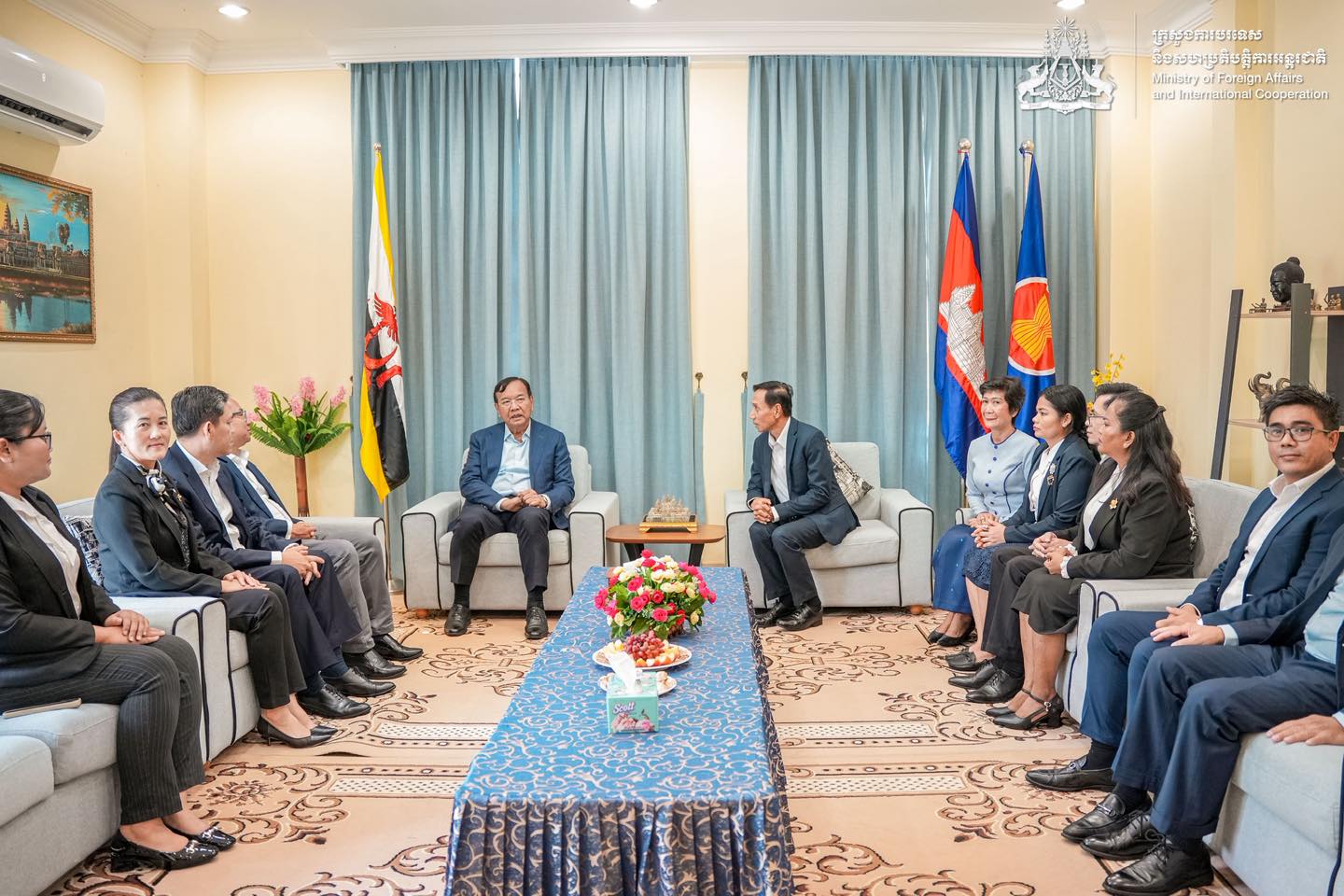
On 27 April, Cambodia and Thailand returned to foreign-minister-level talks on the margin of the 25th ASEAN-EU Ministerial Meeting in Bandar Seri Begawan, the first such bilateral since renewed hostilities in December 2025. The meeting was one of four that Cambodia’s Deputy Prime Minister and Minister of Foreign Affairs and International Cooperation Prak Sokhonn held that day. He then stayed for a separate Brunei official visit and produced an institutional baseline agreement after thirty-four years of diplomatic relations.
Sokhonn met Sihasak Phuangketkeow of Thailand, Vivian Balakrishnan of Singapore, Petr Macinka of the Czech Republic, and Florian Hahn of Germany on 27 April. From 29 to 30 April, on the separate official visit, he met Brunei’s Second Minister of Foreign Affairs Erywan Pehin Yusof and was received in audience by Sultan Hassanal Bolkiah.
Across the week, Cambodia ran bilateral architecture at four speeds, recovering Thailand after the conflict, founding Brunei after thirty-four years of diplomatic relations, sustaining Singapore, and opening Czech and German channels, with the 25th ASEAN-EU Ministerial as operating environment.
The 25th ASEAN-EU Ministerial brought ASEAN foreign ministers together with their EU counterparts in Bandar Seri Begawan, Brunei, on 27 and 28 April. The week of bilateral activity had opened with the Cambodia-China 2+2 Strategic Dialogue inaugural meeting in Phnom Penh on 22 April. The Brunei activity, four meetings on the margin day plus the separate Brunei official visit, ran across 27-30 April.
The Thailand channel had been closed at foreign-minister level since the December 2025 escalation. The conflict produced casualties on both sides of the border, damage to civilian infrastructure, and civilian displacement, per the 22 December 2025 ASEAN Chair’s Statement. Tensions and hostilities continued after the 28 July 2025 ceasefire arrangement. At the 22 December Special ASEAN Foreign Ministers’ Meeting in Kuala Lumpur, Sokhonn and Sihasak attended in respective national capacities at a multilateral, not as a bilateral.
The framework had been built in stages. The initial 28 July 2025 ceasefire arrangement, mediated by Malaysia as ASEAN Chair, halted the July hostilities. The Kuala Lumpur Joint Declaration, signed at the 47th ASEAN Summit on 26 October 2025 by Cambodian Prime Minister Hun Manet and Thai Prime Minister Anutin Charnvirakul and witnessed by Anwar Ibrahim and Donald J. Trump, expanded the framework and committed both governments to work towards the restoration of diplomatic relations. After renewed hostilities in early December, the 27 December 2025 Joint Statement of the 3rd Special General Border Committee Meeting, signed at the defence-ministers level, established the current ceasefire, the ASEAN Observer Team mandate, the Joint Coordinating Task Force on Humanitarian Demining, and provisions on troop deployments and civilian return.
At the 27 April Brunei bilateral, both ministers reaffirmed commitment to full implementation of the December 27 Joint Statement. According to the Cambodian Ministry of Foreign Affairs and International Cooperation readout, the two ministers discussed the border situation, confidence-building measures, and broader aspects of bilateral relations, and reaffirmed their commitment to the ceasefire and full implementation of the December 27 Joint Statement. Thailand’s Ministry of Foreign Affairs said the two ministers met to discuss ways to rebuild trust and understanding, and that both sides welcomed the consolidation of the ceasefire in line with the same December 2025 framework.
Both ministers reaffirmed commitment to full implementation, four months after the framework was signed. The October 2025 Kuala Lumpur Joint Declaration had committed both governments to work towards the restoration of diplomatic relations. No foreign-minister-level Cambodia-Thailand bilateral happened in the four months between the 22 December 2025 Special ASEAN FM Meeting in Kuala Lumpur and the 27 April Brunei bilateral; the Brunei meeting was the first such engagement on the documented record.
One reading of the 27 April bilateral is that it happened because both ministers were present at the multilateral, and protocol pressure rather than diplomatic deliberation produced the meeting. The documented record does not foreclose that reading. What it does record is that no foreign-minister-level Cambodia-Thailand bilateral happened in the four months between the 22 December 2025 Special ASEAN FM Meeting in Kuala Lumpur, where Sokhonn and Sihasak were also co-present, and the 27 April Brunei bilateral. Co-presence at a multilateral did not produce a bilateral in December. It produced one in late April, on the next ASEAN-centred multilateral after the conflict, with both Cambodian and Thai readouts framing the meeting as substantive engagement on the post-conflict framework.
The Brunei speed produced a different kind of institutional act. From 29 to 30 April, on a separate official visit after the multilateral closed, Sokhonn met Erywan Pehin Yusof and was received in audience by Sultan Hassanal Bolkiah. Cambodia and Brunei agreed to explore the possibility of organising the first meeting of the Cambodia-Brunei Joint Commission in 2026, in Cambodia, per the Cambodian Ministry of Foreign Affairs and International Cooperation press release of 30 April.
Cambodia and Brunei established diplomatic relations in 1992. The 35th anniversary falls in 2027. The first Joint Commission meeting, if it convenes in Cambodia in 2026, would be the first such meeting in thirty-four years of diplomatic relations.
One reading of the agreement is that the language to explore a first Joint Commission meeting is conditional rather than executed, and the 34-year baseline finding overstates what is in the documentary record. Cambodia’s full ASEAN Joint Commission architecture per partner is not exhaustively documented in public sources at international standard, and the 34-year delay between Cambodia-Brunei diplomatic relations and the first explored Joint Commission meeting is named here as a documented act of bilateral institutional baseline-founding without comparative claim about whether the delay sits inside or outside the norm. What the record carries is the agreement itself. What produces or does not produce from it across 2026 enters the record as it occurs.
The Singapore speed read as continuity. The Sokhonn-Balakrishnan bilateral covered continued progress in bilateral relations and discussion of the Cambodia-Thailand border situation. Singapore is among the longest-standing of Cambodia’s ASEAN bilateral channels, and the 27 April readout records institutional content rather than baseline-founding. The Cambodia-Thailand border situation as discussion topic placed Singapore inside the multilateral conversation on Cambodia’s most active bilateral file.
The European speed opened two channels in one day. Sokhonn met Macinka and Hahn on the same 27 April margin. The Czech bilateral valued longstanding cooperation in key areas of mutual interest and reaffirmed shared commitment to bilateral and multilateral cooperation. Sokhonn conveyed gratitude to the Czech Republic for continued official development assistance in support of Cambodia’s socio-economic development. The Sokhonn-Hahn meeting registered close relations and strong cooperation across areas of mutual interest, with no specific item for the German meeting comparable to the Czech ODA reference. Both bilaterals operated on the EU side of the multilateral, in the window during which the EU sat across from ASEAN.
Across the week, one structural fact recurs. Cambodia did not pursue a Bandar Seri Begawan visit independent of the ASEAN-EU framework. Four engagements happened on the margin of the 25th ASEAN-EU Ministerial, the institutional cover within which the Thailand re-engagement could happen on ASEAN process discipline rather than in a direct bilateral channel. The fifth, the Brunei founding act, ran on the separate official visit immediately after the multilateral closed, inside the same week, against the same flight booking, in the same capital. The multilateral framework held the architecture together.
One reading of the cadence is that bilateral activity on multilateral margins is routine foreign-ministry work, and four bilaterals on a single margin day is unremarkable against the structural pattern of ASEAN-centred multilateral diplomacy. A comparative baseline of Cambodian or other ASEAN foreign-minister bilateral activity at prior multilaterals would test that reading. Such a baseline is not in the public record reviewed for this piece. What the record carries is not a comparative finding about cadence, but a structural finding about the kinds of bilateral activity Cambodia executed across the week: one channel recovered after a four-month closure, one founded after thirty-four years of diplomatic relations, one sustained, two opened. The structural finding holds whether or not the cadence count is unusual.
Senate President Hun Sen has served as Acting Head of State during King Norodom Sihamoni’s medical absence in Beijing across the week of Sokhonn’s bilateral activity, under Article 30 of the Cambodian Constitution, which provides that the President of the Senate shall assume the duties of Acting Head of State in the absence of the King.
The week documented Cambodia recovering one channel after the December 2025 conflict, founding one after thirty-four years of diplomatic relations, sustaining one, and opening two, with the 25th ASEAN-EU Ministerial as the structuring event of the week.